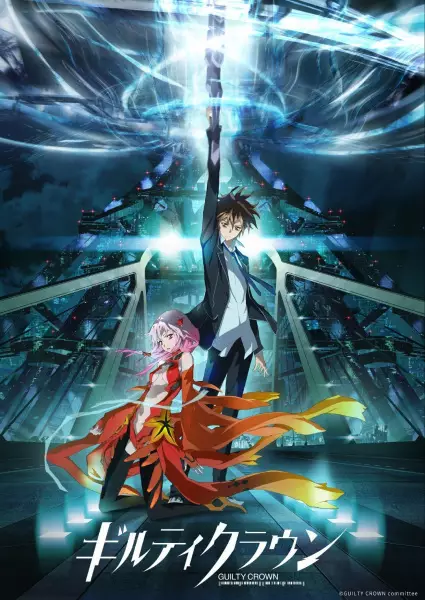
Guilty Crown
ギルティクラウン
Studio: Production I.G
Synopsis
On December 24, 2029—the day colloquially known as the "Lost Christmas"—the Apocalypse Virus spread across Japan, bringing death to its citizens and plunging the country into utter chaos. In an effort to establish order, the United Nations sends the GHQ to assist with the crisis by containing the outbreak while removing all political autonomy in the process. A decade later, the country still lives under their control, unable to break free from their draconian rule. Frustrated with the state of the nation, a resistance group named the Funeral Parlor aims to liberate Japan from the GHQ. Led by the charismatic Gai Tsutsugami, the group plots to steal a vial containing the "Void Genome" to further their goals. The vial falls into the hands of internet vocalist Inori Yuzuriha, who ends up being hunted by the GHQ's Anti-Bodies forces. Having nowhere to go, she seeks refuge in a warehouse where she meets Shuu Ouma—a socially awkward high school student who is a huge fan of her music. Shuu gets dragged into the conflict the moment he rescues Inori, and the Void Genome shatters in his hand, granting him the "Power of the Kings." While learning how to control his grand new ability, Shuu must now fight to liberate Japan from its cruel oppressors. [Written by MAL Rewrite]
Recommendations


Characters & Voice Actors

Ouma, Shuu
Main
VA: Kaji, Yuuki

Tsutsugami, Gai
Main
VA: Nakamura, Yuuichi

Yuzuriha, Inori
Main
VA: Tipton, Alexis

Eagleman, Dan
Supporting
VA: Seitz, Patrick

Emily
Supporting
VA: Hirose, Yuuka

Guin
Supporting
VA: Potter, Brandon

Herikawa, Miyabi
Supporting
VA: Watanabe, Akeno

Keidou, Shuuichirou
Supporting
VA: Inoue, Kazuhiko

Kido, Kenji
Supporting
VA: Ayres, Greg

Kuhouin, Okina
Supporting
VA: Elliott, R. Bruce

Kuhouin, Arisa
Supporting
VA: Endou, Aya

Kurachi
Supporting
VA: Marchi, Jamie
Ouma, Shuu
Main
VA: Kaji, Yuuki
Tsutsugami, Gai
Main
VA: Nakamura, Yuuichi
Yuzuriha, Inori
Main
VA: Tipton, Alexis
Eagleman, Dan
Supporting
VA: Seitz, Patrick
Emily
Supporting
VA: Hirose, Yuuka
Guin
Supporting
VA: Potter, Brandon
Herikawa, Miyabi
Supporting
VA: Watanabe, Akeno
Keidou, Shuuichirou
Supporting
VA: Inoue, Kazuhiko
Kido, Kenji
Supporting
VA: Ayres, Greg
Kuhouin, Okina
Supporting
VA: Elliott, R. Bruce
Kuhouin, Arisa
Supporting
VA: Endou, Aya
Kurachi
Supporting
VA: Marchi, Jamie
Related Anime
Reviews
With the large amount of Guilty Crown reviews going around lately, It wouldn't be too hard to find a 'decent' review, right? well that's not the case at all, It seems that most of the reviews are either written by blind fan-boys/fan-girls or haters, 10's,9's,4's and 3's seem to be the popular choice of overall rating, though looking at Guilty Crown in a balance way, this anime definitely deserves a 7 and I'll explain why in the next couple of paragraphs which will you most likely will flick through. = Story (3) = If you have been watching Guilty Crown or have seen some of the rantingson the forums, you would know that the story is filled with cliché's and awful execution (for the most part anyway), So I won't go that in-depth to the story, basically just think of it as a mecha-action-supernatural-apocalyptic-drama-comedy-Sci Fi-romance-school-fan service super show. In other words, Shu (Shuu), your average 16-year-old guy living in a future version of Tokyo get's himself wrapped up in the activities of terrorist group defying the government called Funeral Parlour, he meets the leader Gai, find's out his favourite singer is a member of the group and that the government is corrupt blah blah blah = Art (10) = If there's one thing that no one can complain about, I'd say it's the art. Every episode looks of cinematic quality and the character designs are well down as you'd expect from Production I.G and Redjuice (supercell). If there is one thing to fault about the art, I believe it's the design of the apocalypse virus, It just doesn't look like some deadly disease that someone would be afraid of, though that doesn't really matter. = Sound (9) = Sound is also a great part of Guilty Crown, the insert music and the OST is brilliant, the first OP 'Euterpe' was only used in the first episode which was disappointing since the second OP which lasted for 11 episodes wasn't hardly as good. The best OP in my opinion and one of my favourite anime openings is the third and last one 'The Everlasting Guilty Crown', It seriously made the other two seem like crap in comparison. = Character (7.5) = 7.5? That's not even an score according to MAL is what you might say though that's really the only score I can give it, The characters and their developments weren't very good though they weren't just good either, sort of in-between. The problem with the characters is that they introduced too many too fast, there wasn't really any-time to grow attached to them or even remember some of them at all. You didn't know which ones were supposed to be Minor or Main characters or just background ones in most of the first half. Another problem was the likeability of the main characters in most of the FIRST HALF, Shu just sit's around most of the time, being a indecisive, annoying loser. Gai was just emotionless (for the most part) and all Inori could do was use the power of singing(?), provide fan-service and dodge (she might of shot a gun once) but that's it. Though, (without spoiling anything) In the second half, the main characters had great development. = Enjoyment (7) = Enjoyment levels really depend on how serious you take Guilty Crown, don't go into the series expecting a masterpiece because you will most definitely be disappointed and hating on it. Though if you are a simple person (no offence) and just like your anime with ton's of great looking action scenes and a little bit of everything rolled in one (even if the result is total mess) then you will obviously enjoy the series a lot more. = Overall (7) = Overall, Guilty Crown is definitely not a masterpiece, though it does NOT deserve the crap reputation it gets, sure the story becomes screwed up beyond repair with the can of cliché's they sprung at you each episode and the character development doesn't really start until halfway through the series, what really matters at the end of the day is how much the viewer enjoys the anime, people will hate, like or love GC and that's their opinion just as this review gives my opinion, I don't really care about the 'helpful' or 'not helpful' clicks, as long as my review isn't buried so deep that it can't be of at least some help to the many users who are looking for a new anime to enjoy, and that's the whole point of reviews, to help people decide whether a anime would be to their liking or not.
Many people are aware of the financial problems faced by the anime industry, and one of the methods that studios have adopted over recent years to try to shore up their crumbling foundations is to adapt popular manga, games, and more recently, Western comics. This approach has become a tried and tested moneymaking endeavour for the majority of studios, but in many cases this is simply due the fact that the source material caters to the lowest common denominator - which usually means fanservice. Unfortunately, the relative success of these shows have allowed them to become the norm rather than the exception, and with thatcomes a number of problems. The sad fact is that while it's okay to find inspiration from other sources, the industry has become so used to the adaptation that studios and writers find it difficult to produce work that could be considered "original". Instead, what passes for a unique story tends to be nothing more than a collection of concepts and ideas from other tales that are thrown together in the vain hope that people will rush to buy the end product because ... well, because someone tells them to. But rather than dwelling on such things, let's take a look at Guilty Crown. Set in Tokyo in the year 2039, a decade has passed since a mysterious outbreak known as the "Apocalypse Virus" killed thousands of people and brought Japan to its knees - a disaster that would later be called "Lost Christmas". Since that time Japan has lost its independence, and has become a martial state governed by an international organisation known as GHQ. The story opens with a pink-haired girl and a small robot escaping from a futuristic-looking facility, but security forces injure and corner her until she falls off a bridge. The next morning is just like any other day for highschool student Ouma Shu, an awkward young man who is a fan of the pop-group Egoist, whose lead singer just happens to be a waif-like girl with pink hair. And then everything gets ... weird. Guilty Crown is a bit of an odd duck as it attempts to blend several disparate themes, but doesn't quite manage to finish the job. The plot has clearly been influenced by several popular franchises - which isn't necessarily a bad thing, but the execution is where the writers have let themselves down. The narrative is often disjointed, and many events in the storyline appear to have no logic behind them other than to put Shu through an emotional wringer. In addition to this, the writers appear to have taken a rather nonchalant approach to reasoning and rationale, one example of which is how GHQ's repeated massacres are never covered by any sort of media outlet. This seemingly lackadaisical attitude is apparent in several areas of the plot - which is littered with "coincidences" - and these cause the narrative to have a mechanical feeling. In many ways it's almost as if the story was nothing more than a collection of bits that would apparently appeal to the largest number of people. Aside from the inclusion of numerous well-known aspects that have clearly been transplanted from other popular stories and the "plot-by-numbers" approach, Guilty Crown also suffers from the rather obvious idea that most adults are evil and only kids are able to save the world. That said, the series does have some good points, in particular the way it attempts to recreate a situation similar to that found in "Lord of the Flies" by putting all of the students in one place and imposing self-rule. There are other, similarly dark influences that add a veneer of maturity to proceedings, but sadly these aren't enough to support the inherent weaknesses in the narrative - the main one being the decision to make yet another school-based anime. In terms of production quality, Guilty Crown is arguably up there with some of the better shows of recent years, but the sometimes stunning visuals and effects are tempered by a few issues that may initially appear to minor, but in actuality are representative of the mentality of the show's creators. It's obvious that a great deal of thought has gone into the background artwork and set designs, but the same isn't true of the characters. For the most part they look good, but the decision to feature highschool students places an immediate limitation that becomes obvious when one considers the variety of features and body shapes found amongst the adults. The problem lies in the fact that the design of the younger roles includes an element of stereotype in order to impart a degree of familiarity - thereby making the show more accessible to people. It's an old marketing trick that has become a staple of the anime industry over the years, and while Guilty Crown has tried to be a little bit more subtle than most in its usage, one does have to question the logic behind Tsugumi. A cat-eared tsundere loli wearing what is effectively a plug suit (and a maid costume later on), only serves to highlight the thought processes of the show's creators. Thankfully Production I.G. maintain their standards when it comes to the animation, and the series is littered with flowing, well choreographed action scenes. The characters are well-balanced in their movements, and a degree of care has been taken with those that are injured, disabled, or suffer from an affliction. Like many anime that run for over twenty episodes, Guilty Crown features two opening and ending sequences - each with an original track written by Supercell. The first OP is a rather dizzying blend of effects, character montages and action scenes while the song "My Dearest" - a suitably fast paced and dramatic pop song performed by Koeda - sets the tone for the series. "The Everlasting Guilty Crown" performed by the fictional band Egoist is the track of choice for the second opening sequence, but while the artwork and design ethic have clearly shifted to promote a bittersweet atmosphere, the actual content is much the same as that of the first OP. Egoist also perform the melancholy ballad "Departures ~Anata ni Okuru Ai no Uta~" for the first ending sequence, which features Ouma Shu and Yuzuriha Inori walking away from each other against a backdrop of character art and effects. The second ED contains a mixture of video footage of landscape speeding by, scenes from the series and a few still images of the school environs that are "projected" onto a screen behind Inori and Shu as they decide to run - all while Koeda performs the rather upbeat rock song "Kokuhaku" Which brings up one small issue. Although it's true that some thought has gone into the composition of the opening sequences and that they are very well choreographed, both also feature overt plot spoilers. Now this does happen in other anime, but in general there are efforts to avoid such things occurring - which doesn't appear to be the case with Guilty Crown. Aside from that minor niggle, the high production standards are also reflected in the quality of the music and audio effects. Sawano Hiroyuki has taken care to ensure that the background pieces are varied and suitably dramatic where necessary. The wide range of sounds and noises are clear and distinct, and the audio/visual choreography shows just how much effort has been made to produce a show that looks and sounds great. Unfortunately the same can't be said of the actual dialogue. Now while it's true that Guilty Crown features a range of characters and personality types, for some reason the decision was made to revert to old anime stereotypes and then write justifications into the storyline. The script is littered with monologues, diatribes, conversations and arguments that would grace any show where the "hero" has to lead his people to salvation whilst fighting against the enemy and his inner demons, forming a pseudo-harem along the way, and showing the world just how much of a tragic-yet-heroic figure he is. Thankfully the actors are more than capable, but no matter how good their skills are, prosaic and formulaic dialogue will always be just that. As for the characters themselves, Ouma Shu is the kind of leading man who can be found in a number of other titles - quiet, reserved, doesn't have many friends, and a bit of a loser - and therein lies the problem. The writers have taken great pains to try to show him as a "human" more than anything else, but in their efforts to promote Shu as the tragic hero, they've ignored one of the most basic rules of characterisation. In other words, Shu has no personality whatsoever - even at the end of the series when all his "suffering" is over. It's this apparent inability to develop the characters in any meaningful way that makes them appear as nothing more than inane, and the lack of any real growth means that everyone pretty much ends the series having learned very little (aside from maybe Daryl). In addition to this there's an element of ridiculousness to the choice of characters, the prime example being Yuzuriha Inori (although Tsugumi does come a close second). One has to wonder what chemically induced delusion could have persuaded the show's creators that having the lead singer of a hugely popular band stealing from the enemy in the opening scenes while wearing her stage outfit was a good idea. Apparently students can recognise her even though she's wearing a school uniform, but soldiers and officers of the military forces controlling Japan have no idea who she is since pink-haired girls wearing fluttery costumes are a dime a dozen in Japan. Guilty Crown is one of those anime that can only truly be enjoyed if you have never watched any of the titles that it takes its inspirations from - and that becomes a problem if one has watched, and enjoyed, most of them. The main issue is that there are several character types and plot elements that are better used in their original anime, so their inclusion here makes them stand out in less than flattering ways. The real problem with Guilty Crown though, is the element of arrogance that is prevalent throughout the series, and this comes solely from the show's creators. The basic premise of Guilty Crown is perfectly fine, but everyone from the director and series composers to the producers have assumed that the "anime-by-numbers" approach that they have so clearly used here is enough to make a hit franchise. There appears to have been a major assumption that the audience will swallow the whole thing without automatically referencing other shows that they may have watched, and that's where everything begins to fall apart. Storytelling is, after all, an art form, and a good writer can captivate their audience without overtly referencing where there inspiration came from. Unfortunately the folks behind Guilty Crown appear to have forgotten this simple fact, and it leaves one with the sad realisation that this anime had the potential to be so much more than it is.