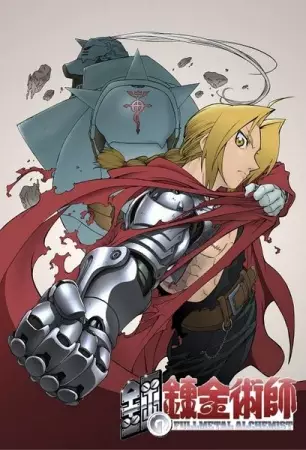
Fullmetal Alchemist
鋼の錬金術師
Studio: Bones
Synopsis
Edward Elric, a young, brilliant alchemist, has lost much in his twelve-year life: when he and his brother Alphonse try to resurrect their dead mother through the forbidden act of human transmutation, Edward loses his brother as well as two of his limbs. With his supreme alchemy skills, Edward binds Alphonse's soul to a large suit of armor. A year later, Edward, now promoted to the fullmetal alchemist of the state, embarks on a journey with his younger brother to obtain the Philosopher's Stone. The fabled mythical object is rumored to be capable of amplifying an alchemist's abilities by leaps and bounds, thus allowing them to override the fundamental law of alchemy: to gain something, an alchemist must sacrifice something of equal value. Edward hopes to draw into the military's resources to find the fabled stone and restore his and Alphonse's bodies to normal. However, the Elric brothers soon discover that there is more to the legendary stone than meets the eye, as they are led to the epicenter of a far darker battle than they could have ever imagined. [Written by MAL Rewrite]
Recommendations


Characters & Voice Actors

Elric, Alphonse
Main
VA: Kugimiya, Rie

Elric, Edward
Main
VA: Mignogna, Vic

Archer, Frank
Supporting
VA: Hayami, Show

Armstrong, Kathleen Elle
Supporting
VA: Kugimiya, Rie

Armstrong, Alex Louis
Supporting
VA: Utsumi, Kenji

Armstrong, Philip Gargantos
Supporting
VA: Utsumi, Kenji

Armstrong, Mother
Supporting
VA: Bréheret, Laurence

Bard
Supporting
VA: Ishii, Kouji

Barry the Chopper
Supporting
VA: Itou, Kentarou

Belsio
Supporting
VA: Joudrier, Tony

Bido
Supporting
VA: Ayres, Greg

Black Hayate
Supporting
Elric, Alphonse
Main
VA: Kugimiya, Rie
Elric, Edward
Main
VA: Mignogna, Vic
Archer, Frank
Supporting
VA: Hayami, Show
Armstrong, Kathleen Elle
Supporting
VA: Kugimiya, Rie
Armstrong, Alex Louis
Supporting
VA: Utsumi, Kenji
Armstrong, Philip Gargantos
Supporting
VA: Utsumi, Kenji
Armstrong, Mother
Supporting
VA: Bréheret, Laurence
Bard
Supporting
VA: Ishii, Kouji
Barry the Chopper
Supporting
VA: Itou, Kentarou
Belsio
Supporting
VA: Joudrier, Tony
Bido
Supporting
VA: Ayres, Greg
Black Hayate
Supporting
Related Anime
Adaptation
Side Story
Alternative Version
Reviews
Obsession is a very strange thing indeed, and may be one of the few human traits that so clearly falls between heaven and hell. What one does with their obsession though, well, therein lies an altogether different proposition, especially as people often define their "obsessions" in terms of what they love and hate, or even what brings them hope and fear. Isn't it strange then, that such a well known human trait can so easily be mistaken for something else entirely? Or is it simply a case of people not seeing what they don't want to see, especially if there something new and shiny to watch? Many animefans are currently raving about the new series of Full Metal Alchemist, especially as it is an almost direct adaptation of the manga, however in the light of all this new found glory, the original adaptation has become the topic of much debate and controversy, especially by those who once praised the show for being something ... a little different. Now unlike many, the fact that the original adaptation didn't follow the manga for much of its run was something that I wasn't overly concerned about, and there's a very good reason for this too. One of the issues I had with the manga, and in turn Brotherhood, was the fact that the tale is far more "shounen" than the original adaptation, and this difference in not only plot and story content, but overall perspective as well, is noticeable in a number of areas. As far as pacing, plot, and depth of story goes, Full Metal Alchemist does lose out somewhat to Brotherhood, however this is partly due to the fact that Arakawa Hiromu had far more time to produce a story that worked, whereas the writers for the original adaptation only had part of Arakawa's work to play with, and had to make up the rest. Normally this would be the cause for a number of issues, not the least of which is continuity, however Full Metal Alchemist never really suffered from those except where the numerous, and unnecessary, comedy moments were included. That said, what the writers achieved was actually quite remarkable, as they produced a tale that is very clearly about one thing only - obsession - and in that respect, they actually managed to score quite a major coup over Arakawa's tale. Some of you may be a tad confused by where this is all going, but fear not, it will become clearer as we get into more detail. Let's talk more about the actually show itself for a moment though. In terms of looks, the original adaptation managed to transpose the characters fairly well, and while they didn't really require any bouts of creativity in general, there were a few new faces as, at the time, the manga hadn't actually introduced all the players. As for the various locations in which the characters find themselves, the first adaptation generally followed the path laid down by the manga, however there were also some surprisingly original and inventive additions to the various locales, many of which are unique to this particular adaptation. Strangely enough though, the quality of the animation is almost the same as that of Brotherhood, and given the large degree of crossover in both adaptations, this is actually surprising as usually one version is greatly superior to the other. That said, the new series does have the advantage of seven years of improvements in animation, so one would be forgiven for thinking the margin between the two would be bigger. Where sound and music are concerned, one might expect more pronounced differences between the two adaptations, however this is not the case. The selection of music for the first adaptation is actually very good throughout the series, and also gave rise to one of the catchiest opening themes in shounen anime - "Ready Steady Go" by L'Arc-en-Ciel. The aural effects are well chosen and choreographed, and while there are many occasions that feature frenetic clashes and lots of noise, care has generally been taken to modulate this to a level that won't unnerve the viewer (admittedly there are some minor overwhelming moments, but they're not really worth going into any detail as they don't really affect the story in any way). As for the acting, granted there are some different seiyuu between the two adaptations, but the series' big guns are in force in both. That said, while there is some acting continuity between the two, the actual quality is a little better in Brotherhood, however this may be due to an increased familiarity with the characters, and also because Brotherhood is far more a straight forward shounen tale than the original adaptation- something which actually shows in the acting. And now to the most interesting bit - the characters. Unlike both the manga and Brotherhood, the original anime adaptation of Full Metal Alchemist featured some surprising and unique characters, not the least of which is Edward Elric himself. But before we get into that though, let's talk Homunculi. One of the most overlooked aspects of the original series was the nomenclature given to the homunculi, and although their names and purpose have been "clarified" by the manga and Brotherhood, the writers for the original adaptation didn't have this knowledge, so they actually made them work in a completely different way. The whole deal with the Seven Sins is very different in the first anime, as the writers used the homunculus to highlight the aspect of obsession throughout the series. This is why the first anime adaptation had them being "born" in a particular manner, rather than the more trite reasoning given in the manga and Brotherhood much later. The homunculi are effectively born from the obsession of humans, a theme which is also present in Arakawa's version of the story, even though it has been downplayed a lot. So what does this have to do with the characters? Well, rather a lot actually. Throughout the whole series, there are very few characters who don't show any of the visible signs that one would normally associate with obsessive behaviour, and this is because they're cleverly hidden for the most part. From Maes Hughes' constant babble about his daughter, to Winry's love of automail. From Izumi Curtis' longing for her baby, to Dante's desire for immortality (incidentally, one has to wonder why that particular character was called Dante). And right at the top of the list is Edward Elric. In essence, his obsession with being better than his father is what starts the whole chain of events, which then turns to his obsession with the Philosopher's Stone, and so on. The surprising thing though, is that Ed never actually lets go of his desires in the same manner that others who attempted human transmutation did, and there is actually proof of this too. One look at the manner of Alphonse Elric's return to his body, as well as the nature of that return, will highlight just how very different this show is to Arakwa's version, and how different the mentality is come the end. And if you want more clarification on this, then feel free to ask. The characters are actually pretty well developed throughout the series, and it's a testament to the writer's and seiyuu's abilities that they turned out as well as they did. That's not to say there aren't any problems, however the flaws with the characters stem mainly from a difference in goals and perspective rather than any real lack of talent. In all honesty, it's difficult to decide which version is actually better as the differences in plot, theme and character development make this version and Arakawa's two very different tales. That said, there will be those who fall on one side or the other, some preferring the darker nature of the first adaptation while others like the more direct approach of the manga and Brotherhood. Personally, I found both versions to be very good, especially as the route that Arakawa's tale takes bears almost no resemblance to this one. While there are some broad similarities between the two in terms of locale, characters and basic plot, in actuality these are only skin deep, as the original adaptation of Full Metal Alchemist deviates quite a lot from the typical shounen sensibilities come the end of the series. The obsessive theme of the first adaptation is a far cry from what one is given in the manga and Brotherhood. Regardless of which version one prefers though, the simple fact is that we, as anime fans, have been given two great takes on the story, and we should count ourselves lucky to have such a wealth as all too often we must suffer through mediocrity and crap just find some entertainment. It just a shame that so many people feel the need to side with one version or the other ...
To be honest, I’m somewhat baffled by the mixed reaction this anime has received after the release of Brotherhood. Because prior to Brotherhood, this anime was often considered a classic by most anime fans. In my opinion it’s still a classic and essential for all fans. I’m probably in the minority here, but I feel as though the original FMA and Brotherhood are equal in terms of quality. Enough of that, lets get into the review.Now I’m sure most of you already know the story. The Elric brothers, Edward and Alphonse attempt to bring back their mother and as a consequence for going against the law of equivalent exchange, Ed loses his right arm and left leg. And Alphonse loses his entire body to only have his soul become bonded to a suit of armor. With the help of their childhood friend Winery, she constructs an automail leg and arm for Ed. Soon, they learn about this special artifact known as the Philosophers stone, it has the ability to defy the laws of alchemy and perform the taboo known as human transmutation. Eventually they come to the conclusion that their best bet in hopes of finding the stone would be to join the military. Although, Ed is the only one who joins because he insisted on doing so. And so they embark on their journey. Along the way, the brothers encounter corrupt government officials, homunculi, chimeras and more. As far as the story goes, it’s fantastic. Especially considering the fact that this anime is a shonen. FMA has a far more intricate and complex plot then shonens like One Piece, Fairy Tail, Naruto or Bleach. Thematically, it delves into area’s that you wouldn’t expect a show of its kind to do. What’s a life worth? An arm? A leg? An entire body? Can human’s play the role of god ? Should we even be allowed to play the role of god in the first place? Can we disrupt the flow of nature? So yeah, Fullmetal Alchemist is smarter then your average shonen! Also, the setting of the anime takes place in a fictionalized version of early 20th century Europe during the industrial revolution. The majority of the show takes place in Amestris. A key part of the plot that I almost forgot to mention involves the neighboring nation of Ishval. Long ago, after the tragic incident of when an Amestrian officer shot an Ishvalan child in cold blood, a chaotic war erupted between the two nations. In the midst of the war, state alchemists were brought in to exterminate the Ishvalans through horrific acts of genocide. This is where the revenge driven Ishvalan named Scar comes in. Speaking of characters, character wise, FMA is just as good. From Roy Mustang, to Riza Hawkeye, to the Elric brothers. All are given considerable amounts of depth. Take for example, the Elric brothers. Ed feels as if he got off easy because he still has his body and is burdened by this. Alphonse is constantly questioning his humanity, existence and whether or not he was a human to begin with ( his memory was erased when Ed bonded his soul to a suit of armor). And I just barely scratched the surface. When it comes to the production values, yet again, this anime doesn’t disappoint. The animation is very crisp and fluid. It never lets up, character designs are good and remain consistent until the very end. The OST is also worth mentioning here. Michiru Oshima did a very good job. One track that stood out in particular was “Brothers.” Simply put, it was a beautifully done string instrumental over some harmonious Russian vocals. In regards to the opening and ending themes, they’re solid. Opening 4 was my personal favorite. Lastly, the voice acting. I’ll tell you right here and now that it is mandatory that you watch the dub instead of the sub. Why? Because, hands down without a doubt, Fullmetal Alchemist has one of the best dubs you’ll ever here in anime. It’s definitely one of Funimation’s best efforts. All the performances were fantastic from Vic Mignogna, to Aaron Dismuke, to Dameon Clarke, to Colleen Clinkenbeard. Unfortunately, there are a couple of flaws here and there that prevent Fullmetal Alchemist from achieving perfection. Most notably the first 15 episode, these episodes were unevenly paced and it really didn’t get interesting until Scar showed up. Episodes 4, 5, 10-12 were completely unnecessary and felt very fillerish (I’m not sure but I think they were actually fillers, but don’t quote me on that). Now of course, I can’t write a review without addressing the ending because it’s one of the reasons why anime fans have such a polarized reaction for this show. I personally liked the ending, it was very bitter sweet. It wasn’t like every other ending for a shonen where everything works out in the end and all the characters hold hands and sing Kumbaya. Plus there are no beach episodes (Jesus Christ, I f**kin hate those g**damn beach episodes in anime). Well, time to wrap this review up, all in all, FMA is an amazing anime. I highly recommend it to anime fans and non-anime fans alike.