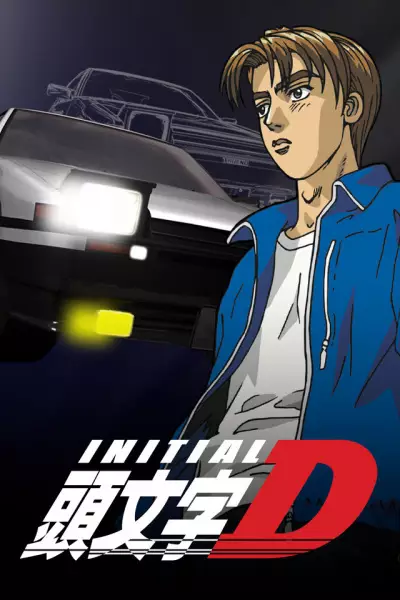
Initial D First Stage
頭文字〈イニシャル〉D
Studio: Gallop, Studio Comet
Synopsis
Unlike his friends, Takumi Fujiwara is not particularly interested in cars, with little to no knowledge about the world of car enthusiasts and street racers. The son of a tofu shop owner, he is tasked to deliver tofu every morning without fail, driving along the mountain of Akina. Thus, conversations regarding cars or driving in general would only remind Takumi of the tiring daily routine forced upon him. One night, the Akagi Red Suns, an infamous team of street racers, visit the town of Akina to challenge the local mountain pass. Led by their two aces, Ryousuke and Keisuke Takahashi, the Red Suns plan to conquer every racing course in Kanto, establishing themselves as the fastest crew in the region. However, much to their disbelief, one of their aces is overtaken by an old Toyota AE86 during a drive back home from Akina. After the incident, the Takahashi brothers are cautious of a mysterious driver geared with remarkable technique and experience in the local roads—the AE86 of Mount Akina. [Written by MAL Rewrite]
Recommendations


Characters & Voice Actors

Fujiwara, Takumi
Main
VA: Miki, Shinichiro

Akio
Supporting
VA: Suzuki, Jun

Fujiwara, Bunta
Supporting
VA: Ishizuka, Unshou

Fumihiro, Hiroshi
Supporting
VA: Cason, Chris

Hiromichi
Supporting
VA: Yasui, Kunihiko

Iketani, Kouichirou
Supporting
VA: Freeman, Crispin

Kenji
Supporting
VA: Takagi, Wataru

Miki
Supporting
VA: Takagi, Wataru

Mogi, Natsuki
Supporting
VA: Kawasumi, Ayako

Nakamura, Kenta
Supporting
VA: Ayres, Greg

Nakazato, Takeshi
Supporting
VA: Hiyama, Nobuyuki

Narrator
Supporting
VA: Hosoi, Osamu
Fujiwara, Takumi
Main
VA: Miki, Shinichiro
Akio
Supporting
VA: Suzuki, Jun
Fujiwara, Bunta
Supporting
VA: Ishizuka, Unshou
Fumihiro, Hiroshi
Supporting
VA: Cason, Chris
Hiromichi
Supporting
VA: Yasui, Kunihiko
Iketani, Kouichirou
Supporting
VA: Freeman, Crispin
Kenji
Supporting
VA: Takagi, Wataru
Miki
Supporting
VA: Takagi, Wataru
Mogi, Natsuki
Supporting
VA: Kawasumi, Ayako
Nakamura, Kenta
Supporting
VA: Ayres, Greg
Nakazato, Takeshi
Supporting
VA: Hiyama, Nobuyuki
Narrator
Supporting
VA: Hosoi, Osamu
Related Anime
Reviews
I never thought a story about street car racing would be this entertaining. And if I had known what I would be watching when my friend made me watch the first few episodes, I would have said thanks, but no thanks. ...Boy, am I glad I didn't know. Story: On the surface, it's about a pretty bland high school guy who's got a bunch of car-crazy friends... and turns out to be the 2nd fastest driver in Akina. (Who's first? Ooooh, don't you wanna know?) Below the surface...? Okay, pretty much the same thing. ;) Most of the"story" is just a bunch of kids in cars racing through dark mountain passes ...or talking about racing through dark mountain passes. I know it doesn't sound interesting if you're not into car races, but it was. There's something about the speed and the pressure and the tension that sucks you into the show. And of course, there's also your normal sports anime type general plot of competition and desire, rising to the challenge, overcoming obstacles, etc. Art: I have to say, this is the biggest downside of the show. Especially in the first season. Thankfully, by the fourth season, there's a remarkable improvement overall in animation quality. One of the most jarring things is the awkward usage of computer graphics for the racing scenes in the first season. There's kind of an old-school feel to the way the people look and the brightness of the show... and then all of sudden out of no where, there's a cgi car that looks like it's from a different decade than the guy driving it. I don't think I ever got used to that. Sound: Personally, I always prefer subs to dubs. Here, I would really suggest the subs... the voices for English dub didn't feel anywhere near as "right" as the Japanese actors. Whenever I heard the dub, I felt like the voices made me like the characters less. The downside of watching the sub, however, is the Japanese soundtrack. Maybe it's my close-minded American taste, but I would have preferred hearing the hip-hop on the dub to whatever that was used originally. Character: The main character, Takumi, was somewhat atypical for this genre, I think, and I liked it. Unlike the normal archetypes like the loser who tries really hard or the cocky natural-born genius, Takumi is sort of actually unique: he doesn't know anything about cars and doesn't even really like driving. It was a nice way for the series to start because I didn't care about street racing when I started the show either. So, even though they toss around a little bit of racing lingo, I was never more behind than the main character was... and, as a viewer, I got a chance to become interested in street racing while Takumi got interested in it. I really liked that his development on the show kind of went down the same road that mine did as a viewer. So I thought they did a great job on his character design and development because his attitude and experience is what hooks you and reels you in to what I assume would be an otherwise complicated and technical world of street racing. Enjoyment: I think you can tell I enjoyed it, right? I had to make mental notes to slow down while driving for a bit after watching the show. Thankfully, I'm too cowardly to try drifting for real! ...And let me tell you, my Corolla never drove like the 86. ;) I think it was also really appealling because Takumi starts off the show as what seems like a normal, typical driver -- it made me feel like there was an inner Takumi just waiting to be woken up buried somewhere in me. (There's not, unfortunately, but I like to delude myself sometimes.)
(Check out my profile for a link to my site containing more up-to-date reviews and bonus media!) EDITED 11/5/2025: Wow. My writing's improved a lot since I first wrote this. I didn't do a total rewrite, but I cleaned up some lousy syntax. Hopefully, it's easier to follow, as I noticed a fair amount of "confused" reactions. It's still not ideal, but it's at least [i]closer[/i] to my current standards. ------- Vroom, vroom, vroom—it’s anime’s most popular racing series, Initial D. Initial D stars Takumi Fujiwara, a constantly spaced-out and quiet gas station worker with seemingly no hobbies or interests in life. The reserved Takumi is forced intothe spotlight when his incredible talent for street racing is discovered by his peers, having been honed through years of making delicate tofu deliveries for his father’s restaurant business. Takumi is pressured by his coworkers and friends into testing his racing abilities by defending Akina’s hometown pride against out-of-towners aiming to be known as the fastest racer in the region. Takumi, initially considering both racing and cars to be a bore, finds himself nonetheless drawn to the thrills, pride, and accomplishment his new skills bring—and it helps when his normally carsick love interest compliments his smooth driving. Takumi is supported by his best friend and racing fanatic Itsuki, as well as upperclassman and lead racer of the Akina Speed Stars, Iketani. Of Takumi's many challengers, most notable are the Takahashi brothers, the fastest team around. Despite growing reverence of Takumi—a new, seemingly unstoppable racer—the older of the elite duo is confident that his driving skill and analytical ability will allow him to keep his crown. Initial D’s cast is generally realistic and likeable, with mild, yet distinct personality archetypes. Characters are passionate about their hobby and take it seriously, but winning or losing at the sport is hardly considered the end of the world. Takumi’s interest in cars and racing grows at an appropriately slow pace, and noticing the nuances in his evolving perspective on the subject feels rewarding and natural. Despite that, little of the cast evolve as people. Takumi’s hobby brings out a competitive spirit in him, but he remains unassertive and distant throughout the season. It’s endearing at first when Takumi is the underdog, as his lack of charisma goes full circle and becomes a charismatic contrast to his cocky opponents—but his small emotional range does get old. His awkward relationship with Natsuki is cute and does evolve throughout the show, but is otherwise uninteresting. Natsuki has no involvement with the show's racing element, and their chemistry is only supported by the "childhood friend" angle. I have no idea why Natsuki would be interested in a guy who only gives one word responses, never starts conversations, and has no interests or hobbies (known to her), but she’s all over him. The supporting cast is weak, because everyone is written to be an inferior, comedic cheerleader to Takumi. The screeching, melodramatic Itsuki straddles a fine line between endearing and unbelievably annoying, just barely landing on the former thanks to the few subplots in which his incompetence with racing and people, despite his passion, evokes genuine sympathy from the viewer. Iketani ends up listless outside of a short, romantic subplot. He’s supposed to be Akina’s number one racer until Takumi shows up, but the little we see of his driving ability is completely unimpressive, and he's far from knowledgeable about racing when compared to the rest of the cast. From behind the scenes, Takumi's street success is closely observed by his father Bunta, a former, once-legendary street racer. A friend of Bunta's, Yuuichi, also happens to be the owner of the gas station Takumi and his friends work at, and he's always willing to provide the adolescents some life advice. The main attraction of Initial D are its races, but there can be a lot of time between them that's spent on hyping up the next opponent, preparing for the race, or comedy/daily life between the main characters—probably more than most sports anime. This can occasionally be a drag, as the races themselves are never longer than three episodes, with the final race of all things being merely two episodes. Initial D does assume a fair bit of prior knowledge regarding racing and car terminology from the viewer, and it’s arbitrary which parts are explained and to what detail. I particularly had a problem following the physical logic of the races, where characters would explain how a technique was pulled off, but without any kind of visual aid. For someone such as myself with little racing knowledge, hearing about how one of the cars moved by shifting gravity and whatnot sounds plausible, but it’s difficult to conceptualize only through the dialogue and simple racing animations. Of course, this makes it harder to appreciate the creativity behind the races and techniques themselves. While the framerate of Initial D can be choppy, and there might not be a lot of movement, the art style itself is decently pleasant—for the most part. Many criticize the “fish-like” eyes and lips of the character designs, but they’re meant to resemble original manga artist Shigeno Shuuichi’s art style, and it’s otherwise distinct, so I don't mind it. By far, the most controversial aspect of Initial D’s animation is its use of computer-generated 3D renders for the cars. CG animation was starting to catch on around this time, with many studios believing it was the natural evolution of animation. Initial D’s studios jumped the gun on what was still a niche medium, haphazardly shoving it into their series in a presumed attempt to look innovative. The irony—as we now know—is that the CG is immediately the aspect of Initial D that dates it the most. Even though CG was a newer animation form than the cel animation otherwise used, the older form is professionally done by professional, experienced animators. Traditional animation had decades to refine its quality standards, while CG at this point was technologically primitive and implemented by people who had less time working with it. Initial D’s CG cars are basic models that lack texturing to give them a realistic surface, and consist of bold, flat colors that contrast heavily with the surrounding environment of 2D animation. So, the animation styles clash, look ugly, and break the series' artistic cohesion, but what else? Initial D’s studios also use the CG as an excuse to cut corners (as has been the case with CG ever since). One of the most noticeable things about scenes with CG in the frames is that the 2D cels they’re on will be completely unanimated. Not only is this awkward if you take the time to notice how everyone and everything in the background is as still as a rock whenever a car pulls up, but any attempts to mask this lack of moving frames is hilariously ineffective. A consistent "disguise" is to have a CG car pass in front of a group of people in the background, such as when it drives across a road at a 180 degree, horizontal angle, and then have that still frame of spectators swapped with another still frame of them looking in the opposite direction. Cheap animation has been a part of anime since its inception, but not often will you find a '90s anime that reminds you of Astro Boy. It's tempting to call it laziness. I can count on one hand the amount of times the series has 2D animation in the same frame as CG animation, but they can clearly do it. There are also occasional instances of disproportional scale and perspective, like a person standing by a car being way bigger than they should be relative to their distance. Use of CG also discourages use of traditional animation techniques to emphasize a sense of speed. There’s no motion lines, blur, or anything of the sort to give audiences a sense of motion or whiplash during the races. This makes the way the races far duller than they have to be—or should be. Without those techniques, there's no way to distinguish how fast the cars are travelling. That is, other than speeding up the rate at which the CG model is dragged across the screen, which would look ridiculous. The visual dynamic of the races is extremely hindered in this way, as the cars' motions always look identical. This means the drama and intensity of the races is primarily conveyed to the viewer literally, by characters commenting on what’s happening during the race, or the sense of speed. But the audience should feel like a front-row spectator, not needing to have it explained to them. Animation is a visual medium, and we have to be told what the stakes are, or what the current rhythm of the race is. The visuals should shift throughout the races to mimic the adrenaline rush and conflicts of the drivers themselves, recreating the dramatic perspective of what the characters are experiencing. Instead, it's delivered in a plain, flavorless manner that doesn’t sell the intensity of the race. On the contrary, that intensity is diluted because of the contradiction between how it's presented in dialogue and the action on screen. This is, without a doubt, the weakest part of Initial D. The CG cars are not cute or endearing. They're not even just aesthetically unappealing in their clash with the main animation style. The real issue is that they’re an active detriment to the very core purpose of the series, and are used to circumvent dynamic direction and animation techniques that could make the series much more exciting. The studios didn’t have the ambition to take Initial D to the level it should have been, and the most important part of the show, the racing, suffers greatly for it. Watch the animated movie Redline, and note the masterful ways it manipulates proportions to emphasize fluidity and speed, and notice how none of them are used in Initial D. Even considering that Redline is a blatant fantasy while Initial D is more realistic, there's no reason why a series in the same genre can’t utilize those same techniques without crossing the line into absurdity. If it’s not even going to try, then why is this series even animated? Does the medium otherwise benefit it? I’m definitely interested in the future of Initial D. While the storytelling pace in First Stage is leisurely at best, it hasn’t crawled for long enough to make me believe that Initial D has reached its full potential. Shuuichi Shigeno seems to realize the basics of having to introduce twists to keep the races interesting. As he becomes more desperate, he’ll hopefully bring more dramatic, significant deviations to his formula. These are all presumptions, though. It depends on Shigeno’s writing skill and ambition whether or not Initial D will reach the next level. Improvements in directing and animation would also be a major help. Though Initial D is a lukewarm thriller so far, there are enough hints of promise to keep me curious in where it might go, so I’ll probably watch to its completion. A street-racing anime is a fine premise, but in Initial D, it hasn’t come close to hitting full throttle.