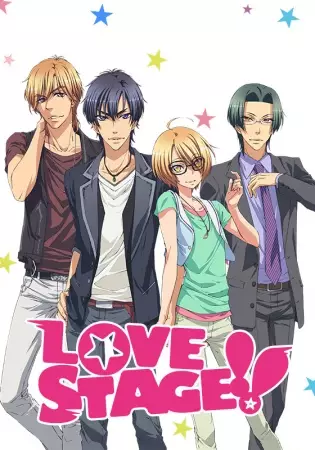
Love Stage!!
LOVE STAGE!!
Studio: J.C.Staff
Synopsis
With an actress mother, producer father, and rockstar brother, anyone would expect Izumi Sena to eventually enter showbiz himself. However, aside from a commercial for a wedding magazine when he was a child, Izumi has never been in the spotlight; instead, he aims to become a manga artist. But a decade after the shoot, the magazine calls for a 10th anniversary ad, requesting the original child actors for the project. This reunites Izumi with Ryouma Ichijou, now a popular actor who, much to Izumi's shock, has been in love with him ever since their first meeting! However, due to Izumi's feminine appearance and unisex name, Ryouma believed the boy was a girl and continues to do so to this day. Izumi's troubles are just beginning, because even after discovering the truth, Ryouma can't seem to shake off his feelings... [Written by MAL Rewrite]
Recommendations


Characters & Voice Actors

Ichijou, Ryouma
Main
VA: Eguchi, Takuya

Sagara, Rei
Main
VA: Hirakawa, Daisuke

Sena, Izumi
Main
VA: Yonaga, Tsubasa

Sena, Shougo
Main
VA: DAIGO

Biscuit
Supporting
VA: Sabat, Christopher

Futoyama, Zenon
Supporting
VA: Gotou, Hiroki

Gaga-Lulu
Supporting
VA: Zougou, Saeko

Hidaka, Tenma
Supporting
VA: Majima, Junji
Ichihara, Ai
Supporting
VA: Miyazaki, Chieko

Kaneda, Kurimu
Supporting
VA: Shepard, Blake

Kurio, Nene
Supporting

Kuroi, Takahiro
Supporting
VA: Kimura, Ryouhei
Ichijou, Ryouma
Main
VA: Eguchi, Takuya
Sagara, Rei
Main
VA: Hirakawa, Daisuke
Sena, Izumi
Main
VA: Yonaga, Tsubasa
Sena, Shougo
Main
VA: DAIGO
Biscuit
Supporting
VA: Sabat, Christopher
Futoyama, Zenon
Supporting
VA: Gotou, Hiroki
Gaga-Lulu
Supporting
VA: Zougou, Saeko
Hidaka, Tenma
Supporting
VA: Majima, Junji
Ichihara, Ai
Supporting
VA: Miyazaki, Chieko
Kaneda, Kurimu
Supporting
VA: Shepard, Blake
Kurio, Nene
Supporting
Kuroi, Takahiro
Supporting
VA: Kimura, Ryouhei
Related Anime
Adaptation
Reviews
 fearlessEdition★ 8
I am a straight male. This show is pretty good. I initially wrote off this show after seeing the now slightly famous intro scene, but soon, a joke amongst friends turned into a marathon of the six episodes that were out at the time. Every week after that, I looked forward to Wednesdays, where I'd get to see the next episode of Love Stage. At this point, after completing the series, the true question is this: Why did I enjoy the show to the extent that I did? I mean, it is quite normal for one to enjoy a show that is that is directed towards a different targetaudience, (I.E. shoujos) and I have nothing but respect for yaoi and the culture, but me enjoying this would seem as a bit extreme...except its not. What this show does well, and likely the biggest reason to why I enjoyed it, was the characters. I will say, I enjoyed the mere presence of almost every single character in this show. The first of the two protagonists is Izumi, the more feminine character of the relationship, and the youngest member of a family of world class entertainers. He has a dream to become a manga artist, however his complete lack of skill causes his family to worry to quite a large extent. Now, there is more to Izumi's wonderful eyes- His character is well developed throughout the show. We get to see all the trails and tribulations he goes through, whether it be with the relationship between him and the other protagonist, which I'll get to in a sec, or the constant tension with his family, who almost sees him as a lost cause. Izumi certainly does go through some entertaining developments throughout the show. The largest cause of this is the other male in the relationship, Ryouma. Ryouma is a growing celebrity in Japan, being seen in commercials and dramas frequently. As the masculine man in the relationship, is it his duty to take charge and progress the relationship along, and this works to create a dynamic between the two characters that I personally found quite entertaining to watch. The other characters, while not particularly developed, certainly add to the overall show- They accentuate the protagonists, while at the same time, being likable. Characters like Izumi's brother, a member of a rock band modeled off the actual manga writer's brother, make for good laughs, as well as Rei, the manager of Izumi's family. The beautiful thing is, all of these characters are likable: you can relate to their issues, and actually care about what becomes of them. When a character cried, I felt sad. When they were happy, so was I. This is the shows strongest point. All characters have their own moments in the story which makes for a good time. (Speaking of good time, I will warn that the show, while not a hentai, does contain its fair share of...*scenes* in it, so do be prepared for that.) As for the story, it is actually nothing quite special, however this is not necessarily a bad thing. Does it take risks? Not particularly, but for what the show is trying to accomplish, (Displaying the relationship between the main characters.) it is quite serviceable. Without spoiling too much, the show begins with a standard romantic, almost love at first sight affair, but quickly turns into a comedic tale about a yaoi relationship. The best part about all this, is that it is quite hilarious. The actual chemistry between the characters is almost more important than the story said chemistry is attempting to progress in the first place. Every scene attempts to have a funny moment, whether it be regarding the hilarity of Izumi's manga, or the conversations between him and Ryouma. So honestly, the story may be weak, but that may be the point. Technically, the show is quite decent. Animation is quite solid here. Nothing to write home about, honestly, but character movements are crisp, and the palette is quite vibrant, adding much to the style of the show. (I mean, Izumi's eyes!) Keen eyed individuals would notice some shoddy art quality on occasion, such as inconsistent character drawings, but this is a nit-pick at worst. Regarding the soundtrack, I would not likely listen to the tracks outside of the show, but they do serve the show well. Songs play at the right times, while the tracks do not stand out, they certainly do fit well with the emotions a particular scene is trying to emanate. The OP, but SCREEN mode, fits in very well with the show. These guys are fairly new to the anime scene, and I do hope to hear them featured in more shows down the road. The ED is slightly less appealing to me, but still works quite well. So yeah, Love Stage. This is the first yaoi show that I've every completed, and while I do not believe that I'll be actively searching for more in the genre, I would be lying if I say I did not enjoy this show. The show is only 10 episodes, and while the length did not hurt the show, I definitely believe that it would have slightly benefited from the extra two episodes, for developmental reasons which you will likely see. Nonetheless, I'd recommend it. Go watch it, you will invested in the characters, feel their emotions, and...yeah I still cant believe I watched a yaoi. Have fun.
 RebelPanda★ 2
Happy LGBTQ+ Pride Month! In celebration, I’m reviewing one of the most beloved Shounen-ai anime from 2014. Love Stage!! ... … … *Trigger warnings: Homophobia, transphobia, sexual assault, victim-blaming.* Once upon a time, your average ~straight~ teenage boy awakens from his bed and greets his idol, Lala Lulu. Izumi, the boy in question, lives with his family of actors and musicians. They constantly put pressure on him to become an entertainer, to his dismay. Izumi is an introverted otaku who dreams of becoming a famous mangaka. Despite wanting to move in a separate direction, he is dragged into showbiz by his family. When I first watched Love Stage as ateen, I thought this would be a coming-of-age story about a boy who achieves his dreams and embraces his sexuality. Oh, how wrong I was. Ten years ago, Izumi starred in a wedding commercial with Ryouma Ishijou, a now-famous actor. Back then, he played a girl due to his feminine features. When they first met, Ryouma fell in love with Izumi’s femininity and beautiful eyes. In the present, they reprise their roles for a new wedding commercial. Once they meet again, Ryouma confesses his feelings because he assumed Izumi was a woman. The two believed they were straight, but their feelings are strong enough to kindle a romance. They enter into a complicated relationship in which Ryouma stalks and sexually assaults Izumi until he ‘becomes gay.’ This is all framed as romantic, cute, and sexy. After all, this is a boys love anime; therefore, it adheres to the most toxic and homophobic cliches ingrained in the genre. Note: Love Stage frustratingly never acknowledges bisexuality exists. Izumi is assigned the submissive uke role (he doesn’t get a choice). Conversely, Ryouma assumes the dominant seme role. In the traditional yaoi erotica, the seme is aggressive and creepy, Ryouma lives up to those expectations. Whereas Izumi is helpless when confronted with emotional and sexual abuse. Ryouma stalks Izumi at school and home by manipulating his family’s trust, as a child groomer would. When Izumi finally calls Ryouma a creep, he apologizes profusely, guilt-trips him, then showers him with shallow compliments until Izumi forgives him. Of course, all that is manipulative bullshit because he kisses Izumi while he’s sleeping in the next scene. Mainstream audiences comprised of mostly straight men and women agree Love Stage is ‘pretty good for a gay anime.’ At the same time, most LGBTQ+ people strongly dislike it, as we should. If Ryouma wasn’t a “hot” and wealthy celebrity, no one would defend their relationship. Stereotypical portrayals of gay characters in anime have desensitized people to homophobic tropes since the inception of boys love manga. The absurd premise forces the ~straight~ men together like two north-pole magnets. Rather than developing a realistic romance like Given and Bloom Into You, it panders to the lowest common denominator with romanticized homophobia. Including both men being disgusted upon realizing they kissed a man. Ryouma insults Izumi for being a “Cross-dressing pervert” as if we needed more clues he’s homophobic. Implying people who try to pass as women are perverts attempting to trick men is also an argument used by transphobic people. There’s only one transgender woman in the cast—an unnamed hairdresser with a stereotypical transphobic character. She is voiced by a man in both the Japanese and English versions. Her only comments are to sexually objectify Izumi. The show continues to be transphobic and homophobic. Occasionally both in the same scene, remarkable! Izumi’s manager, Rei, is also gay. He is supposedly brilliant but frequently allows Ryouma to be alone with Izumi. Which often leads to sexual assault. Throughout the show, various contrived situations force Izumi and Ryouma together. The anime even pokes fun at these deus ex machinas. It is aware of how cliche it is but not aware enough to subvert cliches. Simply doing the trope repeatedly is not the same as parody, satire, or subversion. After Izumi’s first sexual assault, Rei consoles him by confessing his previous forays as a confused homosexual. He describes being gay as “A mosquito that needs to be squashed before it becomes a monster.” Rei pridefully claims homosexuality is a phase that gay people can suppress with effort. These are the same manipulative arguments homophobes use to justify conversion therapy: a variety of harmful practices that target LGBTQ+ people to change their sexuality or gender identity. It often leads to anxiety, depression, and possibly suicide. Not only is Rei’s advice wrong, but it is also dangerous and shows an offensive lack of awareness on the writer’s part. Rei is not a villain; instead, he’s framed as a mentor and treated as though his homophobic beliefs are valid. Izumi’s brother is gay as well, and he’s in a scandalous relationship with Rei. His brother has a not-so-subtle incestuous crush on Izumi and blames his cuteness for why Ryouma attempts to sexually assault him. Again, this is not targeted at the people who it’s about: gay men. It is almost fetishistic how Izumi and Ryouma reject their sexuality. Both make it clear they’re suffering from internalized homophobia, seemingly treated as a cute tongue-in-cheek joke. The only way you know they’re making a ‘joke’ is with the same goofy song and chibi art, regardless of how awful the situation really is. Homosexuality is treated like a dirty secret that everyone must hide, and they do. To the public, they are just “good friends,” and the only openly gay men are stereotypical predators (Including a scene in episode 10 when random men nearly rape Izumi, but it is played off as a joke). The only jokes that made me crack a smile were Izumi’s dream sequences about his idol Lala Lulu. The few female characters are shoujo stereotypes—screeching harpies who fetishize both Ryouma and Izumi. The only exception is Izumi’s mother, who is arguably worse than a non-entity because she doesn’t protect him from his predatory boyfriend and forces him to become an actor. His father is equally to blame for Izumi’s lack of autonomy. The art is what you’d expect. Like most boys love anime adaptations, it was made on a shoestring budget, with not much animation and very bland backgrounds. For 2014, it looks serviceable. The character designs live up to yaoi manga, thin guys with identical body types and abnormally pointy chins. As for the music, the opening and ending are pretty catchy. At first, the soundtrack distracted me from the appalling dialogue. Each background song was repeated over and over until it became mind-numbing. Love Stage is a repugnant anime, but the perfect example of everything wrong with boys love anime. It is stereotypical, homophobic, offensive, and it romanticizes abusive relationships. There’s nothing romantic about this bizarre romcom that seems to care more about condemning homosexuality rather than convincing us these two polar opposite men are genuinely in love.