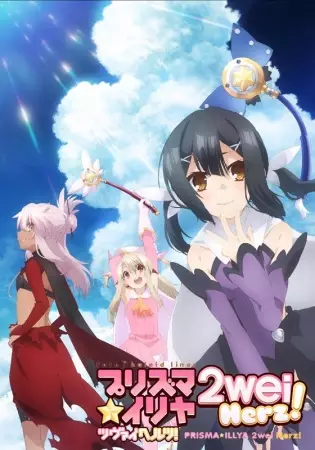
Fate/Kaleid Liner Prisma Illya 2Wei Herz!
Fate/kaleid liner プリズマ☆イリヤ ツヴァイ ヘルツ!
Studio: SILVER LINK.
Synopsis
Little Illya's life has gotten completely out of hand since the Kaleidostick Ruby granted her the powers of a magical girl. Now a regular beach trip is going to turn into another crazy mystery adventure that she and her friend Miyu will have to unravel. (Source:ANN)
Characters & Voice Actors

Edelfelt, Miyu
Main
VA: Nazuka, Kaori

Edelfelt, Luviagelita
Main
VA: Itou, Shizuka

Toosaka, Rin
Main
VA: Ueda, Kana

von Einzbern, Chloe
Main
VA: Saitou, Chiwa

von Einzbern, Illyasviel
Main
VA: Kadowaki, Mai

Auguste
Supporting
VA: Genda, Tesshou

Emiya, Shirou
Supporting
VA: Sugiyama, Noriaki

Fraga McRemitz, Bazett
Supporting
VA: Nabatame, Hitomi

Fujimura, Taiga
Supporting
VA: Itou, Miki

Gakumazawa, Tatsuko
Supporting
VA: Katou, Emiri

Gakumazawa, Reiichi
Supporting
VA: Matsuoka, Yoshitsugu

Gakumazawa, Gaisuke
Supporting
VA: Kimura, Subaru
Edelfelt, Miyu
Main
VA: Nazuka, Kaori
Edelfelt, Luviagelita
Main
VA: Itou, Shizuka
Toosaka, Rin
Main
VA: Ueda, Kana
von Einzbern, Chloe
Main
VA: Saitou, Chiwa
von Einzbern, Illyasviel
Main
VA: Kadowaki, Mai
Auguste
Supporting
VA: Genda, Tesshou
Emiya, Shirou
Supporting
VA: Sugiyama, Noriaki
Fraga McRemitz, Bazett
Supporting
VA: Nabatame, Hitomi
Fujimura, Taiga
Supporting
VA: Itou, Miki
Gakumazawa, Tatsuko
Supporting
VA: Katou, Emiri
Gakumazawa, Reiichi
Supporting
VA: Matsuoka, Yoshitsugu
Gakumazawa, Gaisuke
Supporting
VA: Kimura, Subaru
Related Anime
Reviews
 KouichiKie★ 10
Hi, Before I start reviewing the anime I would like to say watching this first will not help understand the story, so it's best to watch the first season first before even reading/watching this anime or manga. Story - (Rate - 8) The story is about the eighth card which appeared on the map what Rin holds within her possession which shows some form of constriction during the end of Prisma Illya 2Wei. (It is a continuation). With this part of the story, I feel as if the series is beginning to pick up and adapt itself to more serious scenarios relating to possibly theFate route or possibly the UBW Route. It's showing much promising results as it's not just about the fan service anymore, it's more about the action. The reason why I rated it an 8 is because from episodes 1-6 it's more Slice of life rather than battles, however that balances the series out of just being full of action. It is meant to have comedy and fan service, but because of the normal slice of life and fighting it balances everything out. It didn't score 10 because of the somewhat suffocation of the fan service it has to offer, but as the story progresses the entire fan service part just vanishes and focuses on the main battle, which is why it's at 8. If it focused more on Fan service it would have been lower. Art - (Rate - 10) What do I really have to say about the Art? Seriously? The art is AMAZING. It's basically on par with UFO Table's adaption of Fate/Stay Unlimited Blade Works or even better, which I appreciate over all! The amount of effort and pure work they put into the series was phenomenal. I really enjoyed how the animation flowed and fit perfectly with the scenes. There was nothing wrong with the presentation of each episode, and they were all the highest quality in my eyes. The best bit about the art was the eyes and the action. The fighting scenes were amazingly designed and animated, it made my view on the Prisma Illya line better than somewhat of Unlimited Blade Works, though both similar in Art design. Sound - (Rate - 10) What is there to say about all of the sounds? The voices were perfectly in sync with each and every character that existed in the Prisma Illya line, from season 1 to 3. It's amazing how they can perfectly match the character voices and make it work like that. The only one character which I didn't really like was Tatsuko, as she was slightly annoying in the series, but her voice actor was good and matched the childish side of Tatsuko. Over all, the voice of Miyu and Illya was perfect for the roles, which I think deserve some recommendation for their hard work and determination to make their characters sound amazing. The music for this season was amazing as well, they all fit into the scenes and flowed when drastic changes occured in the episodes (this was at the start of episode 7 to 10). The opening for season 3 was awesome, I really enjoyed the way it sounded, and I would definitely have it on my phone to listen to it. The ending was just as good! I think all of the OSTs used in this series deserve to be listened too. Character - (Rate - 10) All characters in this line deserve to be at 10, because of the development throughout the three seasons it's built up to this. Tatsuko is a different story as she has always been this annoying little girl who can't stop herself from running and being hyper, but aside that downfall the character for Illya has developed massively since the first season, from being a coward to now having the ambition to fight and do what she can to protect those she cares about. Her character development began at the end of Season 1. Miyu was just as good as Illya, but in Season 3 her character had developed further than we all expected, from being cold and quiet to being sociable and friendly toward others. The creators of the Prisma Line really wanted to make those two characters stand out over the rest. Rin and Luvia haven't changed much since the first season, so no real point in saying they had their characters being development, though they do get along much more in this season. For the final character I want to mention who really caught my attention during the last half of season 2 until now is Chloe/Kuro. Her character from season 2 was murderous, but after things changed she had a warm heart toward Illya and Miyu, caring for the friends she holds close to her. In my opinion, I feel like Kuro had the most character development from the second half of 2wei to Herz. If you plan to watch this anime then keep an eye on Kuro more than the other two, but personally all three stand out the most. I love this series due to the development of the main 3 characters. Enjoyment - (Rate - 10) I really, REALLY enjoyed this anime because of the mix of comedy, slice of life and action that it has to offer. Of course I feel that the Slice of life comes on a little too much even for me, but as it gradually goes deeper into the episodes that disappears slowly which brings me back to watch it. For others who have only small patience, it can change their view on it and say it's bad. Trust me, once you watch the anime and notice how the plot changes it will catch your attention like it did me. The best bits of the anime I enjoyed the most was the comedy and character development as it was funny yet very interesting to watch. If I could watch this again, I would definitely do so. Over all - (Rate - 10) I think that this anime should be watched especially if you love Illya from the Fate/UBW route. To me, the anime took a turn for the better as it brings in a more serious feel to the battles which makes it better than UBW in some aspects. Season 4 is announced for next year and I'm pumped for it. If you need an anime to watch, the Kaleid Prisma Illya series is for you. I hope it helps anyone doubting this series due to it being a spin off.
 BanjoTheBear★ 4
(This review has been adapted from my blog/reddit thread. Spoilers ahead!) My favorite card game is called “Texas Hold ‘Em.” In this gambling game, the dealer deals two cards to every player. Then the flop (three community cards), the turn (one community card), and the river (one final community card) are dealt by the dealer. Betting occurs in-between each of these rounds. The objective of the game is to make the best set of cards possible – three-of-a-kind, a straight, and so on – with the two cards you own and the community cards. The catch is that each player can only see their own cards. Whatthis means is that the winning hand is not always the winner; a player can and often does bluff their way to victory. And so the saying goes: “you gotta’ know when to hold ‘em and know when to fold ‘em.” I am talking about cards because I am talking about Fate/kaleid liner Prisma☆Illya 2wei Herz!, which is somehow even more ridiculous of a title than Fate/kaleid liner Prisma☆Illya 2wei!. Herz (as it will be called from here on out for sanity purposes) is about finding a final card that Illya and the gang need to acquire. Alongside the secrecy of the plot, the show sort of (read: barely) becomes a game of Texas Hold ‘Em, but this show’s poker face is easily seen through. STORY On a narrative level, Herz takes a different direction compared to its previous two seasons. Rather than intertwining the slice-of-life and action halves – like it has always done – the anime almost completely separates the two. The first half (technically the first three-fifths) is all slice-of-life. Illya, Miyu, and Kuro live the lives of everyday girls: a trip to the beach, going on all the rides in an amusement park, and visiting a nighttime festival are just some of the ways that the girls have fun together. There are scenes that allude to the more dramatic content, but these are very small and irrelevant until later in the anime. In fact, the show focuses so much on the slice-of-life aspect that the series more or less deviates from its magical-girl-parody roots; very rarely, the anime uses its magical-girl motif. This is not a negative so much as it is a clear indication that Herz was looking to take the series in a new direction. Their close friends from school – Tatsuko, Nanaki, and so on – also come with them on these various outings. This gives them a lot more presence than they have had in the past. In fact, an entire episode is dedicated to Mimi, one of these side characters, where she enters the world of “boy’s love” material. By focusing on their friends more so than usual, Herz once again puts emphasis on the slice-of-life portions of the show. Whether or not this new direction worked, however, is another matter entirely. On the one hand, framing the narrative as solely slice-of-life followed by solely action puts Miyu’s plight into perspective. Watching her interact with her friends and having the time of her life before everything starts to fall apart is meant to make it clear that where she belongs is not within a place of despair but right next to Illya and the others who hold her dear. On the other hand, doing nothing but slice-of-life for so long makes the transition from cutesy fun to brutal reality a bit too jarring. The previous seasons did not have this problem because the two halves were mixed. Separating the slice-of-life and the action so much does incur a penalty. Putting everything at the front that is not the main conflict has the inherent problem of lacking direction, intentional or not. The previous season already made it apparent that there was another problem to solve – finding an eighth card – so when the anime essentially brushes off the problem for so long, the problem does not feel as dire, the problem does not feel as important. Again, Herz does reference the main conflict occasionally, such as at the beach with the giant drill and at the amusement park with the presence of their school’s “nurse.” But since these small asides are not at the forefront, the conflict is also not at the forefront, thus causing a loss of importance. If nothing else, the second half has the issue of being unclear. Like the second season, the show has a hard time fully explaining why the events are proceeding as they are. Parallel dimensions and unknown summoning rituals are presumably the cause for the drama, but these explanations are cloaked behind information dumping and assumptions. The massive amount of slice-of-life segments further makes the second half unclear. Spending time on Illya and her family inside a much-too-small swimming pool provides less time for the anime to explain what is actually happening. While the narrative itself might be unclear, it is very clear that the narrative is the weakest part of the show. ANIMATION For a spin-off series, Herz has some surprisingly strong art and animation. While the background art and location details are nothing impressive – Illya’s home is a common location, and the battles take place in open, plain environments – it is the other artistic choices that are. The positioning of the camera. The choreography of the fight scenes. The lighting and the shadow details. A lot goes into making the scenes as spruced up as possible, more so than an anime of this caliber normally gets. Herz also loves its reaction faces that add to the comedy of the show. Mimi flabbergasted at what Shirou and Illya are about to do or Illya getting a giant head with a dumbfounded expression are exaggerations that compound the hilarity of the scenes. The actual animation is likewise high in execution. Characters regularly see hair and body movements that add realism to the scenes. Other effects, like glowing trails, sparkling eyes, and the motion of roller coasters further make the anime as dynamic as it is. And the fight scenes are just as noteworthy. Lots of jumping, flying, and gem-throwing, as well as slow-motion segments and fist-fighting. While there is not as much battling in this season as there were in previous seasons, the battles are as visually impressive as they always have been. Herz also uses CG, usually for the more intense sequences. Episode seven has a lot of examples, like the swirling black clouds of the enemy or Rin’s “Thor’s Hammer” battery ability. For these extra, special effects, the CG is not off-putting, but it is off-putting for the antagonists. Both the eighth card villain and the final, giant demon are CG, which makes some of their movements a bit too rigid and therefore out-of-place among the rest of the normally animated sequences. Lastly, the character designs are well-done. The eyes of the characters, especially Illya, Miyu, and Kuro, are glistening fonts of color. Their hair, too, is stylized without feeling overbearing. And they also constantly change their appearances, from casual clothes to yukatas to their magical girl outfits. Even the rest of the cast see the same attention to detail in their designs and attire, as well as having quirks of their own. CHARACTERS Herz makes a lot of odd choices with its characters this time around. Choices that ultimately reduce the execution of the show significantly. Bazett, the “Berserker woman,” is one of the more obvious. Before, Bazett was nothing short of a villain. She was the adversary to Illya and Miyu, going so far as to thwart their plans and steal their cards for herself and her own organization. In this season, however, she is no longer the antagonist but instead a comedic tool. Her previous escapades have put her in massive debt, so she is constantly forced into situations to make money: selling popsicles, working as a mascot, and running a game stall. To be fair, the contrast of seeing this juggernaut fighter in such pitiable roles is funny. The expense (pun intended) is that she loses the qualities she already had since she goes from an evil brawler to a debt-ridden woman. So it not so much that she changed her character, it is that she became somebody completely different. Tatsuko does not have her character change but she does get time in the limelight. So much time, in fact, that she steals it from many of the other characters. For whatever reason, this season puts a lot of emphasis on the rambunctious kid. Her interactions with the rest of the cast, her crazy behavior, and even the rest of her family are shown. All of these details are done as jokes. For example, when her family is introduced, the characters note how Tatsuko has become the “main character,” to which Tatsuko responds with a philosophical statement that is unlike her. Again, like Bazett, using Tatsuko for comedy is fine, and giving so much on-screen time to Tasuko makes her more of a character than just a hyper little girl. But so much focus on her (and other side characters like Mimi) takes away from the ones who need it most, namely Kuro, Miyu, and Illya Kuro especially has little presence within the season. Outside of her kissing scenes and her teasing of Shirou, she more or less sits on the sidelines. The biggest example is the conflict between Illya and Miyu. Rather than trying to mediate the two when she is aware of the disconnect, she just lets them figure it out on their own. It is not until the final fight that Kuro is motivated enough to take action, action she takes because Illya had finally decided to be the friend to Miyu she should have been all along. Kuro’s refusal to help until Illya decided to makes sense, but Kuro’s character is still a bit contradictory: she is being a good friend by not being a good friend. This is weird because not being a good friend is the main conflict between the characters. So in a way Kuro’s contradiction contradicts the anime’s theme on friendship. The entire first half centralized this theme: the anime, with its slice-of-life events, highlighted the fun times and relationships the friends had together. Yet all of these happy times were avoiding the problem in a similar fashion to Kuro’s own active avoidance. The result is that Illya and Miyu avoided the problem as well. Illya did not pry into Miyu’s life since Miyu was unwilling to share more about herself, and Miyu did not divulge her past since that would have meant hurting the relationship she already had with Illya. In short, Illya and Miyu distract themselves to prevent confronting each other. A lot of the trepidation is caused by Miyu’s social ineptitude. As the first half of the season shows, she does not have a firm grasp (still) on common activities such as hitting a beach ball in the ocean or how festival stalls are more about the fun than they are about the money. As such, she not only has difficulty expressing herself but she also has difficulty understanding Illya’s feelings. So when Miyu accepts her “destiny,” she does not do so to hurt Illya, she does so because she does not want to hurt her best friend anymore. The revelation of her origins is presented awkwardly as more information dumping, but in the end, Miyu learns that she is, as Illya puts it, “not alone.” She learns that friends are meant to be there for one another. She learns that friends are people to turn to when the going gets tough. And considering the magical girl motif, friendship saving the day is as fitting as can be. After Kuro and Miyu comes llya, who is a lackluster protagonist if only because she, like Kuro, does not say or do too much. She is kind and plays the straight man for nearly every joke, so for the slice-of-life segments it works out fine. But her narrow range as a character does not transition well into the dramatic segments. It is not until the very end of the season – where she goes to extreme lengths to save Miyu – that she is finally tested and pushed out of her comfort zone. Yet even this ordeal does not amount to anything. Despite the characters clearly warning Illya of the danger she was putting herself in, she comes out of the situation unscathed. So while Illya is a competent character for the comedic segments, she is a failed character for the dramatic ones. Collectively, the characters are a lot less than ideal, even given that the theme on friendship is fitting for the show. SOUND The opening theme for Herz is quite strange. It combines mellowness and adrenaline into one piece, matching the show’s own split story. The various instruments and hopeful feel of the track are nice, but it is the wonderful vocalist that steals the spotlight entirely. Despite this, the track is not that catchy, making it not worth listening to outside of the show itself. The second ending theme chooses the feeling of the story’s second half, creating a track with a lot of emotion and heaviness. And once again, the vocalist does an impressive job of conveying these same feelings. Coincidentally, the second half of the track is incredibly powerful, but the first half is only marginally so, which is enough to make the track one that is only played while watching the anime. The first ED, for balance purposes, chooses the feeling of the story’s first half. It is a ton of fun, with silly sound-effects and instruments, as well as a fast beat that befits the quick-natured pace of the comedy. This track matches the slice-of-life-ness of Herz extremely well, making it arguably the best part of the anime after its art and its animation. The rest of the soundtrack follows the same theme as the story and the EDs: one half slice-of-life and one half drama. The lighter tracks include tropical tunes, fast country pieces, and guitar-heavy compositions. The heavier tracks include ominous tunes, depressing pieces, and violin-heavy compositions. The OST is nothing special, but it does, at the very least, fit the tones of the anime throughout the season. Finally, voice acting performances are generally above average. Mai Kadowaki as Illya gives the young girl a unique-sounding voice. Kaori Nazuka as Miyu gives the “Holy Grail” girl as emotionless of a voice as possible. And Chiwa Saito as Kuro uses a childish, teasing voice that fits the carefree semi-twin nicely. ENJOYMENT My favorite characters in this series are Liz and Bazett. I like Liz because she is attractive and I like Bazett because seeing her running around and kicking major butt with just her fists and her feet is awesome to behold. Unfortunately for me, I did not get a lot of both. I did get to see Liz in a bathing suit (which was nice) and I did get to see Bazett throw a few punches (which was cool). Yet that was the extent to which I got to see my favorite characters. Now, this is not to say that the anime was boring for me to watch when they were not around, which is hardly the case. As a comedy, the show is pretty solid. Illya’s reactions were funny, especially when Kuro teased her when Shirou was around. The other characters’ shenanigans were funny, too, like when Mimi’s ear was flapping while she was eavesdropping on Illya and Kuro “transferring mana.” The jokes could also be witty: Shirou commenting on why Rin dresses the way she does after being injected with truth serum is a meta joke on Rin’s way-too-short skirt. I just wish there was more of Liz and Bazett since I prefer them over the other characters. The fewer amount of battles this time around was also disappointing, as were the antagonists. The group squaring off against a dark blob and a giant just did not have that same sense of evil, that same sense of urgency. Or this might just be me still perturbed that Bazett was not the villain this time around. Furthermore, I cannot say that I like Miyu a whole lot, meaning her plight did not emotionally move me. The result is that the second half, with its lame fights and its boring drama, is definitely not as fun or as entertaining as the first half. Fate/kaleid liner Prisma☆Illya 2wei Herz! is more of the same but not quite so. The new direction of the narrative does not work, the characters are poorly handled, and the latter half of the show is not as powerful as it could have been. The art and parts of the music are well-executed, and the comedy of the first half works well-enough, so the anime is not a total wash. Even so, if the hand I was dealt in Texas Hold ‘Em was as weak as this show is, I would follow the mantra and fold immediately. SUMMARY Story: Bad, separating the slice-of-life and dramatic halves has purpose, but the jarring switch, the loss of conflict, and the unclear events hurt the narrative Animation: Good, cool artistic direction, above average actual animation, nice character designs, shoddy CG Characters: Bad, Miyu is okay at best, and the theme on friendship has merit, but the downgrade to Bazett, the over-focus on the side characters, Kuro’s contradictory characterization, and Illya being a poor main protagonist are too much to overlook Sound: Fine, okay OP, good first ED, okay second ED, okay OST, above average VA performances Enjoyment: Fine, the comedy was funny, but the latter half is boring, and there needed to be more Liz and Bazett Final Score: 4/10