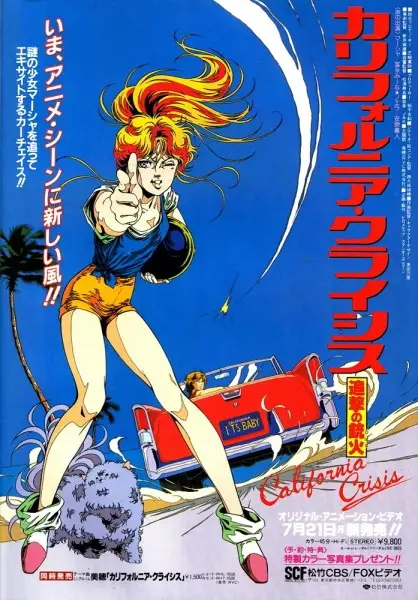
California Crisis: Gun Salvo
カリフォルニア・クライシス 追撃の銃火
Studio: Studio Unicorn, Hiro Media
Synopsis
One hundred miles south of Los Angeles, a reckless biker named Marcia and her newfound acquaintance Noera crash their vehicles after getting caught in the explosion of a semi truck. In the resulting confusion, Marcia manages to sneak off with a briefcase containing a mysterious dark orb. When Marcia and Noera touch it, they experience a vision of Death Valley. Taking this as a sign that the ball needs to be brought to Death Valley, the pair set out on the road, chasing their version of the American Dream, all while evading those who seek to take the elusive object back from them. [Written by MAL Rewrite]
Recommendations


Characters & Voice Actors

Marcia
Main
VA: Tominaga, Miina

Noera
Main
VA: Yasuhara, Yoshito
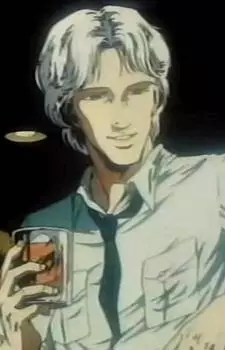
Varo, Jack
Supporting
VA: Shiozawa, Kaneto
Marcia
Main
VA: Tominaga, Miina
Noera
Main
VA: Yasuhara, Yoshito
Varo, Jack
Supporting
VA: Shiozawa, Kaneto
Reviews
 Armitage87★ 6
There's not much to say about this OVA. It's an anime that tries to recreate a 70s-80s american action movie (a bad one), and for the most part it does a pretty good job. Story: Well, there's just enough story to justify the action scenes. Basically a boy and a girl discover some UFO fragment and they're chased by government agents who try to recover it. Characters: There's no character development. After watching it I can't even remember the names of the main characters. There's not a single moment where you might actually feel something for them. Art: For the most part it's okay (keep in mindthat it's an anime made in the 80s). The only problem that I had was with the shading style witch was horribly done. Sound: The whole movie has just 3 or 4 tracks. They're the same type of songs you'll find in old action movies. Some of them are pretty good, they fit the mood of the story well. They're definitely the best part of this anime. So, if you're bored (like I was) and have nothing better to do, you might wanna give it a try. The whole thing's about 45min long and it will keep you interested till the end.
 bitchassdarius★ 7
We finally learn the girl's name after 18 minutes, more than a third of the way in. Not that the main characters' names matter anyway, nor does the plot nor the characters' backgrounds nor really any of the specifics. In this way, California Crisis reminds me of Monte Hellman's sun-baked road movie classic, Two-Lane Blacktop; that is, there is a story, one about a road trip, but that story also happens to be the aspect of least interest. Forget the story, and the focus is now what is being presented on screen. You've got the really striking art style reminscent of Patrick Nagel, with itsbold colour palette on clean yet detailed line art and two-tone shading that gives a strong sense of directional lighting; the wonderfully '80s boogie soundtrack delivered by city pop singer Miho Fujiwara; the '80s Hollywood movie staples of SoCal, dive bars, diners, and car chases. But even looking at the plot, certain familiar threads pop up, like the optimistic sci-fi elements tying outer space to the domestic life (Star Trek IV: The Voyage Home was also released in 1986) or the highly idealized sexual freedom of American women (think of all those provocative coming-of-age sex comedies the '80s is known for). Yet at the core of California Crisis is a novelly foreign critique of the American Dream. Here we have Noera, the male protagonist who claims he cares about his job, his car, his wallet, etc. but whose actions say otherwise; he is barely coerced by a complete stranger to take a road trip to Death Valley and during said trip ends up totaling two cars on unpaid loans. There is no hesitance in this adventure, the brakes never pulled to sit and wonder what the point of it all is, only the impulse to move forward to the next leg. Reflected is an attitude that pervaded America's, and Japan's, economic prospects of the time. During a reunion scene between Noera and his old classmate Jack Varo, his friend unwittingly sums up the mood of the trickle-down era while reminiscing about their high school basketball days: "Those times were great, weren't they? We all just did what we wanted." Still, California Crisis is even more explicit. The trip to Death Valley is initially decided on a whim when, after receiving a vision from the mysterious orb at the diner, Marsha dazedly blurts "American Dream" out of the blue. This tenuous association, along with Marsha's suspicious lack of a past, gives the impression that she's running from, or towards, something. But their arrival at Death Valley is met with a final car chase, after which they end up breaking the "Space Mind" after falling into a river. What's left is a transparent glass ball leaking river water. And then the OVA abruptly ends, their journey as fruitless as the American Dream. California Crisis is a document of what director Mizuho Nishikubo and his production team saw and felt on their location scouting trip to California. The sum total is a time capsule of a certain era of American pop culture, which is a bit odd coming from a Japanese animation, but the accuracy is undeniable. There's a chase scene set to a neon-lit night club performance whose storyboard could have been taken straight out of a classic '80s action movie (I'm thinking Beverly Hills Cop?). Captured is not just the decade's aesthetic but also the dead-ends of its materialism. And how fitting for this idiosyncratic, Western-facing production, which could only have been born out of the '80s anime boom from a studio that almost immediately went out of business.