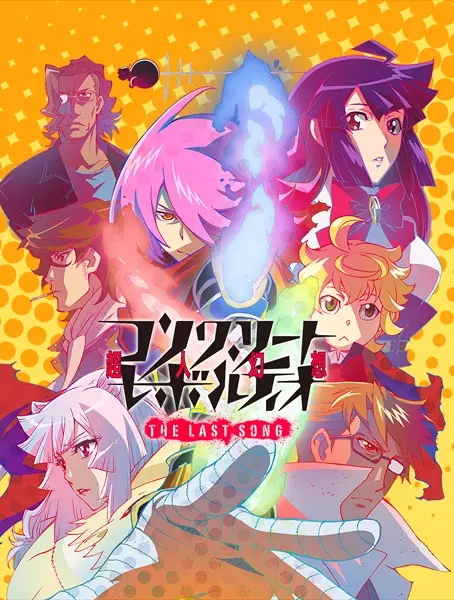
Concrete Revolutio The Last Song
コンクリート・レボルティオ~超人幻想~THE LAST SONG
Studio: Bones
Synopsis
Titans from outer space, life forms from a mystical world, phantoms and goblins from ancient times, cyborgs created by scientists, relics that rose out of the ruins of ancient civilizations. In another Japan, it's not just a question of "what if"—it's a reality. Some of the superhumans choose to keep their identities a secret, while others bask in their superhuman fame. Jiro Hitoyoshi, member of the Superhuman Bureau, keeps track of their doings. (Source: ANN)
Recommendations


Characters & Voice Actors

Hitoyoshi, Jirou
Main
VA: Ishikawa, Kaito

Hoshino, Kikko
Main
VA: Uesaka, Sumire

Kino, Emi
Main
VA: Toyosaki, Aki

Akita, Daishi
Supporting
VA: Kanao, Tetsuo

Campe
Supporting
VA: Mizuki, Nana
Devila
Supporting
VA: Yukinari, Toa
Devilo
Supporting
VA: Sakura, Ayane

Earth-chan
Supporting
VA: Taketatsu, Ayana
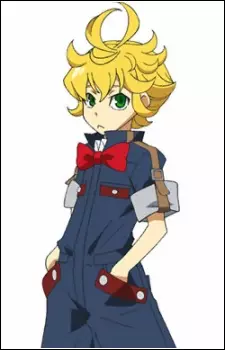
Fuurouta
Supporting
VA: Nakamura, Eriko
Hatakeyama, Sanae
Supporting
VA: Tirado, Jeannie

Hitoyoshi, Magotake
Supporting
VA: Miki, Shinichiro

Kage, Koma
Supporting
VA: Oozora, Naomi
Hitoyoshi, Jirou
Main
VA: Ishikawa, Kaito
Hoshino, Kikko
Main
VA: Uesaka, Sumire
Kino, Emi
Main
VA: Toyosaki, Aki
Akita, Daishi
Supporting
VA: Kanao, Tetsuo
Campe
Supporting
VA: Mizuki, Nana
Devila
Supporting
VA: Yukinari, Toa
Devilo
Supporting
VA: Sakura, Ayane
Earth-chan
Supporting
VA: Taketatsu, Ayana
Fuurouta
Supporting
VA: Nakamura, Eriko
Hatakeyama, Sanae
Supporting
VA: Tirado, Jeannie
Hitoyoshi, Magotake
Supporting
VA: Miki, Shinichiro
Kage, Koma
Supporting
VA: Oozora, Naomi
Related Anime
Reviews
 somaisbatman★ 8
I've said it before and I'll say it again: Concrete Revolutio is one of the most underrated shows out there. It's a project that its creators clearly poured their hearts into. It's full of social commentary and critiques of post-war Japan, and it's satisfying to piece the story together while figuring out what it all means. So naturally, I've been very excited for the second season of this show. Did it meet my expectations and deliver a great product? Yes, but that's a qualified yes. Story: 8/10 Concrete Revolutio's most powerful aspect has always been its narrative, and that rings true for The Last Song aswell. The narrative picks up a few years after the events of season 1's final episode, and things have changed for the worst. Jiro, now an outcast, seeks to find justice, truth, and meaning in the contentious world of superhumans he lives in. While the first season used its narrative to craft a huge world full of complex characters and situations, the second season takes a more introspective approach. Each episode focuses primarily on Jiro and how he chooses to handle the superhuman-centric events he finds himself in. His former friends criticize his ideals and his actions. He goes from having a strong sense of what is right to deciding he doesn't know anything and is a monster. He is broken down and brought back up, but he still can't find a strong sense of justice to cling to. Jiro is a tragic hero through and through, and his transformation is exciting, but sometimes frustrating, as he can come off as wavering and unpredictable. But I think that's the point. Nothing is black or white in this world, and Jiro exemplifies this. The overarching narrative has an unusual format. The first two episodes move the story forward and explain the biggest events of the timeskip between the seasons. However, the next string of 4 or 5 episodes are essentially one-offs, episodes that don't contribute to the overarching plot. I was told that many of these episodes were written by guest writers, which would explain their lack of connections to the rest of the show. These one-offs aren't a bad thing for the most part. Each one tests Jiro's character in a different way and leads to his sense of justice further being challenged. My biggest gripes with the story have to do with the ending. Concluding a complex work like Concrete must be difficult, but I don't feel they did as good of a job as they could. I was satisfied with the ending messages and motifs at the very end, but the road they took to get there during the final episode was confusing and unsatisfying. Art & Sound: 9/10 Everything checks out here. The artwork is just as vibrant and unique as the first season's, with no noticeable lapses in animation quality. The Last Song's opening is simply phenomenal. It's got everything I could want out of an opening - hype-inducing visuals, a line or two spoken purely in broken English, and a dubstep breakdown featuring characters dancing (Dimension W's OP also checks every one of these boxes). The ED is good enough, although the first season's is a bit better to me. Characters: 7/10 In my review of the first season, I mentioned that there are a ton of characters in Concrete. However, this season focuses heavily on Jiro. Unfortunately, this means that the rest of the characters suffer a bit. While some characters are further fleshed out (mostly the ones allied to Jiro, like Earth-chan and Raito), the majority of the cast doesn't get much room to grow. The characters of Emi and Kikko suffered the most in this regard. Kikko spends nearly all of the Last Song futzing around without accomplishing much. And Emi --poor Emi-- stays mysterious and underdeveloped like she did in the first season. She plays a much more active role in the finale, but if that was meant to be her development, then I'm sorry Bones, but it wasn't enough. Enjoyment: 9/10 One of the main criticisms directed towards the first season of Concrete was that its story was convoluted and hard to follow. This was due to the episodes being set non-chronologically, and it was up to the watcher to piece the narrative's timeline together. If you fall in this school of thought, then you'll be happy to know that The Last Song has a linear timeline! Although there are gaps of time between episodes, they all play out in chronological order, so it's significantly easier to follow the story this time around. Events in previous episodes are still referenced frequently, but as long as you were paying attention, you shouldn't get too confused. Overall: 8+/10 The Last Song has been a wild ride, and for the most part it's been very good. It's caused me to think about the societal standards of Japan and the United States, past and present, and the fact that it inspires critical thinking places it above many, many shows. However, I am a reviewer who tends to linger on the ending of a show. As such, I can't say that this second season of Concrete Revolutio was as good as its first. The end of its story didn't blow me away like the first season, and I felt unsatisfied with how most of the supporting cast was handled. But don't get me wrong. Concrete Revolutio: The Last Song is still a great show very much worth your time. Even if you didn't enjoy the first season, I'd give this one a try and I guarantee that you'll be hooked. In addition, I'd recommend everyone who watches Concrete to think critically about it. Think about the events that occur in each episode, and what they are supposed to parallel in real life. Think about how the senses of truth and justice they discuss in the show impact individuals and society. And if you're feeling up to it, read up and talk to people about this show. There are multiple blogs that do great writeups on Concrete episodes, and multiple communities willing to have thoughtful discussions on what everything means. If you can watch the show alongside a friend and talk about each episode together, even better. Concrete Revolutio and The Last Song are definitely worth your time and I strongly recommend them to any one who enjoys their shows having value and meaning beyond the direct plot.
 ZephSilver★ 5
Carving out a niche appeal for itself in the market, Concrete Revolutio stands as one of the more unique entries in the ever-expanding superhero genre. Unlike its contemporaries, it doesn't just glorify superheroes while vilifying certain ideals deemed unethical by most societies but chooses to question the very fabric of justice and what it means to those with the power to implement their version of it. With superhero related content being produced ad nauseam, Concrete's unfamiliar approach help subside the impending feeling of 'superhero fatigue', by allowing the subject matter to be seen through a fresh perspective. By treating superhumans and other supernatural entities asplaceholders for the man vs man parable, Concrete is able to delve into several topics that draw from real world issues involving ethical dispute, social critique of post-war Japan and civil rights in general. This isn't to say Concrete's position is set on uncharted waters; the X-men franchise has long adopted this stance before this show's inception. But what Concrete does hold over titles of this similar vein is the approach it opts out to take. It presents us with multifaceted ideas regarding justice and what it truly means to be a superhero. This is displayed through the course of actions taken on a micro and macro-scale. For a broader overview, it's the policies implemented by the overseeing bodies of the Superhuman Bureau, which, since the events of season one's climax, has been growing increasingly totalitarian towards their ideas of "managing" the superhumans. This directly dictates the actions taken on a micro-scale, which brings us back to Jiro Hitoyoshi and the storyline that finally resolved his reasoning behind abandoning the Bureau in season one. This time, he isn't alone, as Raito Shiba also goes turncoat with him, due to his idea of justice not coinciding with the Bureau's newly adopted forceful approach. With a seemingly 'concrete' (excuse the pun) foundation set forth by season one to build off of, it appeared that season two should have seen smoother sailing. Unfortunately, this wasn't the case. This final installment to Concrete's story is a mixed bag. On one hand they resolve a lot of plot lines that was left up in the air from the 1st season, as well as peeling back the layers of its initial concept to allow for more think-pieces to flourish; but on the other hand its parent studio's infamy shines through more than ever, with contrived and often undermined narrative threads that have become the bread and butter of most of Bones's efforts as of late. For every praiseworthy endeavor achieved by this follow-up, there's an equally headache-inducing add-on that didn't work in its favor. For one, if you were invested into Jiro's character arc then this 2nd season would satisfy you, as the show did a commendable job in fulfilling that end of the bargain (even in the cross-hairs of the sporadic narrative it's a part of) . However, if you were invested in more than just that, and was curious as to how some major plot points were going to be resolved, then you'll find yourself running into many roadblocks to your destination (sometimes containing no destination at all). It quickly became apparent that the creators wanted to cover certain story beats but just didn't know how to get there, which resulted in several events being retconned in order to achieve the end goal that was already set in stone. It became a show that offered one ultimatum: either you follow Jiro's character arc and negate everything else around it, or you take it all in and find yourself perplexed at the forced narrative choices the show took to reach that intended mark. Jiro's revelation is like a double edge sword, it becomes the biggest highlight and as well as crux that keeps the title from elevating any higher than the concept would allow. On one hand, it brings his personal arc full-circle, allowing for a sense of finality to his tale, but on the other, the revelations that serve Jiro's story indirectly dilutes the storyline that came up to that point. It's like an M. Night Shyamalan plot twist, great as a spectacle to gawk at, but contrived when you retrospectively go over the story by order of events. It made an already messy plot even more muddled. And where my previous stance defended the show's writing as simply being harder to follow than usual but not inherently bad, I can no longer in good conscious defend the show any further. Forced retconning will never be something I advocate for. This new stance isn't limited to the story either, as these issues also stemmed into the character department as well. In my review for season one, I stated "These are characters who's definitive personality traits are only as interesting as their superpowers. They're better defined by what they can do than who they are." When I wrote that, I did so with the hope that with the continuation of this show, I could discuss their growth as individuals. Since the 1st season began in medias res and had finally resolved the case of Jiro's betrayal, I was hoping that the follow-up season would have more room to fill in the personality of the main cast that was neglected up to that point. Sadly the statement I made regarding their personality in my first review still carries over in describing them here. Outside of Raito Shiba, no one else is given the limelight to allow for further introspection. They're very paper thin by the time all the storylines intermix into the final act. All they have going for them are personality quirks, and with a subject matter being used as a way to traverse different ideals of ethics and justice, it was a wasted effort. There's good to be found with these characters, but the show never brought it out with the time it unjustly denied them to flourish. But despite these blemishes, there are still things here worth praising. One of which is the idea revolving around what it means to be a superhero. Even with the distinction, the governing bodies make towards the difference between humans and superhumans, there is never any generalized statements to categorize superheroes in specific.They're always referred to as superhumans or beasts but rarely is that extended to the common terms of super"hero/villains". Nowhere is this clearer than with Jiro's personal beliefs. In episode 7, during a conversation with someone, Jiro was asked whether he was a superhuman, to which he replied "No, I'm just a human that looks up to superhumans... For me, superhumans are those that can do what no human can do." This simple, yet brilliant exchange explains the psyche of Jiro better than most shows are capable of attempting. He identifies superhumans not by ability but by intent, and despite technically being a superhuman by standard definition, he himself doesn't cast himself in that light. It's unattainable to him, something he could desperately seek after but could never truly obtain. There's so much weight behind these words, and by extension, so much weight behind Jiro's strife. So when the show finally reveals its hand in regards to Jiro's backstory, it's a poignant one. This way of viewing what true superhumans are in a world filled to the brim with them adds a new layer to the show's ideas up to this point. Another area in which Concrete excelled was undoubtedly the show's audiovisual front. Bones brings their A-game once again, delivering the same wall-to-wall color and comic book inspired stippling (halftone) effects. Regardless of how messy the script became at times, Bones never fails to impress on a visual front. The opening song "Wareru Doukoku by ZAQ was also a step up, possibly outpacing the first depending on your taste in music. Mixing EDM with pop-rock, it hightailed the viewer into every episode, getting you pumped for the events to follow. The ending also held its own fairly well, making the sound mixing and visual direction a complete package. Enjoyment: 6/10 Despite the issues that impeded on my enjoyment of the series, I was still glad I stuck with Concrete. It lost my interest at times, and I often dismissed its decisions, but despite everything I was still satisfied with the overall experience. It may be a title I hesitate to recommend to others but did enough that I would encourage giving it a chance if someone was interested in starting it. Overall: 5/10 With everything finally on the table, did Concrete Revolutio fully deliver on the early promise it demonstrated? Well not entirely. While it brought closure to some things, the revelations it made to push certain agendas forward often felt like spur of the moment solutions to a problem far out of the creators' hands. Many intriguing parts were simply cut prematurely, stunting the outcome of many of season one's build up. In the end, the show suffered from being overambitious. It shot for the stars and drifted off course. Had it been revised, or even extended further, the outcome could have been more satisfactory. Even with that in mind, the moments where Concrete shined through it did so in spectacular fashion. It may have just been glimpses of what could have been, but they were great qualities nonetheless. Concrete felt like a passion project from all those involved. It didn't come off as something concerned about profit first but instead wanted to display its ideas for the audience to consume and ponder over. It may not be high up on my suggestion list but for that "art first, profit later" mindset, I say it's a title worth keeping on your radar.