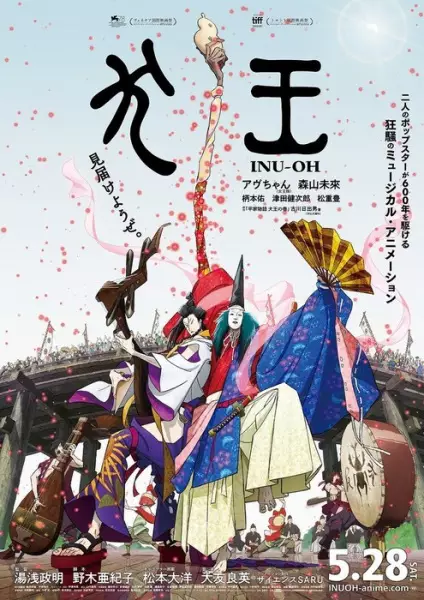
Inu-Oh
犬王
Studio: Science SARU
Synopsis
After diving for an ancient sword in the waters where the battle of Dan-no-ura was fought and the Heike clan fell, Tomona loses both his sight and his father. Left with few options other than learning to play the biwa, Tomona gains enough skill to join a prestigious troupe of storytelling performers and takes the name "Tomoichi." Soon after, Tomoichi meets a strange person who finds joy in terrorizing others with his deformed appearance, but is surprised when the sightless storyteller treats him as an equal. The pair become fast friends and begin performing together after the stranger—who chooses the name "Inu-Ou"—discovers that he is able to hear spirits telling forgotten tales of the Heike clan. Tomoichi changes his name again to Tomoari and uses his music to promote Inu-Ou's underground dance performances, achieving incredible popularity among the masses. However, the brazen and unconventional style they develop challenges traditions that the shogunate values deeply. As the pair's fame continues to increase, they must contend with the forces of tradition that control the society around them. [Written by MAL Rewrite]
Recommendations


Characters & Voice Actors

Inu-Ou
Main
VA: Avu-chan

Tomona
Main
VA: Moriyama, Mirai

Ashikaga, Yoshimitsu
Supporting
VA: Emoto, Tasuku

Fujiwaka
Supporting
VA: Yoshinari, Shoutarou

Hino, Nariko
Supporting
VA: Matsuoka, Misato

Inu-Ou's Father
Supporting
VA: Tsuda, Kenjirou

Inu-Ou's Mother
Supporting
VA: Mori, Nanako

Taniichi
Supporting
VA: Gotou, Yukihiro

Teiichi
Supporting
VA: Yamamoto, Kensho

Tomona's Mother
Supporting
VA: Edamoto, Moe

Tomona's Father
Supporting
VA: Matsushige, Yutaka
Inu-Ou
Main
VA: Avu-chan
Tomona
Main
VA: Moriyama, Mirai
Ashikaga, Yoshimitsu
Supporting
VA: Emoto, Tasuku
Fujiwaka
Supporting
VA: Yoshinari, Shoutarou
Hino, Nariko
Supporting
VA: Matsuoka, Misato
Inu-Ou's Father
Supporting
VA: Tsuda, Kenjirou
Inu-Ou's Mother
Supporting
VA: Mori, Nanako
Taniichi
Supporting
VA: Gotou, Yukihiro
Teiichi
Supporting
VA: Yamamoto, Kensho
Tomona's Mother
Supporting
VA: Edamoto, Moe
Tomona's Father
Supporting
VA: Matsushige, Yutaka
Reviews
 Turtles_cute★ 10
Bear with me, for this is my first review on this website, but more importantly, this is the first anime for which I feel the need to write one. Inu-Ou is a musical in the truest sense of the word, in that it presents almost all of its story beats through the art of music. A fantastic musical at that, as the use of the biwa in the film alongside some other instruments as well as their melding with modern music left me in awe, as I am a person who is not particularly interested in music. The music is magisterial, commanding the progression of thestory every time it swells and falls. Speaking of stories, Inu-Ou tells three in its runtime of an hour and a half and some odd minutes. It is hard to follow, and the film moves at breakneck speed without any regard for the viewer's convenience, with much being left up to the watcher to infer at certain times. The three tales are those of the Heike clan (for context, I would HIGHLY recommend watching 'The Heike Story', also from studio Science Saru), of Tomona, and of Inu-Ou himself. One might think that all this would jumble up the themes and make the entire ordeal seem muddy in its message, however, I argue that these three storylines are intrinsically connected to one another, and exploring one leads to the natural exploration of the other in the film. Without spoiling much, I believe the film succeeds entirely in portraying themes of historical reclamation, rejection of that which is new, greed, as well as, believe it or not, the power of friendship. It explores successfully the treatment of an outsider and the power of a name. Alongside being masterful in its storytelling, Inu-Ou looks fantastic. Although not as grand as theatrical productions from the likes of Kyoto Animations or the films of Makoto Shinkai, the studio has made a film which makes brilliant use of camera angles, tight editing, and a sort of look that just perfectly fits it (I don't know how to explain it, not that experienced with techniques of animation and stuff) to make a movie that is just as beautiful to look at as it is to listen to. I admit that this film is a challenging watch, and requires some prior knowledge of Japanese history. However, to readers who are willing to overlook some minor problems with a small lack of character development (the movie does the best it can in its short runtime) and the apprehension it requires, you will be met with an experience worth remembering.
 ichin★ 8
Inu ou can be a very good movie if you go into it with an open mind. I watched it a year ago at the Venice Biennale. It was the only Japanese animated entry of the festival, which happened to screen somewhat close to where I lived. I went there just to see it thinking that no matter what, even if I wouldn't get the story at least I would let my eyes feast on what looked like the next great feat of animation, provided by such an indie and original studio as SCIENCE SARU, known for jewels like Devil Man Cry Baby and laterHeike Monogatari. What I got was the complete opposite. Even if I didn't get it completely, the story was heartrendingly beautiful and well executed, while the animation.. well I would not have paid the full ticket just for that. No Makoto Shinkai level of detail for sure, but not even the elegance seen in previous features like the Night is Short. It has a gritty, almost dirty, yet precise style that nevertheless manages to perfectly portray the vibe of a story revolving around the poor and outcast. Realistic and vibrant, with uncensored sweat and spit and bodily hair which is pretty refreshing to see in the contemporary hyper-idealised anime landscape. The character design and the action is great, bold, intense. What did not sit with me was the conspicuous use of frame recycling. There were many instances where the scene is exactly the same and just the color or the context change, while the animation goes in a loop. But allow me a little digression. I need to mention how this anime is, first and foremost, a musical. It is a story told almost entirely through musical lines, like a biwa player singing in the streets used to do. There is an incredible amount of time (like 10+ minutes) in multiple sections throughout the movie dedicated to the full development of a song, which makes it feel as if you were really witnessing a rock concert in real time. The music the two protagonists craft with just their voice and a biwa pimped to electric guitar has a visceral, universal allure that will probably make you hum the lyrics while clapping your hands to the beat. If you like festival folk music you'll have a blast and will be avle to grasp what I think is the most important message in the movie: how the power of music and art unites people through the ages, through their differences, through their struggle against society and against fate. Just like the development of the folklore fairytale it is based upon, the story and the music in this movie go through a repetition with variations scheme until they gradually reach a climax. It's an elementary old way of treading a story, something I only remember hearing in my grandparents bedtime stories or some Grimm Brothers. Not the kind you'd expect in an anime. Which is probably what makes Inu Ou a unique viewing experience. I deeply appreciated this decision to honor the forgotten ways, but to come back to my point, I still felt like I was being cheated on a bit in terms of the looping animation. Was it laziness, lack of finances or time? Or was it done on purpose for full coherence in all facets of the medium? In that case I could accept it, as radical and weird as it feels. In all other aspects Inu Ou is successfully fleshing out character dynamics and their ambitions, the clashes within society and the politics of that historical period that so often tend to blend into myth. More than anything, it reveals how magic is intimately connected to human psychology and spirituality. And that sometimes, what originates a legend is the sheer energy turned sacrality of certain extraordinary instants we live in our ordinary life.