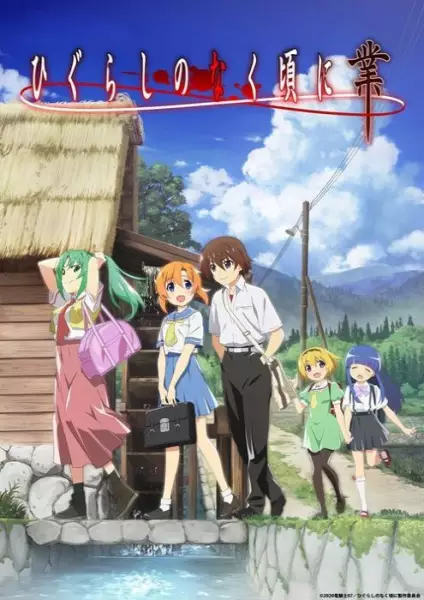
Higurashi: When They Cry – Gou
ひぐらしのなく頃に業
Studio: Passione
Synopsis
Rika Furude and her group of friends live in the small mountain village of Hinamizawa; in June 1983, they welcome transfer student Keiichi Maebara into their ranks, making him the only boy in their group. After school, they have fun playing games and spending each day living their lives to the fullest. Despite this seemingly normal routine, Keiichi begins noticing strange behavior from his friends, who seem to be hiding the town's dark secrets from him. Elsewhere, a certain person watches these increasingly unsettling events unfold and remembers all the times that this, and other similar stories, have played out. Using that knowledge, this person decides to fix these broken worlds. However, when certain variables change, the individual is faced with a horrifying realization: they have no idea what to expect or how to stop the impending tragedy. [Written by MAL Rewrite]
Recommendations


Characters & Voice Actors

Furude, Rika
Main
VA: Tamura, Yukari

Houjou, Satoko
Main
VA: Kanai, Mika

Maebara, Keiichi
Main
VA: Hoshi, Souichirou

Ryuuguu, Rena
Main
VA: Nakahara, Mai

Sonozaki, Mion
Main
VA: Yukino, Satsuki

Sonozaki, Shion
Main
VA: Rojas, Michelle

Akasaka, Mamoru
Supporting
VA: Mazzei, Wilken

Chie, Rumiko
Supporting
VA: Orikasa, Fumiko

Chief
Supporting
VA: Yanagita, Junichi

Eua
Supporting
VA: Hidaka, Noriko

Hanyuu
Supporting
VA: Horie, Yui

Harayama
Supporting
Furude, Rika
Main
VA: Tamura, Yukari
Houjou, Satoko
Main
VA: Kanai, Mika
Maebara, Keiichi
Main
VA: Hoshi, Souichirou
Ryuuguu, Rena
Main
VA: Nakahara, Mai
Sonozaki, Mion
Main
VA: Yukino, Satsuki
Sonozaki, Shion
Main
VA: Rojas, Michelle
Akasaka, Mamoru
Supporting
VA: Mazzei, Wilken
Chie, Rumiko
Supporting
VA: Orikasa, Fumiko
Chief
Supporting
VA: Yanagita, Junichi
Eua
Supporting
VA: Hidaka, Noriko
Hanyuu
Supporting
VA: Horie, Yui
Harayama
Supporting
Related Anime
Adaptation
Reviews
 Luubie★ 10
--- The review contains spoilers --- "Oh Rika, I told you to pick one, didn't?" ~ Satoko Houjou 24 episodes, a dream: to continue a franchise of almost 20 years at the height of visual novels and anime. Higurashi no Naku koro ni returned in 2020, with a surreal season. In the first season, we saw crazy, disturbing scenes and a shocking story. Higurashi Kai softens and resolves the disruption and brings a great ending to the entire series. Higurashi Rei is shorter, only 5 episodes, serving as a sequel after Kai. Now, in 2020/1, Higurashi Gou is broadcast and a new information clash is used inorder to create two more cours for the show. "14 years have passed since the original broadcast, will they still like the anime?", That question has bothered me since the first of October, but today I can finally understand who liked it and who hated it, after all, it is not common in the days of today having an anime like this. To begin with, it is visible the work and the high effort of Passione studio and the director, Keiichirou Kawaguchi, in making episodes without any reference to games and bows different from what we already knew before. Of course, the first thirteen episodes brought many impactful scenes and managed to recreate iconic moments (like Rena's "USODA !!"). It was definitely surprising how the first half of behaved positively as being a sequel, after all, Rika is already tired. A hundred years in loopings ... I must admit that this reference to Higurashi Kai may seem confusing at first, but it managed to bring up a new hypothesis: what if she leaves Hinamizawa, after a happy ending in 1983? Well, that's what happened. Rika enrolls at St. Lucia College and begins her journey. Obviously, we don't know how the end of this world was, since she herself doesn't have all the memories herself (even Hanyuu offering everything she has in Nekodamashi). It is incredible this change of perspective, in which Rika goes from being a simple and not very important character, to the protagonist of every anime. "But, wait, what? What's going on with Satoko ????". Yes, now we have a situation where Satoko knows more than the viewers themselves and even Rika herself. You know, I had some problems with the first two seasons. Interesting characters, like Oishi and Satoko, were not fully utilized. In most cases, they were more like a character group that is only important to be quoted or used specifically in some episodes. But look at how we are doing: Oishi has gone mad in Tataridamashi and Satoko finds Eua, an entity, like our dear Hanyuu, who also has creative powers from other worlds. It is difficult to say and explain all the points and relevance of Eua without mentioning Umineko (another series in the When They Cry franchise), so much so that it is understandable to see people disgusted by this introduction of a sudden character, but I must say that it was a great choice of scriptwriter for this fourth season. He brought a continuation with material shortened by the Ryukishi07 series limits and transcended the limits for something big. Rena, Shion, Mion and Keichi are the ones that were most "forgotten" during the second part of the anime. In fact, this is unpleasant. It is not the same impression of character development that they had, compared to the old anime. My favorite Shion (even Higurashi Gou), was practically nonexistent in the entire show. Rena again became the "yandere" character of the show, maintaining many climaxes and iconic moments, especially in Onidamashi. Keichi, on the other hand, became the protagonist of the entire first half, but again presented some construction flaws with the show in the sequence. I don't say it was bad, since the outcome was purposely focused on Rika, Satoko and Hanyuu. Speaking of Hanyuu, she finally had more explanations regarding her limits as an entity that personifies Oyashiro-Sama. She did in fact become a fundamental piece for Rika during the final events, but I was sad to see that she apparently had a not very good and even melancholy fate. And how can we not mention the masterpiece that was episode 16? Among all that we've seen, this moment was much more exciting and cathartic than anything we've seen before. It was a promising entry from a different Satoko. It seemed that she was the villain of the series, and in fact, she comes to be. When Eua offers part of its powers to Satoko, it uses it to normalize the problems that Rika leaving Hinamizawa would leave forever marked in these infinite fragments. It is not common, nor usual to see Satoko being a scary character in Higurashi. The cases always involved Rena, Shion, Keichi and Mion as the biggest protagonists and cursed. Satoko has never been so prominent before, and I loved it. Her personality having a little change, experiencing everything that Rika lived, was a great narrative to follow the story forward. I like alternating postures and psychological dualities in Higurashi, but Satoko's perspective has outgrown much of what has already been brought up. She starts from a child who loves her friend as her only family to a young woman unsure about the upheaval that changes in her friendship with Rika could change Hinamizawa's course. And even though this seems to be a spook on Satoko's part, her side of concern for her home village is visible, after all, even if there is a perfect destination, Higurashi always contains tragedies and plot twists, where some moments are not predictable. Higurashi Gou was like that and knew how to use his elements very well. Another issue to be valued is the production of the show. Of course, Higurashi was never an anime to be praised for its animation, that I confess, but the Passione studio brought a much better look than the art of 2006 and brought it much closer with the version of the games. This aesthetic is reminiscent of the Monotagari Series (of course, the show's designer did direct work on this series), in addition to appropriating more up-to-date environments. Again, some episodes are not well used even with this improvement, it is not easy to accept the Kimiyoshi scene in episode 15, for example, but it was the best they were able to do in its entirety. Many moments had a very good and above average graphic, which made me happy from the beginning. In addition, the songs again are one of the strongest points of the franchise. The opening was very good for the situations that the anime was in with the time, besides the endings were absurdly good. Irregular Entropy and God's Syndrome are songs that will mark me forever, because in addition to adding well to the message that Higurashi wants to convey, he promoted a great artistic style in the images that composed them throughout the show. The plot? As already said, he was creative, innovative and brought a different posture. It was a perfection made by the show's screenwriter, who knew how to take advantage of many of Higurashi's details, in addition to his references to the old one and the game, which are huge. The director was also impeccable at many times (episode 16 was, for me, the best of all anime in 2020, easily). The franchise can surely celebrate with the result obtained. When They Cry and 07th Expansion must be happy. Many are wondering if Higurashi Gou can continue with a sequel. I feel like yes. At times, the show has convinced itself that it has more to show. It's not like everything that happened was empty, there are already 3 other seasons that show that clearly. But it would be great to see other strands and attempts in history, to continue the series seriously. Particularly, Hinamizawa has a lot of content to be explored, that is a fact. So, continuing with a few more episodes and a new sequence would bring new chances and adaptations to the show as a whole. (And look what a surprise, before sending the review, Higurashi will have a sequence confirmed by Funimation.) Finally, if you've made it this far, you should realize that it's not just any anime. Higurashi marked generations (me too) and broke many paradigms of horror and suspense, something that has not been seen for a long time. 2020 was a difficult year, the anime obviously suffered from the bad reception of many fans and newcomers with the show. I must say, it is normal and I respect the position of these people. Nobody imagined that these more controversial versions and changes in history would be chosen by Kawaguchi. However, I loved everything that was proposed. Higurashi has entered my favorites because of this season, which, for me, is nothing short of great. I really hope for a possible reinterpretation of people with the show, in fact, we are talking about a unique and exclusive content, the beloved of Ryukishi07, a little commented masterpiece. Congratulations to everyone who pledged to make this anime. Congratulations to Passione, for taking such a good title and continuing with great originality. To those who didn't watch the first few seasons, I highly recommend watching it, if it pleased you. You will certainly have no regrets about this. NIPPAH <3
 SingleH★ 2
To turn a remake into a failure, you simply have to make it worse than the original, and to turn a sequel into a failure, you have to make it contribute nothing of value to and be so significantly worse than its predecessors that watching it actually dilutes the quality of the entire series as a whole. In an effort to be simultaneously accessible to newcomers and satisfying to long time fans, Higurashi no Naku Koro ni Gou tries to be a remake and a sequel at the same time, but it manages to only have the failures of both, so the resulting mess shouldhardly pander to either demographic at all. While I’m not going to spoil anything specific, it's worth mentioning this show begins exactly where season one does, but it also immediately exposes secrets from season two before finishing a single arc or even establishing the fact this series is a time loop, thus it dismantles everything good about the original mystery by revealing what's inside the mystery box before you even knew it was there. Newcomers won’t appreciate or even comprehend the significance of certain knowledge without fully understanding the time loop and will also fail to recognize principle characters when so much focus is being shifted to those who shouldn't even be introduced yet, and fans of the original will be confused as to why any of this is appearing so soon and in such a jumbled fashion. Higurashi no Naku Koro ni Gou consistently miscalculates how it plans to cohesively rearrange major fixtures of the plot so often, it fails to even feel like the same story any longer. Before I even criticize the writing in depth, however, I first must decry the aspect of Higurashi no Naku Koro ni Gou which turned me off to it even before fully comprehending its horrendous narrative structure and other fundamental problems: and that is its art style. Studio Deen has been well known in all the wrong ways for all the right reasons for the last twenty five years, and the original Higurashi no Naku Koro ni was no exception to their sometimes disastrous animation production values. That said, as much as the community wants to make memes out of awkward looking screenshots, the scratchy hand-drawn look of Deen’s linework combined with the simple colors and thick retro shadows Chiaki Kon used to juggle the show’s two very different tones made the general atmosphere feel extremely artful and visually cohesive, and when it came to the true horror and gore, the disregard for the anatomical integrity of the character art really did contribute to the demented feeling of the already shocking scenarios. The animation quality of Studio Passione’s Higurashi no Naku Koro ni Gou is consistently and clearly higher than that of the original Deen projects, but the actual art design and visual style is inarguably uninspired, and in my own personal opinion, just downright ugly. Everything looks so uncannily shiny and clean despite the naturalistic setting of Hinamizawa, and the glossy, digital coloration on all the character art just makes everyone look inhuman. It’s impossibly unimmersive. It’s almost a shame the original voice cast did such a good job reprising their roles, because the writing is so dull, it turned a thriller into a slog. While season two definitely slowed down to unpack the mystery and finally work towards a solution to stop the loop and save the day, season one was absolutely nail-biting, fiercely memorable, and filled to the brim with clues and hints season two would eventually come around to piece together. Every episode had it’s own twists and turns, and even some of the dialogue found in the saccharine scenes at the beginning of each loop was meant to imply something important to the plot, and this tight script never failed to keep you so far on the edge of your seat, you’d nearly fall off when the excitement went up to eleven. However, this ability to remain engaging throughout has been entirely lost. The same meandering conversations and pandering diversions from the story at hand which are so common in anime nowadays have now penetrated a franchise as famously intoxicating as this one, and the resulting show is honestly boring to sit through. The worst part of it all, though, is the caveat of expanded universe. It turns out a lot of the alterations that make no sense even to those who’ve seen the original are actually elements from the Higurashi AND Umineko visual novels, so if you want the full experience, you have to venture outside the franchise and outside the entire god damn medium of animation which you came to enjoy in the first place to do so. Being the cynical bitch I am, my original conception of this project was one of pure skepticism and dismissal upon first seeing the key visual with Reina’s new generic moe design. If anything, I figured they were just bringing the series back to milk it for the gore and call it a day, but they didn’t even deliver on that. The death scenes are paltry when compared to the legendary originals, and I think it all just comes down to a misguided vision for what the series was or, frankly, just bad directing. To even do the whole remake-but-also-a-sequel thing at all, they had to make the first episode essentially a one-to-one copy of the original to mislead everyone into thinking they were starting from narrative scratch, and even though the show slowly but surely crashes and burns, I think this was a good decision to begin with because it gives the audience a perfect and immediate opportunity to directly compare the two iterations. Say what you will about Chiaki Kon as a creative, and say what you will about Studio Deen as a production company, but you simply must recognize how well the original team captured the foreboding ambiance 07th Expansion manifests within the core of all their works, and you also must appreciate how electrifying the tension was in Kon’s sporadic direction, sporadic direction which itself demonstrated how expertly she was able to capture Ryukishi’s whiplashing tone shifts. Basically, it’s a matter of artistic inspiration, and Higurashi no Naku Koro ni Gou has absolutely none. Thank you for reading.