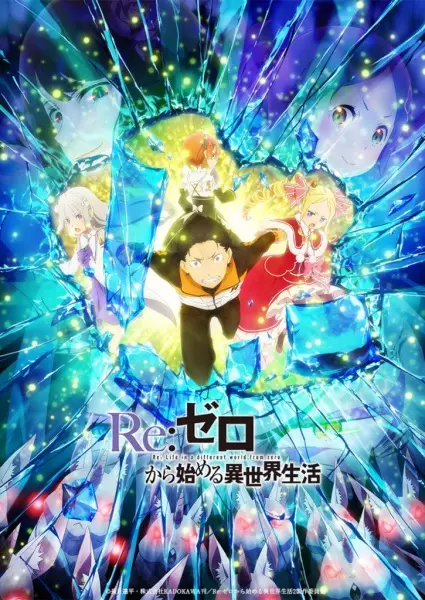
Re:ZERO -Starting Life in Another World- Season 2 Part 2
Re:ゼロから始める異世界生活 2 part 2
Studio: White Fox
Synopsis
After a stern yet compelling speech by Otto Suwen, Subaru Natsuki solemnly swears that he will successfully make it through this timeline and save everyone he can along the way. The first step toward achieving this goal is to help Emilia work through her past; however, that is easier said than done. Feeling as if she has been lied to by everyone around her, it will be difficult for Emilia to trust anyone, even Subaru, her self-proclaimed knight. Re:Zero kara Hajimeru Isekai Seikatsu 2nd Season Part 2 presents the culmination of Subaru's experiences with the Sanctuary and its people, along with his unwillingness to give up hope on saving them. [Written by MAL Rewrite]
Recommendations


Characters & Voice Actors

Emilia
Main
VA: Takahashi, Rie

Natsuki, Subaru
Main
VA: Kobayashi, Yuusuke

Baumann, Frederica
Supporting
VA: Nazuka, Kaori

Beatrice
Supporting
VA: Arai, Satomi

Clind
Supporting

Corneas, Regulus
Supporting
VA: Ishida, Akira

Echidna
Supporting
VA: Sakamoto, Maaya

Elior, Archi
Supporting
VA: Namikawa, Daisuke

Fortuna
Supporting
VA: Tomatsu, Haruka

Granhiert, Elsa
Supporting
VA: Noto, Mamiko

Hector
Supporting
VA: Suwabe, Junichi

Leyte, Petra
Supporting
VA: Kouno, Marika
Emilia
Main
VA: Takahashi, Rie
Natsuki, Subaru
Main
VA: Kobayashi, Yuusuke
Baumann, Frederica
Supporting
VA: Nazuka, Kaori
Beatrice
Supporting
VA: Arai, Satomi
Clind
Supporting
Corneas, Regulus
Supporting
VA: Ishida, Akira
Echidna
Supporting
VA: Sakamoto, Maaya
Elior, Archi
Supporting
VA: Namikawa, Daisuke
Fortuna
Supporting
VA: Tomatsu, Haruka
Granhiert, Elsa
Supporting
VA: Noto, Mamiko
Hector
Supporting
VA: Suwabe, Junichi
Leyte, Petra
Supporting
VA: Kouno, Marika
Related Anime
Reviews
“I love who I am.” The final line of the opening’s chorus, as well as the ending’s titular “Believe in you”, form the thesis and backbone of this season of Re:Zero. This cour shifted its focus away from the usual Subaru character study, delving more into worldbuilding, developing its side cast and delivering its core messages. Why does Re:Zero, within the abundant sea of modern isekai, stand out like a shining beacon of light 5 years later? Some will argue it’s the breadth of its “best girl” selection, others will say it’s the impactful thriller elements. Re:Zero’s true strength lies, if you were to ask me, inthe humanity of its characters and the messages it imparts. These aspects are in the limelight in this cour. The previously established Trials mechanic is used to explore characters’ histories and motivations, all the while sprinkling in setups upon setups leading up to the grand picture of the series. Subaru, as the protagonist, takes a back seat; he lends a hand to the other characters, gives them a push, and yet it remains up to them to make a choice and save themselves. Yes; Re:Zero Season 2 is about self-reliance — but it is also about the fact that when you do decide to take that first step, whether it’s to change, to save or improve yourself, there are people out there who will cheer you on. The message of this cour is a deeply positive one, hence the show momentarily forsaking its usual gimmick. It’s also a very satisfactory watch, after the feeling of deadlock within the first cour, as the characters smash through insurmountable odds set up by the charismatic villain of Part 1. Due to the nature of the show, some spoilers will follow. Cour 1 revealed the antagonist for this season to be Roswaal, behind both the Sanctuary situation and the mansion attack. I would, however, say that beyond specific characters, the true antagonist in this arc is a symbolic, or abstract one — the idea of “stagnation”, which happens to be behind every obstacle of the arc. Roswaal is stuck in 400 years past, believing in the permanence of feelings and chained to the past, intent on fostering that same weakness which he believes exists in others to manipulate them; Elsa is on a desperate hunt to recapture a feeling of warmth from her past; Beatrice remains bound to a 400 year old contract; Garfiel is terrified of the world being too big for him to protect everyone and decides that the Sanctuary should remain closed off. Re:Zero acknowledges that the status quo is attractive — is it not normal to stay attached to the beautiful Witch who saved your life, to want to recapture a feeling of relief from one’s past, or to want to keep your world small where you can control and protect everything? — before pointing out that it is also deeply self-destructive and dangerous, from the impending doom in the form of a carnivorous rabbit horde to the mental degradation of Roswaal and Elsa’s characters. All of these ideas are conveyed with no shortage of symbolism, the most striking one for me being the use of Beatrice and Roswaal’s Gospels. In order to overcome these barriers, Re:Zero asks its characters to find the balance between “dangerous self-reliance” and “toxic dependence”. Subaru, unable to overcome anything by himself despite his abuse of Return by Death in the first cour, realizes something in the second thanks to a friend; the gears of victory start spinning only when he reaches a hand out to his allies and starts valuing his own life. The main heroine Emilia takes the opposite path, beginning her growth only when her dependence on Puck and Subaru is broken. From there, this hero-heroine duo constitute the heart of the anime, spurring everyone else into action. Characters argue and fight; ideals clash, sparks fly. This would be around the part where the average viewer would call the dialogue overlong and repetitive, without any effort on their end to connect with, or at least understand the situations at hand. I couldn’t disagree more. The dialogue forms the heart of the arc; when a character speaks, their lines aren’t artificially tailored for some 3rd party viewer. The core ideas, themes and motivations aren’t spoonfed; they’re inbetween the lines, asking a degree of investment and attentiveness from the viewers. Camera angles assist the viewer in finding meaning, if not to simply immerse them into the scene, like the series’ iconic eye reflection shots that convey “understanding” or “trust”. The argument between Subaru and Emilia in EP40 is probably the strongest display of that particular strength of the series, from the sheer rawness of it to how real it felt as an unreasonable clash of emotions, all the while allowing the two characters to overcome their emotional hurdles. It wouldn’t be difficult to argue that the Sanctuary premise, and the mansion situation at hand, are only present to allow all of these clashes and character explorations to take place, and the attentive viewer will most definitely appreciate this setting that goes beyond the isekai fantasy norm. From a purely script-writing perspective, a lot of these moments overshadow the first half of Season 1, and come close to even the legendary, all-dialogue episode 18. This is all, sadly, from a purely script-writing perspective. While the directing throughout the show is generally good (with sadly more dips than usual in this cour — and no, this isn’t referring to the liberal use of filters, which I didn’t find too bothersome as someone used to such things), the animation is insufficient to carry the weight of certain moments. Anime is, first and foremost, a storytelling medium, but even the best story will fall flat if poorly translated on screen. While Part 2 certainly doesn’t fall to that level, the feeling that something is *missing*, or to be more precise that the characters are too static to properly elevate the scene is certainly there. It also certainly doesn’t help that the downgraded character designs, making most of the male characters hard to look at compared to Season 1, have carried over from S2P1. Re:Zero has had segments even heavier in dialogue than this cour before (again, the pure dialogue-heavy EP18 comes to mind), but a lack of dynamic animation on top of the increased complexity of the writing will inevitably lead to some false perceptions for the average viewer. These production-related issues, along with some cuts to the source that may negatively affect the flow of scenes for some, make it so that I cannot give this a perfect score; nevertheless, White Fox persevered admirably, trying their utmost to stay faithful to the source with consistent 30-minute episodes, this entire season reaching up to 33 episodes disguised as 25. While cracks in the production are present, series director Watanabe managed to balance out ambition with a schedule that didn’t require a crunch to the finish line like other popular gems of this season. But I digress. Making up for the more static animation is a soundtrack that may just match AoT in its movie-like feel; the “fantasy” aspect of the series shines through in almost every track. The voice acting is stunning, from Yuusuke Kobayashi’s emotional performances to Rie Takahashi’s more and more confident and energetic voice, matching the arc of her character. Let’s also not forget to praise Takehito Koyasu, who managed to convey every facet of Roswaal’s character with skill. To top it off, this season came with two character insert songs, both used fittingly and beautifully. In a season as focused in fleshing out its cast through numerous backstories, character arcs and climactic moments, these are some of the most essential components, and I can only be glad the production remained stellar on that front. Overall, if I had to sum up in a sentence what this arc of Re:Zero imparted in me, it would be, once again, “when you finally decide to take the first step to make a change, there will be people willing to help and encourage you along the way”. Subaru isn’t strong, he isn’t even cooler, but he isn’t alone anymore— just that fact is enough to change the tone of the series into something more positive. You cannot remain dependent on others, but avoiding human relationships with those around you will also get you nowhere. If nothing else, I think what Re:Zero Season 2 does is worth lending an ear to.
Bravo, Re:Zero. Bravo. First of all, I would like to give a huge thanks to the staff at Studio White Fox for giving us such a passionate adaptation of Re:Zero Season 2, to the Author, Tappei Nagatsuki for writing this brilliant series, to the Voice Actors for their incredible performances as the characters, and everyone who worked on this show. As a huge fan of the series, seeing Re:Zero Season 2 receiving such an amazing adaptation like no other, it's honestly like a dream come true, and I couldn't have asked for more. With that out of the way, let's proceed to the review. Re:Zero Season2 is back after an agonizing 3-month break, honestly was the longest 3 months of my life, while I had a lot of Fall shows to indulge myself in at the time, none were able to fill the empty void inside my heart left behind when Re:Zero S2 Part 1 ended, and now starts another agonizing wait for Season 3, I'm truly going to miss watching this every week. This season starts, literally immediately where Part 1 left off with the Otto punch of friendship and giving Subaru the confidence he needs to overcome the problems Roswaal meticulously set up this season. With a new profound determination to not die and have the people that care about him suffer because of him, he resolves to save everyone in this final loop and makes a bet with Roswaal, it was a long shot, the stakes are high, it was risky, but Subaru was ready to take that risk. A common criticism of Re:Zero is that the story focuses too much on Subaru that it leaves no room for other characters to shine, that was true for Season 1 and Season 2 Part 1 that was focused primarily on Subaru's development, Season 2 Part 2 fixes this problem and gives every single character a much-needed character development and each and every one of them gets to have their time to shine this season. Whether it'd be Otto being best bro, Emilia and Garfiel learning to overcome their traumatic past, Ram wanting to save Roswaal from his 400-year obsession, Beatrice finally letting go and breaking off the shackles of her past that bound her soul preventing her from moving forward, and this. This is what makes Re:Zero special, it's not just a story about Subaru but everyone else around him, it's a story of him starting a new life from zero, how the actions of others affect him and how his own actions affect others. Re:Zero is not a story about suffering, nor is it a story about being the strongest, killing the demon lord, and getting a sweet ass harem. No, Re:Zero is a genuine and emotional story of growth and self-improvement, learning to accept and love yourself, everyone has flaws, no one is perfect, everyone makes mistakes, but that's not a bad thing, it's precisely because you are imperfect, that you have flaws that make you human. I feel like a lot of people have a bias against modern shows, and I get a lot of people will disagree. But Re:Zero IS a DEEP series, deep in the sense of its emotional and psychological themes, there are genuine underlying messages portrayed in the show, and I have mentioned some of them already in my previous paragraph. One of the central themes of Season 2 is the idea of obsession and stagnation. Roswaal is the embodiment of this ideology, and every character in the series shows a part of this in their respective personality, they are stuck at a point in time unable to move forward, unable to change. A lot of people complain about Season 2 being stuck in the sanctuary for 25 episodes but that is the point, that symbolizes stagnation and directly parallels the stagnation of some of the characters, they are stuck in time, in one place, and after this season are able to move past all of that and change, that is the main theme of this season. These are examples of those characters; Roswaal's 400-year obsession with Echidna, Ryuzu Shima's wish to respect Ryuzu Meyer's sacrifice, Garfiel's trauma that leads to him to hate the outside world, resulting in him resolving to keep the Sanctuary closed off forever. Emilia is bound by her traumatic past, Beatrice's stubbornness to keep her 400-year contract with Echidna, to wait for a person that doesn't exist. A lot of people have also been complaining about the pacing of this season, I don't understand why. They are completely missing the sheer significance and importance of this arc, before you start complaining about the arc being so long, ask yourself. Why is this arc in particular so long? Firstly, it sets up important plot points and mysteries for the future. Secondly, give some context and revelations of some questions we've been asking back in Season 1, and finally, It serves as a turning point for the Emilia camp as a whole. If Season 1 focused entirely on Subaru and his development, then Season 2 focuses on building up and strengthening the Emilia camp through character growth for the side characters. The Emilia Camp was all over the place during Season 1, and they aren't really united and especially Emilia herself was a problem, she didn't possess the necessary qualities that a Ruler should have, no solid foundation, this Arc not only develops Emilia's character, but it also serves to develop and unite the rest of the Emilia camp that will help and support her in the future. Emilia back in Season 1 as we know is a very immature person, she was very naive and had very idealistic goals for the Royal Selection, as she was then, she was unfit of becoming the Ruler, and that's a big problem. She doesn't have the best leadership and has problems with self-confidence because of discrimination she has faced due to her Half-Elf lineage and looking exactly like the Witch of Envy. Even the determination she lacks, unlike the rest of the Royal Candidates. However this season she has learned to become more mature and start to become better as a person, slowly becoming someone who can lead the country in the future. Through the 1st Trial she found the resolve and determination to make her wishes come true, through the 2nd Trial she learned to fully accept herself and to not be afraid of what others think of her, and finally, through the 3rd Trial, she gained the confidence to overcome the disaster that may come. The characters are the best part of Re:Zero. They feel genuine and real, not in the sense that their personalities are realistic, but instead in their character flaws, and psychology. The author gives a lot of thought into them, even the characters that may seem very insignificant at first glance. Apart from the characters, the story is solid as well. Season 2's plot is complex and tightly written, unlike the first 3 arcs in Season 1 which were more simplistic and straightforward. Part 1 served as the build-up phase by introducing the central mysteries and problems like Elsa, Meili, Mansion Problems, Rabbits, Witches, and Roswaal's true intentions. While Part 2 is the emotional climax and development, and it was well worth all the build-up. The songs and OST this season is amazing, the opening and ending are both really good too bad they're not played much often, we also got some really nice Insert Songs by Emilia and Ram's VAs, and some new tracks courtesy of Kenichiro Suehiro and are honestly some of the best of the series. Animation is a step up over Part 1, might not be the same quality as Season 1 but there is one fight, in particular, this season that I believe is the best-animated fight of the series thus far, Kazuhiro Ota is a god, and is carrying all the fight scenes on his back. All in all, this season of Re:Zero has been spectacular and I feel it far surpasses Season 1 in almost every aspect that's not animation. It has everything that made Season 1 so good and improved upon it and also fixes a lot of problems people had with Season 1. This deserves a 10/10 rating. If you've lasted until the end, thank you very much for reading, and I hope you liked my review. Have a good day!