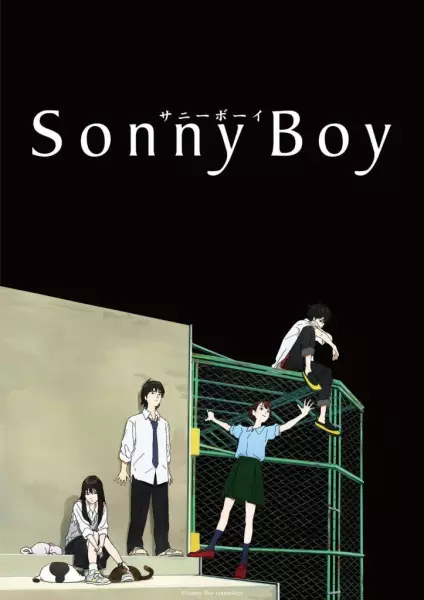
Sonny Boy
Sonny Boy (サニーボーイ)
Studio: Madhouse
Synopsis
Thirty-six students find themselves and their school building suddenly adrift in a void-like dimension. When supernatural powers awaken in some of them, a sense of detachment begins to divide the group. Despite the student council's attempts to impose order, they clash with the students possessing special abilities, who rebel against their strict control. This conflict leads them to discover that this world has its own set of rules—and following them is necessary for survival. After one of the students decides to take a leap of faith, the school switches dimensions once again. While they deal with the unique challenges and circumstances that each world presents, the students must unravel the mysterious phenomenon and find a way back home. [Written by MAL Rewrite]
Recommendations


Characters & Voice Actors

Asakaze
Main
VA: Kobayashi, Chiaki

Mizuho
Main
VA: Yuuki, Aoi

Nagara
Main
VA: Ichikawa, Aoi

Nozomi
Main
VA: Oonishi, Saori

Aki-sensei
Supporting
VA: Kakuma, Ai

Cap
Supporting
VA: Ueda, Youji

Futatsuboshi
Supporting
VA: Matsuno, Taiki

Hayato
Supporting
VA: Yamamoto, Shouta

Hime
Supporting
VA: Hikisaka, Rie

Hoshi
Supporting
VA: Naitou, Ami

Kodama
Supporting
VA: Taketatsu, Ayana

Kosetsu
Supporting
VA: Ozaki, Yuka
Asakaze
Main
VA: Kobayashi, Chiaki
Mizuho
Main
VA: Yuuki, Aoi
Nagara
Main
VA: Ichikawa, Aoi
Nozomi
Main
VA: Oonishi, Saori
Aki-sensei
Supporting
VA: Kakuma, Ai
Cap
Supporting
VA: Ueda, Youji
Futatsuboshi
Supporting
VA: Matsuno, Taiki
Hayato
Supporting
VA: Yamamoto, Shouta
Hime
Supporting
VA: Hikisaka, Rie
Hoshi
Supporting
VA: Naitou, Ami
Kodama
Supporting
VA: Taketatsu, Ayana
Kosetsu
Supporting
VA: Ozaki, Yuka
Reviews
 SingleH★ 9
The only thing I don’t understand about Sonny Boy is what other people don’t understand about Sonny Boy. The story is a reimagining of The Drifting Classroom, only now, some of the students lost in limbo have thematically relevant superpowers. People all over the anime community have given this show a reputation for being abstruse, or “2deep4u” as the saying goes, but I could not disagree more, and in fact, I actually think the show almost suffers from being too simplistic. Sonny Boy is a metaphor for entering the Japanese school and work system, and the emotional issues of these characters stem from their middleschool graduation. It’s hard to see beyond what’s here at school; some of your friends are developing amazing talents and maybe you’re not; you have to take a leap of faith out into the real world; nothing comes for free, you have to stand up and work for it. Pretty much every episode can be boiled down to embody similarly basic coming-of-age themes, and everything interesting or innovative the show does is certainly not achieved though the depth of its writing. The very first piece of exposition at the beginning of episode one makes this crystal clear. “People who were nothing special yesterday suddenly gaining tremendous power. Of course they’ll want to test themselves to find out what they can do.” Tremendous power can symbolize adult responsibility, independence, or a salary, and testing one’s self can symbolize pushing boundaries which others may not have the confidence or maturity to: learning to drive, moving out of your parents’ house, starting a family of your own, and so on. It’s honestly really in your face. The school exists in its own pocket dimension where all your needs are met, all your resources are replenished, and all your wounds are healed, whereas the worlds they travel to outside the school hold actual risk and uncertainty. My friends…this is not subtle. As a work of art, Sonny Boy is a modern masterpiece. It’s not flashy, but it consistently blew me away with its fluid animation and detailed artwork. As expected, this show is animated by 80% freelance talent from Shingo Natsume's friends list, and the names he continues to attract despite post-2011, post-Maruyama Madhouse being such a dilapidated ghost town never ceases to amaze me. Sonny Boy’s commitment to hand-drawn, non-digital stylization is worthy of everyone’s applause, and the work of art director, Mari Fujino, another genius to come out of Studio Pablo—such as Yuji Kaneko and Seiko Yoshioka, just to name a few—is stunningly beautiful and goes hand in hand with Natsume’s atmospheric tone. Every episode is endless wallpaper fuel, filled to the brim with cool, memorable shots, beautiful backgrounds, and excellent music which compliments the ambiance perfectly. I repeat, the messages delivered by each episode are pretty obvious and a little on the nose, but if I’m going to concede a single point to the people who are calling this show confusing, it’ll be this: what makes Sonny Boy a bit more difficult to watch than your average anime is how little is spelled out. We’re treated to so many short moments, gestures, and facial expressions which all tell a little story in and of themselves, and they exhibit character development in a nuanced manner any other show would devote five minutes to explaining with overwrought, melodramatic dialogue. But this is something I really liked about it. The show doesn't spoon-feed you, and it rewards you for paying attention and treating its characters like people. It’s not “high-IQ.” It’s just dense visual storytelling. Very few times in my life have I had the privilege to witness a series which pushes all my buttons so well and in so many ways, and even if you don’t share my exact aesthetic preferences, I promise you'll agree when I say Sonny Boy is an audiovisual masterclass. What depth it lacks in the theme department, it more than makes up for in the character department, and not simply because they brought Hisashi Eguchi back from the grave. Natsume stated in an interview, “Sonny Boy is a simple story about a boy growing up and people drifting apart,” and the only reason he imagined it with such an abstract presentation was simply because “life can be absurd and inexplainable sometimes, and you find yourself asking ‘Why?’ a lot.” To me, this is very obvious. The tangible plot of Sonny Boy is a straightforward mystery box which just so happens to have a great deal of surreal elements, but this simplicity is a good thing, because with all the symbolism and character details you already have to keep track of, any narrative structure more complex than this would’ve been way too overbearing and—now that I mention it—probably would’ve made the series as confusing as everyone already says it is. What makes the cast so good is a combination of the expressive character animation I mentioned earlier and the fact Natsume personally wrote the script for every episode, making every character feel consistent. I was actually worried about him writing, because while Natsume is a fantastic director, I wasn’t sure how confident I was in his ability to direct AND write his own original project. While his themes weren’t as profound as he might've hoped, his character writing was first-class, and while some episodes were definitely more verbose than necessary, he still proved my worries wrong. There’s a cute, snarky cat girl whose cats work for Jeff Bezos at Nyamazon, an Indian exchange student who literally invents bitcoin, a New York Yankee’s fan who builds a religion around baseball playing monkeys, and a five thousand year old talking dog. This idiosyncratic charm defines nearly every character, and the few exceptions are still well-realized and serve as a much needed anchor. Rereading everything I’ve written here, I suppose there’s always a chance I’m subconsciously handwaving parts of the show which are obviously lacking, or perhaps I’m similarly making excuses for what the average viewer may see as wasted potential by overselling what already stands out, but I sincerely think this is one of the most visually compelling anime to come out in years, and aesthetically speaking, I’m not sure if an anime has ever resonated with me in quite the same way. I imagine it's a simple lack of all the abhorrent digital filters, aftereffects, bloom, and other post-production alterations which are layered on top of every modern anime, but this show is just SO gorgeous. It looks like it has all the hand-painted goodness of older anime, but also the crisp visual resolution of digital anime. Its internal consistency is incredible. A lot of modern anime mix 2D and 3D together (where the 3D is usually poor quality), and then adds other effects on top of that. This is just the 2D and little else, with only two noticeable 3D models used throughout the entire show. It looks like Mamoru Hosoda's One Piece film without all the shitty CG. And I hardly did justice to Eguchi’s masterful character designs, or for that matter, the masterful music. The soundtrack for this show is just so immaculate, and it was advised by Shinichiro fucking Watanabe! It uses genres and styles you almost never hear in anime, and hardly for the sole sake of standing out or being pretentious. It just works. It sounds like seminal stage progrock, or some weird Close To The Edge stuff, and I love it. There’s a subtle yet worthwhile distinction to be made between something which is trite and something which is simply commonplace, and I think Sonny Boy has more than enough heart and soul in its creation to excuse any level of unoriginality you may perceive in its coming-of-age themes, and if you tried to call these audiovisuals anything close to lackluster, they’d scoff. Thank you for reading.
 danielsalt★ 10
Here is my very own, humble, spoiler-free take on Sonny Boy: Sonny Boy is an anime that had a lot of promise, and quite frankly, it absolutely delivered. Likely inspired by The Drifting Classroom, Sonny Boy is the surreal story of a class of students that is sent adrift into a void-like alternate dimension. With a touch, but not much focus into its fiction, Sonny Boy explores the relationships between charismatic, captivating characters and the inner challenges they face along the length of the story. Admittedly this anime is not for everyone, but it stands out from the bunch. Watching this anime weekly the pace already feltfast, and each chapter was very plot heavy: I can’t even begin to imagine what this anime is like when you binge it from beginning to end. It has its quirks, and it’s not easy to follow. If you dislike open endings or having to make your own interpretations of events or even themes of a story, you may want to watch a purer drama or psychological show instead. Art: 10/10 The art in Sonny Boy is magnificent, the artists skillfully use colors to express a flurry of emotions and the polished animation is reminiscent of the old Madhouse we saw years ago in OPM or HxH. Madhouse is back in full force, with APFTTU being the only anime of such excellent quality that they’ve produced in a long time, that I can think of that is. Sound: 10/10 The OSTs that Sonny Boy uses are outstanding, I can’t help but use the OST in the beginning of episode 11 as an example of how well Madhouse does to use sound that fits the scenes to perfection. Even background sound and silence are used as tools to evoke a mood or another. Additionally, the ED is an absolute banger that reflects the themes of the anime itself very well and is a great listen outside of the anime too. Characters: 10/10 Sonny Boy presents a variety of characters with different stories and motives, which make the anime miles more compelling than it would be without them. Characters like Nagara, Nozomi and Mizuho as well as less influential characters like Yamabiko, Pony and Cap are characters with real problems many of us have or will face and can relate to, and the way that the authors write the story so that every minor event and other characters around them affect their struggles and perspective is short of fascinating. I appreciate the fast pace of the anime because it allowed us to be introduced to plenty of different characters, stories, and contexts, all meaningful to the resolution of the story. This is something that I can say about very few anime, if almost any. Acting (VA): 10/10 Acting is always an area where I see points being dropped in MAL reviews, and I’m guilty of this too. I was going to rate the acting a 9 or an 8.5, maybe even an 8, but the more I thought about it the more I realized that I really had no reason to. The voice actors in Sonny Boy are very experienced and talented, not only did they adapt to the characters very well, but they also generally fit their personalities, looking at their past projects. I’m not Japanese nor do I speak it, so I won’t get into the tidbits of it, but the VAs were able to adeptly personify the individuality of each character and bring us closer to understanding each one of them, and that’s a magnificent performance in my book. Story: 9/10 The story itself is the hardest thing to review from this anime, not only is it complex and often confusing, but it can’t be treated the same as most other anime. We’re presented with a simple enough premise: a, well… “Drifting Classroom”, but it quickly starts to spread in all directions. It would be easy to criticize the storyline and other notions like the powers each student has, but ultimately each event was meaningful and gave personality and quirks to each character, and overall, I believe the story delved into interesting concepts in each and every step of the way. What I can say with full confidence, is that this is *not* a rip-off of The Drifting Classroom, as many (myself included) first described it (I really wanted to get this off my chest, seriously, I don’t even know why, just really bothers me for some reason), I hear this ALL the time, and it couldn’t be further from reality. The premise is shared, and it would be foolish to deny that, but Sonny Boy is much more than “haha classroom go zoom, bad copy lol 3/10 gottem”. Enjoyment: 10/10 Sonny Boy is a wild ride, if you’re able to ride along a somewhat complex and confusing story and make your own out of it, you will be fascinated by what Sonny Boy has to offer. Sonny Boy is nothing less than a modern masterpiece in my eyes. Therefore, overall: 10/10