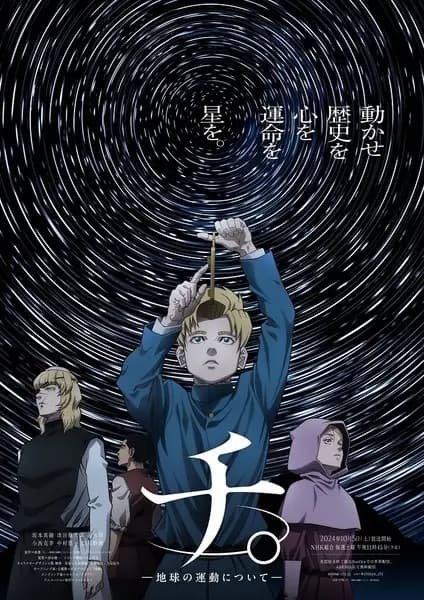
Orb: On the Movements of the Earth
チ。―地球の運動について―
Studio: Madhouse
Synopsis
Twelve-year-old prodigy Rafal believes in living rationally, so as to earn praise and respect from society while not being led astray by his emotions. To this end, he publicly states his intention to study theology—the academic field held in highest regard in early 15th century Poland. However, an encounter with a mysterious man upends Rafal's life, sparking an illogical desire to instead pursue his passion for astronomy. Rafal is determined to prove the beauty and rationality of heliocentrism—the theory that the Earth revolves around the Sun. This belief is considered heretical by the powerful Church, which promotes geocentrism—the Sun revolving around the Earth—as the sole truth of the universe. Those whose beliefs do not align with the will of the Church suffer unfathomably gruesome consequences. In pursuit of evidence for a heliocentric model of the universe, Rafal grapples with obtaining precise calculations and building empirical theories. His greatest challenge, however, lies in conducting this research discreetly—lest he wish to meet the same fate as other heretics. [Written by MAL Rewrite]
Recommendations


Characters & Voice Actors

Badeni
Main
VA: Nakamura, Yuuichi

Brudzewski, Albert
Main
VA: Ishige, Shouya

Draka
Main
VA: Shimabukuro, Miyuri

Jolenta
Main
VA: Hitomi, Saya

Nowak
Main
VA: Tsuda, Kenjirou

Oczy
Main
VA: Konishi, Katsuyuki

Rafal
Main
VA: Sakamoto, Maaya

Schmitt
Main
VA: Hino, Satoshi

Antoni
Supporting
VA: Mikami, Satoshi

Asch
Supporting
VA: Harada, Shouhei

Bolko
Supporting
VA: Nakano, Taisuke

Damian
Supporting
VA: Ueda, Youji
Badeni
Main
VA: Nakamura, Yuuichi
Brudzewski, Albert
Main
VA: Ishige, Shouya
Draka
Main
VA: Shimabukuro, Miyuri
Jolenta
Main
VA: Hitomi, Saya
Nowak
Main
VA: Tsuda, Kenjirou
Oczy
Main
VA: Konishi, Katsuyuki
Rafal
Main
VA: Sakamoto, Maaya
Schmitt
Main
VA: Hino, Satoshi
Antoni
Supporting
VA: Mikami, Satoshi
Asch
Supporting
VA: Harada, Shouhei
Bolko
Supporting
VA: Nakano, Taisuke
Damian
Supporting
VA: Ueda, Youji
Related Anime
Adaptation
Reviews
Orb: On the Movements of the Earth - Damn, does NHK know what shows to show on its network that not only bring in heaps of Japanese citizens, but also people globally as well, going n-for-nth or historical drama shows that just keep you coming back for more and don't waste your precious time? If you don't know what I mean, do you remember shows like last Spring - Summer's Karasu wa Aruji wo Erabanai a.k.a Yatagarasu: The Raven Does Not Choose Its Master, and especially famed mangakas' series from Yasuhisa Hara's Kingdom to Yoshitoki Oima's Fumetsu no Anata e a.k.a To Your Eternity? Yes, allof these series aired on Japan's premier broadcasting station NHK, and anime showcased at the TV network, for the past few years or so (not counting its sister station NHK Educational that's branded for children), has been pumping out banger after banger shows with reputations that precede their fame. And in the most recent of times, there comes yet another contender to follow this highly regarded trend: mangaka Uoto's Chi. Chikyuu no Undou ni Tsuite a.k.a Orb: On the Movements of the Earth, which since its inception has gone on to be nominated many times and even won prestigious awards in the form of the Osamu Tezuka Cultural Prize in 2022, and the Seiun Award in the Best Comic category the year after. No doubt then, the anime must have a talented staff well equipped enough to handle a well-regarded and highly prized work such as this. TL;DR, I have 2 words for you: Philosophy and Madhouse (as in both literally and the studio itself). Let's cover the Philosophy section first, and to get a head start on the overall context of Chi a.k.a Orb, I'd like you to always keep this question in mind behind one of the Earth's most rebutted debates since the dawn of mankind: Can religion and science co-exist? "From religion comes a man’s purpose; from science, his power to achieve it. Sometimes people ask if religion and science are not opposed to one another. They are in the sense that the thumb and fingers of my hands are opposed to one another. It is an opposition by means of which anything can be grasped." - William H. Bragg, British physicist The precedence for just about any experiment, more or less proving that the concept exists, is something that, while pretty much prevalent in today's society, while opinions are open to enable endless discussions between people and the like, is not so the case when you look at how humanity has come forth within the past few centuries. Most especially, within the last rites of the 15th Century's Late Middle Age, just right at the turn of that century into the Renaissance and the Age of Discovery, where the author's series is based upon: a fictional "P Kingdom (of Poland)" where the "C(atholic) religion" reigns supreme, ousting almost every other radical "terrorist" thinking that is outside of the spectrum of what is suitable to the masses of its time, being a mostly authoritarian system where even the bright minds can be gathered but can't make fascist remarks depicting anything outside of Catholicism itself. This, of course, poses a cardinal sin that labels anyone a heretic and subjects them to fearmongering from the Church through its Inquisitors, capable of persecuting just about anyone who defies all sense of the man-made religion and its orthodoxy (that the Earth has seen through many generations of popes come and gone, and people still respect the religion, which opposes the very core of Jesus Christ and the works of Christianity). While you may not know that Uoto's series is a literate reference to the now-famous Greek Renaissance polymath Nicolaus Copernicus's De revolutionibus orbium coelestium a.k.a On the Revolutions of the Heavenly Spheres, which attempts to circumvent the well-known knowledge of fellow astronomer Claudius Ptolemy's geocentric system (which is where the heliocentric model is derived from as an alternative), the author's retelling of that story through fictional characters is what sets the precedence for the art of heliocentrism to exist in a world where the geocentric system has been widely accepted by astronomers at the time. Yes, you could argue that the story is simplicity at its best, seeing generations of people experimenting with the likes of "black magic" (a reference to the night sky and the revolving of the Earth), only to be labelled as martyrs for their work being chased down by the same authoritarian system that they would quote as "blind beliefs" to the cause, but its profound overall statement (which can be referenced to the Bible) that "faith is the opposite of fear," the aforementioned question of religion and science's co-existence...blurs the line even more. "Science and religion are not at odds. Science is simply too young to understand. Whether or not you believe in God, you must believe this: when we as a species abandon our trust in a power greater than us, we abandon our sense of accountability. Faiths, all faiths, are admonitions that there is something we cannot understand, something to which we are accountable. With faith we are accountable to each other, to ourselves, and to a higher truth. Religion is flawed, but only because man is flawed. Science tells me God must exist. My mind tells me I will never understand God. And my heart tells me I am not meant to." - Dan Brown, author of Angels & Demons To pay the price for challenging beliefs and visions and dreams that exist and are/have yet to be discovered, this is one of Uoto's strengths when it comes to the depiction of how far humanity will go to prove why and what they believe in has a right to exist within the laws of the Earth, much more than the God that is prevalent in the world. Just like Christianity with the Apostles' Creed, science itself has no backers, which opens up the possibilities of people assessing the Earth and its unnoticed profound wonders, which is represented in the series through generations of ordinary people (like you and I) seeing how the world runs and finding an intrigue in why theories existed way before but were not further capitalized as such (since people didn't know better back then). And within the 3 parts of the series itself, we see the spearheaders "heretics" of Hubert and (which is passed down onto) Rafal, Oczy, and Badeni, as well as Jolenta and Draka, thereby culminating to link up with actual documented history with famous mathematician Albert Brudzewski (which improved upon Nicolaus Copernicus's theories about astronomy in the late 15th Century to his publishings that would redefine how we see the cosmos today). As unremarkable as they are, Lao Tzu's quote of "The journey of a thousand miles begins with a single step", as well as Confucius's quote of "It does not matter how slowly you go, as long as you do not stop," perfectly sums up the generations of the forerunners who were all in for martyrdom believing in the faith that not just moves them, but the universe as well. Again, it's simplicity that wins out in the end, and for a story that transcends centuries of liberal knowledge, that to face persecution in the form of torture and ideological fascism, these characters play a huge part according to their available research and resources at the time, proving that their science, as much as religion whitewashes the cynicism about heliocentrism, is proven wrong as the Dawn of the Age progresses to the modern day. And none of this is possible without the most defining character of all: Nowak. Like Vinland Saga's main antagonist Askeladd, Nowak's outward appearance is strong and carries his life conviction of his loyalty to the Church and its orthodoxy. However, internally, he who lacks a specific ideology is blind to the ways of the world when it comes to progress, always wanting to stay in his comfort zone that Catholicism will not perish even when he passes on. Sadly, from the very start, he's blindsided when the 12-year-old blonde-haired intelligent kid comes to him and proclaims about the greatness of heliocentrism and the depth that it could create newborn scientific research that spawns the Movement on the Earth, enough to trigger him into a lifetime's worth of being a serial killer for those who oppose the Church. With experience telling him that anybody in relation to this dissident, unorthodox/heterodox thinking is a liability, it sets off a flurry of events that would see him chase every single man and woman down to give them the deathly torture of their lives, only for karma to come back to realize that the religious hollow of his life's belief is but a shadow of its former self (which history has shown of the progress through the age of the Reformation in 16th Century Europe, challenging the beliefs of Catholicism and marking the beginning of Protestantism a.k.a salvation in Christianity based on faith in Jesus Christ as opposed to good works). What a Madhouse of chronological events. Truly, religion and science REALLY cannot co-exist...but is this by any means the end of the story? I tell you, absolutely NOT. "Science is not only compatible with spirituality; it is a profound source of spirituality. When we recognize our place in an immensity of light-years and in the passage of ages, when we grasp the intricacy, beauty, and subtlety of life, then that soaring feeling, that sense of elation and humility combined, is surely spiritual. So are our emotions in the presence of great art or music or literature, or acts of exemplary selfless courage such as those of Mohandas Gandhi or Martin Luther King, Jr. The notion that science and spirituality are somehow mutually exclusive does a disservice to both." - Carl Sagan, American astrophysicist To experience the cosmos, the stars, and the planets with all your heart is a surreal journey that many have taken its path, and few succeeded with theories that span centuries, showcasing that the cosmos truly is a far-flung space of exploration that even more is the glory of its own beauty. And from the director that brought you Fall 2014's Kiseijuu: Sei no Kakuritsu a.k.a Parasyte: The Maxim, Kenichi Shimizu, may have spent time at Madhouse doing all the major staff roles (storyboarding, key animation, animation/episode director) except being series director (if you count out Fall 2016's All Out!!). Since then, Chi a.k.a Orb is a return of the veteran maestro after 10 years of being dormant to give us a show that indeed, beauty is in the eyes of the beholder. What magnificence that the studio has undergone such a massive and radical change, that the once revered Madhouse has finally found its own Renaissance era delivering quality shows that hearken to the hearts of old anime fans who've lived to see its glory days in the 2010s. From Sousou no Frieren a.k.a Frieren: Beyond Journey's End last Fall to yet another Fall show of this series, the word "boundary" is no limit to how far Madhouse respects the works they not only adapt but also get down to the heart of the matter to deliver experiences that you rarely would find, at least for a passion project of this magnitude. From the essences of the gorgeous night sky to the violence and gore that depicts death incarnate, this show has it all and is fiercely unapologetic in depicting the uncensored rawness of life (which you can't say for 99% of shows nowadays that choose to go the safe route and disrespect their source materials in the name of censorship). If you have someone like Kensuke Ushio orchestrating the music for your series, be glad and thankful that everything this man touches turns into absolute solid gold. This man is a prime example of how anime OSTs should be done, and more than in his works for prior series like Dandadan and Chainsaw Man, he understands the importance of musicality in the right places and moments and has consistently pumped out great OSTs over the years, where his quality outshines the quantities of series that he's responsible for. Chi. a.k.a Orb may only have one OP song throughout its 2-cour, 6-month run, but believe me when I say that Sakanaction's OP song is one of, if not the best OP songs I've heard for 2024 alone. To their credit, "Kaiju" may be the Hokkaido rock band's first Anisong, and for a band that has consistently reached Oricon's Top 10 charts in Japan since 2006, for the songs that they have performed in the past that have never failed to generate their huge fanbases, it truly is a record that's noteworthy of their popularity. Funnily enough, with the resurgence of the band in the 2020s, their 2019-released song "Wasurerarenai no" was being used as a surprise/jump cut reveal at the end of various posts or general references to anime music style, where the most prominent post suggested that "regardless of how an anime show ends or a character dies, there is usually an upbeat final theme song in the style of this band." And you can tell that "Kaiju" was made with this sense in mind, right down to the visuals of the anime-cut song, which sees all characters being involved with heliocentrism and the extent of the outcome that goes with them. It's this attention to intricate detail that makes a song both visually and musically metaphoric, and it's just outstanding on every degree. Pair this with the 2 ED songs from Yorushika (which need I say that they're great to begin with), and you'll have a masterpiece OST on your hands. "There is a fundamental difference between religion, which is based on authority, and science, which is based on observation and reason. Science will win because it works. I believe the universe is governed by the laws of science. The laws may have been decreed by God, but God does not intervene to break the laws. When you look at the vast size of the universe and how insignificant and accidental human life is in it, the existence of a God seems most implausible." - Physicist Stephen Hawking I cannot, simply CANNOT, understate how, on the face of the Earth, Netflix has licensed other shows (like Sakamoto Days) alongside Orb, but the former is getting all the attention while the latter is just there in the anime catalogue of shows, just being yet another stickler show in the race of many to be added into the streaming platform's library. Even here on MAL, Chi. Chikyuu no Undou ni Tsuite a.k.a Orb: On the Movements of the Earth is already on the brink of underrated shows due to its complex but simple story of historical philosophy, mixed in with the realism of life that you just will not find anywhere else. Be it a loose interpretation of European history that Orb is written as such, it's still primarily fiction at the end of the day that still focuses on the actual conception of heliocentrism and its themes. I ten billion percent will guarantee that the show is ABSOLUTELY worth your time, even if history is not your thing at all. As God exists in this world, so shall your ability to dream dreams and change the world, because the world revolves around us. And the Copernican heliocentrism that has now spanned centuries towards modernization is pretty much alive today. So go and experiment, because the world is your oyster, as science and religion, while incompatible with each other, are the reasons behind the existence of life and the vast universe.
Orb: On the Movements of the Earth is one of the most thought-provoking and visually gripping shows I’ve seen in a long time. Set in a reimagined medieval Europe, it weaves together the tension between religion and science, between blind faith and dangerous curiosity. It’s a story where the simple act of thinking differently could cost you your life and honestly, that alone made it stand out from everything else airing at the time. The series doesn’t follow one protagonist but several, across multiple timelines, all connected by one idea: the pursuit of truth. Specifically, the heliocentric theory that the sun, not the Earth, is thecenter of the universe. Every episode hums with quiet dread. You watch people wrestle with fear, conviction, and the weight of systems designed to crush dissent. It’s slow, yes, but some episodes hit like a silent scream. You feel it in your chest. And I truly admire its ambition. I love what it tries to be. But I won’t pretend the ending worked for me. It felt… unfinished. As if the story was building toward a revelation, a final burst of something grand or gut-wrenching only to stop mid-thought. The credits rolled, and I just sat there, blinking, waiting for more. I’ve seen people call it poetic and brave. And I get that. But I guess I wanted a moment that landed. I wanted the story to complete its sentence. It didn’t. So I’m left feeling torn: grateful for the journey, but unsatisfied by the silence at the end of the road. Visually, though? It’s breathtaking. The art is dark, painterly, and rich like a Renaissance oil painting come to life. Even if the narrative didn’t fully work for me, the visuals alone are worth the experience. That said, I’ll be honest: it’s not my favorite art style. It’s more impressive than emotionally resonant, at least for me. But I can absolutely appreciate how perfectly it suits the tone. The direction, animation, and atmosphere are undeniably top-tier. That said, there’s one very specific art choice that kinda bugged me: the way they depict bald heads. The transition between forehead and hair often looks unnatural, like there’s a sharp line cutting off where the hair begins instead of a gradual fade or subtle root texture. It almost makes the characters look like they’re wearing skin-colored caps or glued-on wigs. Given how detailed and painterly the rest of the art is, this stands out. Just a little shading or hair-root texture could’ve fixed it. The sound design is equally stunning. Kensuke Ushio’s score haunts the background like a ghost subtle but overwhelming in the best ways. It lingers in the silence, swells in the stillness, and sometimes says more than the characters ever could. The voice acting, too, is phenomenal. There are moments, especially during intense monologues, where I could feel my skin crawl. Not from fear, but from sheer emotional pressure like the words were too heavy to say out loud. As for the characters, the core figures are solid. One antagonist, in particular, goes through a transformation that’s fascinating to watch. But many of the side characters feel like flickers: they appear, burn bright for a moment, then vanish. There’s not always enough time to fully care. You understand their place in the story, but you don’t always feel their loss. There are also moments where the show’s logic feels… inconsistent. A character preaches nonviolence and then leaves a trail of bodies. The Church is painted as brutally anti-science, yet there’s an elite college teaching astronomy? I’m not saying these contradictions ruin anything, but they do make you pause. They pull you out of the story, even if just for a second. And yes, the pacing is glacial. If you’re not into dense philosophical dialogue or theological debates, this show might feel like a high school history lecture wearing an artsy mask. Some people jokingly called it “turbo nerd content,” and you know what? That’s valid. It demands your attention. It doesn’t guide you. It expects you to catch up. There’s also been criticism from historical purists (especially a Polish reviewer I read) about how loosely the show treats figures like Copernicus. For me, it wasn’t a problem. It’s not pretending to be a documentary. It’s art. A dramatized reimagining. But it’s still something to be aware of. If you’re looking for historical accuracy, this isn’t it. What struck me most, though, is how the show talks around science more than it talks about it. For a series centered on astronomy, there’s very little actual process or discovery. It’s more about the consequences of knowledge, not the joy of learning itself. And that felt like a missed opportunity. Still, despite all this, Orb left something in me. A strange ache. A quiet admiration. A sadness that stories like this still need to be told. It’s not an easy watch nor enjoyable. But it means something. Watch it if you love slow-burn historical drama, philosophical tension, and stories that don’t hold your hand. Skip it if you need action, closure, or emotional attachment to a single character. This isn’t an anime that tells. It asks. And whether or not you have the answers, it leaves you with a silence that feels almost sacred. TL;DR: Orb: The Movement of the Earth is slow, heavy, haunting, and unlike anything else that aired at the time. It dares to ask big questions, to stare directly into the cost of knowing, and to sit uncomfortably in the space where faith and reason clash. The visuals are stunning, the music chills, and the themes cut deep. But the ending feels abrupt, and the storytelling doesn’t always deliver emotional closure. It’s a series that either moves you deeply or puts you to sleep. Thank you for reading.