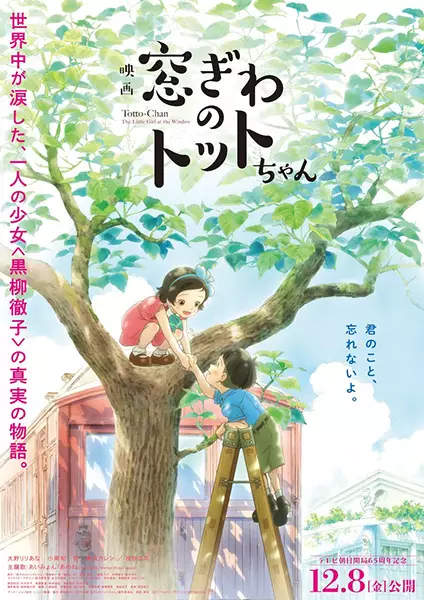
Totto-chan, the Little Girl at the Window
窓ぎわのトットちゃん
Studio: Shin-Ei Animation
Synopsis
This engaging series of childhood recollections tells about an ideal school in Tokyo during World War II that combined learning with fun, freedom, and love. This unusual school had old railroad cars for classrooms, and it was run by an extraordinary man—its founder and headmaster, Sousaku Kobayashi—who was a firm believer in freedom of expression and activity. (Source: Kodansha, edited)
Recommendations


Characters & Voice Actors

Totto-chan
Main
VA: Oono, Liliana

Kobayashi, Sousaku
Supporting
VA: Yakusho, Kouji
Totto-Chan's Mother
Supporting
VA: Cahen, Claire
Totto-chan
Main
VA: Oono, Liliana
Kobayashi, Sousaku
Supporting
VA: Yakusho, Kouji
Totto-Chan's Mother
Supporting
VA: Cahen, Claire
Reviews
 frozenpandaman★ 8
This was a really, really beautiful film, heartbreaking and devastating at times but so full of kindness and hope and love. As someone who also was a very unconventional child that needed an idiosyncratic, accepting environment (and was so generously afforded this), this story really affected me emotionally, spoke to me on a deep level, and was significantly moving. This is a real story, about a real school in Tokyo during World War II that encouraged children's freedom of expression and independence, run by a wonderful, forward-thinking man named Sōsaku Kobayashi who so genuinely loved, understood, and valued children. Japan is a *very* rule-based culture –"the nail that sticks out gets hammered down" – and that fact has personally been quite hard for me to deal with since moving here a month and a half ago. It's depressing to see kids who aren't even ten years old being dressed like miniature adults in formal school uniforms every day. I'm not one for conformity, or blindly following rules without question or understanding, and almost nothing makes me angrier or sadder than children's (especially girls') independence and weirdness and curiosity and creative spirits being quashed, suppressed, or diminished. So even now, 60 years after his death, I feel grateful to the real-life headmaster Kobayashi for providing such a unique, rare sense of freedom, warmth, and trust, even during difficult times, to these children – including the author Tetsuko Kuroyanagi whose autobiographical novel this film is based on, and who in turn wrote of her gratitude and her memories at Tomoe Gakuen. There were some really beautifully hand-animated sequences in this too, fantastical departures from the film's regular style at subtly emotionally-charged moments that break free of the concrete and literal, evoking that childhood sense of wonder and imagination that is (or was) common to us all. The first one happens about 20 minutes in and really caught me off guard, since I was initially a bit put off by the artstyle of overly-rosy cheeks and lips that everyone has, and unsure of what to expect of the film or its story – but upon seeing Totto-chan's imagined journey (https://www.youtube.com/watch?v=LpaTrEoVE5A&t=70s) in the old railroad cars which served as her school's classrooms, I was sold. The following one is drawn in little more than lines of pencil with faint color, depicting a freeing and transcendental experience in the school's swimming pool, in the nude, where Totto-chan helps her physically disabled friend Yasuaki-chan, who had polio, swim for the first time. I'd love to go back and watch these parts again, paying particular attention to how they focused on motion and movement and made use of color. Really, really stand-out work. I could be mistaken, but I don't think the original book is too well-known outside of Japan, despite the fact it's *the best-selling book in Japanese history* (?!) and has been translated into over two dozen different languages. By now, it's sold 25 million copies – that's on par with The Wind in the Willows, more than Things Fall Apart and almost as many as James and the Giant Peach! There hasn't been much mainstream English-language coverage of it, either – one piece being the NYT article at https://www.nytimes.com/1982/11/21/books/growing-up-japanese.html from 1982, and another short but sweet column in the Asahi Shimbun about the sequel that just came out this year at https://www.asahi.com/ajw/articles/15020303. Both are worth reading. I really hope this gets licensed in the US and elsewhere, subtitled, and shown in theaters abroad, as it truly deserves to be seen. I'm so glad I went to see this. Happy tears. Watched: December 17, 2023 Via my Letterboxd: https://letterboxd.com/frozenpandaman/film/totto-chan-the-little-girl-at-the-window/
 kumajoi★ 8
Review summary: A story from before the war to during the war. However, this is a story that goes beyond that. The core of this story is Totto-chan's life. I think this is one of the best animated films. Check out the characters and art background images in the trailer. It's a lot of effort. Who should watch: People who have seen "Kono Sekai no Katasumi ni (In This Corner of the World)". People who like foreshadowing. Who should not watch: This movie shows everyday life, so it can be boring for people who want to enjoy the highs and lows of their emotions. This is ananime adaptation of Tetsuko Kuroyanagi's autobiographical novel. There is probably no one in Japan who doesn't know her, who is also active as an actress, entertainer, and TV show host. The novel has been translated into over 20 languages and over 25 million copies have been published. (+) It's fun to watch the characters The characters are cute. It seems like they are trying to give it a Showa feel. And it moves well. In particular, the main character, Totto-chan (=Tetsuko Kuroyanagi), runs around freely. You can clearly see her free-spirited personality. (+) Create amazing art backgrounds It seems like they tried to faithfully reproduce it. The director interviewed her. The inside of the house and school are also depicted in detail. Art backgrounds is drawn in poster color on drawing paper. (+) Easy to notice story Totto-chan is a rich girl. I didn't know about the daily life of wealthy families in pre-war Tokyo (though the war was actually started). There have been several animated movies based on World War II, but most of them are from local cities, including Hiroshima. Therefore, There were many things I learned for the first time. Western architecture is stylish, rich. This story takes place before and during the war. In other words, we can see that the situation is gradually becoming a state of war. This is subtly revealed in the background and facial expressions, and can be noticed by those watching the movie. Sorry, I couldn't find any negative points ... Well, IMPORTANT points of this movie: Anti-war is just one element of this story. The core of this story is Totto-chan's life. This movie based on her autobiography. Totto-chan is free-spirited. She causes trouble to her teacher and is forced to transfer her school. At the new school, Totto-chan grows up freely and in accordance with the school's educational policy. And she interacts with her disabled friend. This is the main storyline. In Director's interview says: People with disabilities may have been exposed to discrimination, and children's freedom was taken away in Japan at the time. So, children with disabilities must have suffered even more psychologically. When people from overseas see this movie, I would be happy if they could empathize with the situation that children were in at the time, rather than just seeing it as a Japanese anti-war movie. Finally, here are my impressions. This movie has no emotional ups and downs. Therefore, it may feel a little boring at times. I was the same. But, when I quietly came to a realization from the movie, I felt a pain in my heart. It's a movie with a lot of hooks that tug at your heartstrings. I think Totto-chan will expand your world.