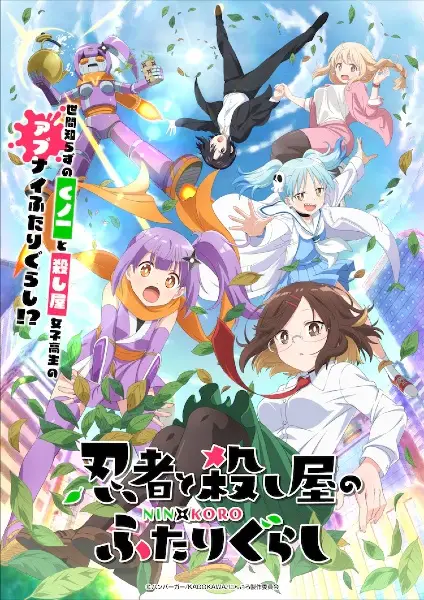
A Ninja and an Assassin Under One Roof
忍者と殺し屋のふたりぐらし
Studio: Shaft
Synopsis
At first glance, Konoha Koga is an average high school girl who lives alone. However, she has a secret—she works as an assassin on the side! One day, fate puts her in an encounter with Satoko Kusagukare, a runaway ninja hunted by her comrades for accidentally leaving her village. When Konoha kills one of the people seeking Satoko, the mysterious girl uses her exceptional ability to cover up corpses. Seeing potential in Satoko's skill, Konoha offers her a deal: she can live with Konoha in exchange for cleaning up the scenes of her assassinations. As the ninja and the assassin now live under one roof, they begin enjoying their new life together, whether at home or during their conveniently aligned collaborations. [Written by MAL Rewrite]
Recommendations


Characters & Voice Actors

Koga, Konoha
Main
VA: Hanazawa, Kana

Kusagakure, Satoko
Main
VA: Mikawa, Haruna
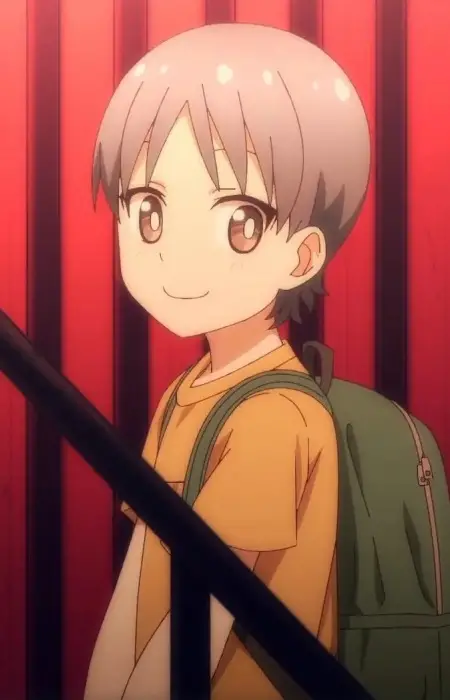
Aoi's Brother
Supporting

Izutsumi, Marin
Supporting
VA: Serizawa, Yuu

Izutsumi, Minato
Supporting
VA: Tanaka, Aimi

Kuro
Supporting
VA: Kitamura, Eri

Kusagakure, Kanie
Supporting
VA: Taichi, You

Kusagakure, Sakura
Supporting
VA: Itou, Ayasa

Kusagakure, Karin
Supporting
VA: Uchiyama, Yumi

Kusagakure, Meiden
Supporting
VA: Minaguchi, Yuko

Kusagakure, Yukari
Supporting
VA: Shintani, Mayumi

Kusagakure, Mao
Supporting
VA: Koga, Aoi
Koga, Konoha
Main
VA: Hanazawa, Kana
Kusagakure, Satoko
Main
VA: Mikawa, Haruna
Aoi's Brother
Supporting
Izutsumi, Marin
Supporting
VA: Serizawa, Yuu
Izutsumi, Minato
Supporting
VA: Tanaka, Aimi
Kuro
Supporting
VA: Kitamura, Eri
Kusagakure, Kanie
Supporting
VA: Taichi, You
Kusagakure, Sakura
Supporting
VA: Itou, Ayasa
Kusagakure, Karin
Supporting
VA: Uchiyama, Yumi
Kusagakure, Meiden
Supporting
VA: Minaguchi, Yuko
Kusagakure, Yukari
Supporting
VA: Shintani, Mayumi
Kusagakure, Mao
Supporting
VA: Koga, Aoi
Related Anime
Adaptation
Other
Reviews
 KANLen09★ 9
A Ninja and an Assassin Under One Roof — Hey, it's Lv1 Maou to One Room Yuusha, but better in every way! *tilts head with the Essence of Monogatari vibes* Everyday mundaneness. This is the reality that as the sorry-ass humans we are, we go about day and night and do things that sum up the everyday life that seems to repeat endlessly in a body clock's cycle. But what if there is that element that somehow gets you out of that rut and enables quite the spark to life that you can't go one step away from that premise to see life as anything butnormal? This is the outcome and result with mangaka HundredBurger's lone work of Ninja to Koroshiya no Futarigurashi a.k.a A Ninja and an Assassin Under One Roof (shortened to NinKoro), which I think is the better version of Summer 2023's Lv1 Maou to One Room Yuusha a.k.a Level 1 Demon Lord and One Room Hero, in terms of both content and aesthetics. For as long as time exists, the terminology is one and the same for different settings and aspects when it comes to ninjas and assassins. And although the idea of having them both in communion will, for sure, reap commonality that's unforeseen, that's exactly the case for two rather not-so-ordinary girls, Satoko Kusagakure and Konoha Koga: a ninja who has found herself on the escape route out from her ninja village alongside a group of deserters, and an assassin who is but a rookie at best and trying to stand out amongst the crowd that's constantly executing assassinations and climbing up the regional ranks. What ensues is quite the story of a comedy that hits harder than most but also can inflict some emotional damage in the midst too. At first glance, it's not all that common to hear of ninjas deserting their villages for reasons one might think of and not. And for Satoko, she, along with the group of ninja deserters led by their leader Kuro, makes an attempt to leave the Kusagakure ninja village in the dead of night and resolves to live the lives that they wanted to live. However, while everyone has got a goal to look forward to, it's Satoko who gets left behind, being one without any money or friends in the outside world and surviving day by night until she almost starves to death. That's where the unassumed Konoha steps in as her saviour, and the two quickly form a mutually exclusive relationship where Konoha will fund Satoko's everyday life inreturn for the latter ninja deserter helping the assassin out on her execution job by turning people into piles of leaves, which sets quite the quick-and-swift comedy, plus taking care of the everyday household duties. Despite being in the vein of a CGDCT-esque setting (of which this show clearly is trying not to be), I don't know about you, but I'm thinking that how HundredBurger does things here for NinKoro is kind of genius. It's almost like Asobi Asobase, but in a classic slice-of-life setting that, while it doesn't undersell its premise, it provides just about enough "plot" to get you along and then throws you a curveball when you least expect it to happen. From the pure to the gore, and from the funny to the serious, this show will (and I mean WILL) make you feel emotions that are the culmination of teenage angst and a whack-ton of emotional damage that'll leave you baffled at how things got from point A to (not B but) C. I'm telling you, something about this show just screams "it's working" types of unexplainable ruthlessness that just leaves speechlessness hanging at the seams. To contribute to the wackiness of the premise, there are a fair few entities of note that'll shape Satoko and Konoha's "normal" life of killings, both physically and emotionally. You see, the national assassin rankings are brutal for anyone wanting to make a name for themselves, and while Konoha sits well at the "delegation zone," before Satoko would become a vital resource for her to climb the rankings, even within assassins, there'll be rivalries to beat their own kin at the game. And one of them is Marin Izutsumi, a young mad scientist who sees Konoha as her rival to spy on her and figure out her roots of success, before she'd eventually succumb to the competition and become quite the reluctant friend of the ninja and the assassin. Marin is a load of fun, despite her short-term emotionally broken fuses to hurl her frustrations, and although she can be labelled a tsundere for one (though not exactly that), it's her behaviour that eventually settles for a consensus rather than fighting to have her way. Going back to close acquaintances, you'll find Satoko's leader Kuro fleeing the Kusagakure ninja village, all in the hopes of finding love with her partner, the ordinary human Yuriko, though this relationship has its woes in terms of the former experiencing the "wealth" of the local pachinko parlour and other unnecessary things. And yes, since this fits "within" the mould of a CGDCT, or even towards Yuri territory for that matter, this show has it all, which doesn't distinguish itself as either, but it's also a distinction to not be confined towards the mould. It's been a long while, but studio Shaft is finally back into the anime scene once again, after what seems like a long drought of not being listed for projects since the failure of Summer 2022's RWBY: Ice Queendom, outside of the studio's mainstay of the Monogatari Series (which saw last year's adaptation of the Off & Monster season) and outsourced work with helping the then-new studio of Bug Films with the adaptation of Zom 100 (which, if you know, is one hell of a production crunch). But this is even more of a promise that getting your work produced by Shaft will have its own visual flair and style, and the overall production looks great, as you would expect, with the cheek to even feature the occasional Monogatari head-tilt style, it being always the undeniable telling of a Shaft-produced work. Moreover, it's the work of in-house director Yukihiro Miyamoto, for whom this show serves as his lone debut directorial series after the adaptation of the Magia Record: Puella Magi Madoka Magica Side Story series from 2020 to 2022. He's come a long way in his time being tutored and mentored at the studio itself. His narrative writing style can be seen as a vision cut from Shaft itself, which NinKoro fits perfectly into the "somewhere between comedy and despair" style, which Miyamoto is the absolute madlad for directing shows that look depressing but are also comedic in nature. On the musical stipend, the OST composed by Ryuunosuke Kasai is quite the charm that somehow fits within the eccentricity of the series in both shape and form. And to bring it one step further, both HanaKana's OP and HoneyWorks feat. HaKoniwalily's ED add every bit to the trippiness of the show's expectation-subverting trope that's just all in the name of fun. A slice-of-life setting that looks all fun and pleasant on the outside, but with unhinged features that provide the constant of unimaginable plot twists? Only in Ninja to Koroshiya no Futarigurashi a.k.a A Ninja and an Assassin Under One Roof, would you find a marriage of all things unconventional while still managing to layer with a facade so simplistic that it doesn't make you suspect anything out of the ordinary. The very definition of "hook, line, and sinker," I'll give to NinKoro for a feat that it's a damn good watch.
 MoiraCarey★ 9
Studio Shaft’s body of work is fundamentally defined by the conceptual interplay between form and content. Remarkably, they maintain a unified vision even through adaptations: while the Monogatari series deconstructs the rules of visual storytelling, works like Sayonara Zetsubou-Sensei or Maria Holic prioritize avant-garde chaos and stylistic exercises over plot, utilizing the anime medium's full toolkit. Their latest series, NinKoro, might initially seem like an outlier due to its lack of typical aesthetic maximalism and sensory overload. However, it functions on the same principles as their earlier works, drawing from genre characteristics, clichés, tropes, and specific directorial techniques. The difference lies in how the anime synthesizesthem: instead of fragmented stylistic bursts, it integrates these elements organically through a "slow burn" approach. As for the concept: The clash between form and content has perhaps never been more acute. The "Under One Roof" trope has evolved from a cheap romance cliché into a fascinating subgenre over the last two decades. Whether the contrast between the characters' worlds is literal (Miss Kobayashi's Dragon Maid) or metaphorical (Hinamatsuri), the focus remains on their shared existence as an unusual duo. Its popularity comes from its versatility: it blends seamlessly with the "healing" iyashikei vibe, draws humor from the casual-absurd contrast, and facilitates "found family" dynamics, character growth or even romance through forced proximity. Of course, it also carries the inevitable weight of wish-fulfillment and self-insertion... NinKoro exploits every facet of this subgenre. The story follows the near-harmonious daily lives of a unique pair: Konoha, the assassin, and Satoko, the runaway ninja. They navigate the "idyll" of cohabitation, whether it’s perfecting an omelet, liquidating clan members, murdering random citizens for a lot of money - every day is a new adventure. Their symbiosis is total: Konoha does the dirty work, while Satoko acts as the crime scene cleaner, using her ninjutsu to turn non-living matter into leaves. If this is their routine, why couldn't it be slice of life? Why couldn't it be CGDCT? Don't forget how the show starts: in a dark, traditional ninja chase, Satoko is an absurd outlier. While her pursuers wear classic black uniform (they are actual ninjas), she practically glows in purple and orange with an unpractically long scarf, barely surviving the prologue through sheer clumsiness. The message is clear: Satoko doesn't belong in the shadows of the ninja world, but in the pastel-colored world of moe and CGDCT. Well, the "things" they do aren't always cute, but at least the killing happens off-screen. The essence of the show lies in this conscious, ironic incompatibility, served with devastating black humor. When a vengeful rival recites a grand shounen monologue from a script, Konoha simply stabs him mid-sentence—we’ve heard it all before. NinKoro uses aesthetics as a weapon with surgical precision. Occasionally, however, the candy-coated design gives way to dark tones and heavy silence, where brutality is no longer masked by comedy. In these moments, the anime shows its teeth, leaving a lingering "this is not right" sensation that makes it harder (though not impossible) to laugh at the next joke. This raises a fundamental question: What defines a story - the sequence of events or presentation? While most viewers focus on plot, NinKoro gives an obvious answer: the "how" is what matters. It functions as a soothing iyashikei simply because it adheres to the aesthetic and dramaturgical forms of one. The "found family" and yuri-bait work despite a total lack of genuine chemistry. Many other anime have done this, NinKoro is just the first to play with its cards face up. To understand what NinKoro is deconstructing, we must look at 2021’s famous "under one roof" anime, Hige wo Soru (HigeHiro). In many ways, it is a "synthesis" of how NOT to handle the subgenre. The only "true" thing in it is the title: After Being Rejected, I Shaved and Took in a High School Runaway. HigeHiro uses narrative framing, genre tropes to sanitize a crime. It presents a middle-aged man, unable to find a partner in his own social sphere, who secretly harbors a minor. The narrative, music, and genre tropes are all weaponized to manipulate the viewer into seeing this as a wholesome "savior" story. It reinforces incel gender roles: the girl is extremely vulnerable at many levels - emotionally, financially, she's 17 etc. - allowing the working man to indulge in a protector/breadwinner fantasy. She performs emotional laboring, cooking and cleaning to soothe him after a long day. The story demands we view the protagonist as a moral hero simply because he refuses to sleep with her when she asks — an irony that actually only serves to highlight his ego and total dominance. NinKoro takes this exact dynamic but strips away all ambiguity, resulting in comedy / satire (note: Konoha is a female so she fits CGDCT, but it doesn't change anything regarding their relationship). In HigeHiro, the "cute" and "wholesome" atmosphere can trick the viewer into ignoring the crime. In NinKoro, however, everyone knows that murder is a crime; the cute mask can no longer fully hide the reality. It forces the viewer to recognize that they are consuming something inherently wrong. As for gender roles: just like the heroine in HigeHiro, Satoko is fleeing her "family" environment (the ninja clan), becoming utterly helpless in the modern world. The financially stable but burnt-out Konoha takes her in, and Satoko immediately fills the submissive role. She disposes of the trash bags, prepares dinner, and supports Konoha as a "right hand" in the business. Her provider's needs always take precedence. Anyone searching for the missing girl is framed as an "enemy" to be eliminated, exactly like the narrative structure of HigeHiro. Where HigeHiro-like atrocities hide the objectification of women, NinKoro magnifies and exposes it. If their daily interactions weren't clear enough, consider Episode 5: when an antagonist sends a robot double of Satoko into the apartment, the tension isn't about the risk of being caught. Instead, it leads to a much more painful realization: Konoha doesn't even notice the switch. In fact, she is happier with the robot because it satisfies her needs more efficiently. The show dedicates an entire episode to the functional dehumanization that waifu culture represents.. (While Konoha's and Satoko's relationship eventually does evolve, it is due to a narrative trick I won't spoil here.) If NinKoro makes you feel uneasy because you’ve caught yourself perceiving something repulsive as "heartwarming," then the story has succeeded. It asks: how much moral bankruptcy can be shoved down a consumer's throat if it's wrapped in a gift box? According to the ending: any amount. Our only defence is media literacy - something that NinKoro teaches us brilliantly. It is often said that art should not cater to the audience's desires, "good art disturbs the peace" and so on. Well, NinKoro does both at the same time.