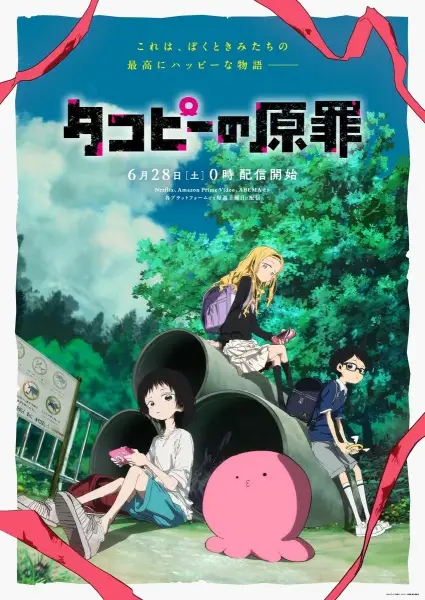
Takopi's Original Sin
タコピーの原罪
Studio: Enishiya
Synopsis
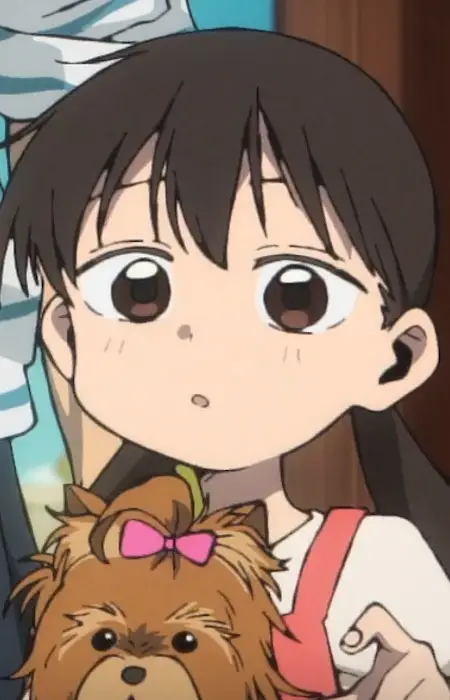
A squid-like creature, known as a Happian, leaves his home planet with the desire to spread happiness across the universe. He lands on Earth, but quickly finds himself in danger of captivity by its inhabitants. Fortunately, he is found by an unsmiling little girl named Shizuka Kuze, who feeds him and names him Takopii. Feeling indebted, Takopii decides to do everything in his power to bring a smile to her face. The task is easier said than done, however. Shizuka is bullied by her classmates, she does not have a father, and her mother is never home—though the gravity of these issues flies over the naive Takopii's head. Even so, Shizuka does have one source of happiness: her dog Chappy. The connection Shizuka and Chappy share only increases Takopii's desire to make the girl smile. While Takopii's attempts to lift Shizuka's spirits lead to unintended consequences, he is determined to take things into his own tentacles, test his understanding of human beings, and achieve his goal of spreading happiness. [Written by MAL Rewrite]
Recommendations


Characters & Voice Actors

Azuma, Naoki
Main
VA: Nagase, Anna

Kirarazaka, Marina
Main
VA: Kohara, Konomi

Kuze, Shizuka
Main
VA: Ueda, Reina

Takopii
Main
VA: Mamiya, Kurumi
Azuma, Junya
Supporting
VA: Oosaka, Ryouta

Azuma's Mother
Supporting
VA: Uchiyama, Yumi

Eri
Supporting

Happy Mama
Supporting
VA: Noto, Mamiko
Marina's Father
Supporting
VA: Kawada, Shinji
Marina's Mother
Supporting
VA: Tsunematsu, Ayumi
Satsuki
Supporting
VA: Ooki, Saeko

Shizuka's Father
Supporting
VA: Kakuda, Yuujirou
Azuma, Naoki
Main
VA: Nagase, Anna
Kirarazaka, Marina
Main
VA: Kohara, Konomi
Kuze, Shizuka
Main
VA: Ueda, Reina
Takopii
Main
VA: Mamiya, Kurumi
Azuma, Junya
Supporting
VA: Oosaka, Ryouta
Azuma's Mother
Supporting
VA: Uchiyama, Yumi
Eri
Supporting
Happy Mama
Supporting
VA: Noto, Mamiko
Marina's Father
Supporting
VA: Kawada, Shinji
Marina's Mother
Supporting
VA: Tsunematsu, Ayumi
Satsuki
Supporting
VA: Ooki, Saeko
Shizuka's Father
Supporting
VA: Kakuda, Yuujirou
Related Anime
Adaptation
Reviews
 IWearClothes★ 9
Takopi’s Original Sin is not the latest misery porn, nor is it an exercise in mere shock value. It is not exploitative of its sensitive subject matter and it does not aim to subvert conventional perspectives of death. It is not abstract or surreal. These are not what encapsulate Takopi’s Original Sin. It is, more or less, the inverse of each. Its gut-wrenching depictions cannot be surreal because they are literal. It cannot be totally abstract because it mirrors its own face value. It is exempt from accusations of exploitation because its dark events are seen from an overlooking view and earned by the narrative.It is too meaningful in how it deals with trauma to warrant reactive, emotionally illiterate labels like “trauma bait”. The many tragedies of Takopi’s Original Sin are witnessed by the most unbiased observer imaginable; a cutesy, alien octoblob, entirely naïve to the ways of human nature. Therein lies the true horror which the series proves beyond any shadow of a doubt: humanity itself, viewed through no lenses whatsoever. On display here is a one-to-one facsimile of a species that wakes up and chooses violence every morning—a ruling handed down by the infinite cosmos above. Takopi’s Original Sin could only be more direct with this theme by having the characters look at the viewer and say it out loud. Extreme conflict is a complex idea when seen through interpersonal relationships—through the people who instigate it among themselves—but it’s oh so simple when viewed from above. That flipped perspective is perhaps the series’ most impressive achievement. Only humans can see “humanity” with unblinded eyes because only humans understand what that entails to the fullest extent. An outside observer instead sees a bigger picture, the ups and especially the downs of humanity, laid bare and stripped of all pretense. The title character Takopi (read: just a little guy) points this out in the anime by completely failing to understand negative human emotions. Jealousy, hatred, contempt, wrath. Each time, Takopi can only process these emotions with one invariable result: confusion. This is a story where literal magic can’t save humanity from itself, a pessimistic and bleak outlook that parallels real-world sentiment. The failures of the adult characters are reflected in the lives of their children, and the anime treats this transmission of trauma as both a spectacle and a thesis. It’s an age-old problem presented with modern bluntness. Magic doesn’t mean shit when the worst problems we can conceive of are orchestrated and perpetuated by ourselves; we’ll keep pressing the suffer button regardless. If Takopi is confused simply by the existence of cruelty, then Shizuka, the main human character, is defined by it. She doesn’t ask why people hurt each other because she already accepts that’s the world she lives in. In contrast to Takopi’s blank-slate perspective, Shizuka is a child who knows far too much, far too early. She is a truly pitiable gamin predominantly concerned with survival—nowhere near privileged enough to actually try to flourish in life. It’s a striking contrast that goes especially well with the fact that Takopi practically becomes her shouldermon, cleverly nailing that Pikachu and Ash Ketchum sort of dynamic. More excellent contrast is that the child characters’ designs are just as adorable as Takopi’s. Armed with only their moe essences and the clothes on their backs, they must struggle hopelessly against inheriting their parents’ very worst tendencies, alone in the dark in a society that only pretends to care. Now, this theme posed by the narrative is certainly not black and white; human nature is not reduced only to its basest evils in this anime. It is bluntly pessimistic while managing to avoid cynicism, as Takopi’s tame innocence (mostly) deflects any would-be mental scarring. He doesn’t have to endure many of the horrors before him because he’s oblivious—impervious, even—to them. He’s a chronically upbeat creature from a place straight up named Planet Happy, unwittingly serving as a tentacled island of optimism in a rough sea of despondency. Takopi is an almost ludicrously simple character, and his simplicity makes it so that the narrative barely needs to try to actualize this design. Takopi doesn’t remain this naïve forever though, as he does have a capacity for learning and begins to experience inner moral conundrums. And so, Takopi is not a symbol solely for optimism or determination. Instead, he acts as an extensive microcosm where all sorts of symbolism can gather and read differently depending on viewer interpretation—taking a page from the Andrei Tarkovsky school of storytelling. Through this lens, Subject A is not always Symbolism B; it can represent a multitude of takeaways depending on the viewer. It’s easy to see, then, that there is more to Takopi than a first glance might suggest. The optimistic threads aren’t limited only to Takopi, anyway. Hope still has a constant spotlight on it. An outstretched hand or a shoulder to cry on can be found if only the characters look for them; there’s always a light in the dark. Even in an anime so dense with philosophical quandaries and deep-seated character studies, the animation often steals the show. Whether that be through cogent first-person snippets, a reorganizing of backgrounds to signal a dream-like passing of time, or even something as simple as a sudden flip of the color design, these ephemeral visual concepts work in tandem to create awe-inspiring set pieces. It’s also a Chekhov’s Gun playground; everything and everyone has a preordained reason for showing up. If it’s shown, it’s used in some way down the road. Frankly, there are so many interesting things going on in some episodes that other details become easy to miss. Characterization might seem to take a backseat to the ingenious animation, not because it’s trying to compensate for anything with fancy visuals, but because the animation can get so involved that it tells an additional story on top of the main narrative. This dual narrative is not always present, and in this intentionality, it is all the more discernable when it does show up—a brilliant, simultaneous interplay of two worlds colliding to create hair-raising sequences. The musical score is merely serviceable, but the sound design is great. Use of the latter is always careful and sparing—for example, an intense buzzing noise to aid in depicting quickly mounting overwhelm, only there for as long as it needs to be. In no uncertain terms, the production goes sicko mode and is easily good enough to rival the eclectic story content. In retrospect, Takopi’s Original Sin is a forceful, visceral, and no-frills examination of humankind. It’s not really concerned with delivering some lofty message or ominous warning. It simply holds up a mirror and asks us to confront what the glass reveals: our own capacity for cruelty, our own complicity in suffering. At only an intimate six episodes, it sets these ideas out on display in true scorched-earth fashion, leaving no room for padding as its opposing worldviews compete to dominate the narrative. Misery for misery’s sake? Spectacle for spectacle’s sake? This anime flies in the face of such shallow takeaways; it actually has something to say. Malevolence. Compassion. Nihilism. Determination. These are what encapsulate Takopi’s Original Sin. Oh, the horror.
 RomanRonin★ 8
Takopi's Original Sin is a uniquely captivating anime, but rather than shower it in praise, I'm going to cut against the grain and explain why I think it's a bit more flawed than others may lead you to believe. However, before I get to my criticisms, let me begin with the positives that even a cynic like me can admit. In terms of production values, the show is a masterpiece. The OST is perfectly fitting, contrasting naive joy against brutal reality in a way that really makes you feel that eerie sense of unease at pivotal moments. The visuals are stunning, with bright and vividcolors being contrasted against the gritty and dirty realities in which these characters live. Enishiya nailed the juxtaposition of idealism and realism key to interpreting this work in animation, perfectly balancing the two in a way that highlights the message of the show without getting in the way, and never falling short. This is further supported by great VA work across the board. Their raw emotion really added to each and every scene. With that out of the way, let's get into my main issue with the anime: the story. Takopi's Original Sin is a tragedy about the lives of children impacted by the careless decisions of their parents. By the time Takopi arrives on Earth, the ramifications of these decisions have already gone too far to be fixed. The anime really wants you to understand this fated doom, hammering the point for a good portion of its runtime. No matter what Takopi does, some character suffers the ultimate price in order for another to benefit. The problem is that rather than really focus on the nuance of doomed circumstances and the role of characters' agency within them, the anime chooses to just hammer in the misery nail. Each and every time the plot works towards a potential resolution by the characters, some other element of misery is hammered in. In a vacuum, this would be fine. Actions have consequences, and it's foolish to think that an action has only positive consequences. However, the story does the exact opposite. No matter what the characters do, there are only negative consequences. There are NEVER positive consequences, at least as a net sum, by any of the changes caused by Takopi's meddling. This is just outright unrealistic, and is an attempt to further drive up the hopeless misery and pull on the user's heart strings. This leads me to another flawed aspect of the story: its insularity. Besides the main cast and their parents, no characters impact the plot, and no characters are impacted by the plot. Shizuka is bullied relentlessly by Marina and no one cares. She has to buy a new stationary board every day and yet the stationary store owner doesn't recognize this. I get there are children who suffer in silence, but the anime magnifies this to such a level that it feels practically impossible for others not to notice. It is a cartoonish level of apathy that breaks the suspension of disbelief. These attempts at magnifying the trauma as much as possible actively get in the way of the plot, too. I've already mentioned that the level of abuse Shizuka (and to a lesser extent, Marina) endure is just not feasibly left unnoticed by others. Azuma as a character introduces some plot inconsistencies. When he's first introduced, he is one of the few that notices Shizuka's abuse, but he never does anything significant about it. This just doesn't make sense with his later established personality as a white knight seeking someone to save. There are also plot holes relating to Takopi's gadgets, some of which could have actually helped try to resolve the conflict but are just thrown aside like gags. A bit of a minor spoiler, but among these gadgets, one enables time travel, and this leads to a whole slew of time-related issues. These issues are not only plot-related, but also impact the flow. How time actually works seems clear at first, but eventually it gets so messy that the rules become unclear. It's not so messy that it's impossible to understand or anything, but it just isn't as clearly presented as it could have been. What I've said so far might seem like incoherent rambling to some, but I'm trying my best to avoid actual spoilers in a show where my issues lie with the plot itself, so forgive me. If I'm being fair, none of these criticisms are outright devastating in themselves, but taken as a whole, a watcher may become annoyed with the frequency at which the show rounds around details in order to make an emotional moment. This, in my opinion, is the main reason why this show is being so consistently heaped with praise by others, and it's the reason why I think we should be a bit more measured in our approach to it. For emotional moments and captivating visuals, this show is fantastic and is worth the watch. But, if you're expecting a philosophically deep show that delves into the balance between agency and circumstances, this isn't it. Takopi's Original Sin is thus the squandering of what could've been an all-time masterpiece by over-insisting upon emotional impact at the cost of narrative tightness.