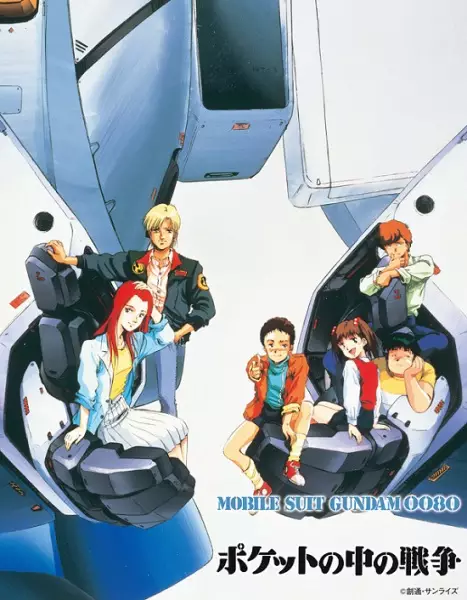
Mobile Suit Gundam 0080: War in the Pocket
機動戦士ガンダム 0080 ポケットの中の戦争
Studio: Sunrise
Synopsis
Alfred Izuruha is a 10-year-old who lives in the neutral colony cluster of Side 6 and, like most boys his age, is obsessed with the war between the Earth Federation and the Principality of Zeon. Unbeknownst to him, Al's next-door neighbor, Christina, is the test pilot of a prototype Gundam being developed in secret by the Earth Federation in the colony. A Zeon Special Forces team is assembled and tasked with infiltrating the colony in order to either steal or destroy it. When a skirmish breaks out between the Federation and infiltrating Zeon forces, the fascinated Alfred stumbles upon a Zaku mobile suit that has been shot down, piloted by Zeon rookie Bernard "Bernie" Wiseman. After this encounter, the two start a mutual friendship, so Alfred can learn more about the war that interests him so much, and Bernie can acquire inside information about the colony to aid his team's mission. [Written by MAL Rewrite]
Recommendations


Characters & Voice Actors

Izuruha, Alfred
Main
VA: Namikawa, Daisuke

Mackenzie, Christina
Main
VA: Hayashibara, Megumi

Wiseman, Bernard
Main
VA: Tsujitani, Kouji

Carioca
Supporting

Charlie
Supporting
VA: Forest, Michael

Chay
Supporting
VA: Chiko

Detective
Supporting

Garcia, Gabriel Ramirez
Supporting
VA: Shimada, Bin

Hardy, Steiner
Supporting
VA: Akimoto, Yousuke

Hayes, Dolores
Supporting
VA: Fahn, Melissa

Izuruha, Michiko
Supporting
VA: Orikasa, Ai

Izuruha, Ems
Supporting
VA: Blum, Steven
Izuruha, Alfred
Main
VA: Namikawa, Daisuke
Mackenzie, Christina
Main
VA: Hayashibara, Megumi
Wiseman, Bernard
Main
VA: Tsujitani, Kouji
Carioca
Supporting
Charlie
Supporting
VA: Forest, Michael
Chay
Supporting
VA: Chiko
Detective
Supporting
Garcia, Gabriel Ramirez
Supporting
VA: Shimada, Bin
Hardy, Steiner
Supporting
VA: Akimoto, Yousuke
Hayes, Dolores
Supporting
VA: Fahn, Melissa
Izuruha, Michiko
Supporting
VA: Orikasa, Ai
Izuruha, Ems
Supporting
VA: Blum, Steven
Related Anime
Reviews
 RedInfinity★ 9
"War does not determine who is right - only who is left" -Bertrand Russell Sometimes, the best war stories are not told from the perspective of the people who fight, but from those who don't. Without offering any sort of resistance in most cases, civilians are defenseless against the cruelties which are present at these times. This way, some horrific stories remain hidden without record and linger profusely in the wounded hearts of many. Gundam is a series that usually relies heavily on action to show off the designs of the mechs, which are the main selling point of the franchise. By this method, alesser emphasis is placed on what is happening in the background of the stories, separate from the pilots who control them. War in the pocket diverts from the norm and instead focuses on Side 6, a neutral colony in space consisting of peaceful civilians. One of these people is Alfred, a 10 year old boy who is still full of dreams and hasn't yet understood the gruesome reality around him. What follows is a coming of age story about overcoming loss and the pointlessness of warfare. Story: 9 Right from the get-go, we can see that schoolchildren are highly uneducated about the war surrounding them; most of which are not even aware that two opposing sides exist. The demeanor of the children is reminiscent of those isolated in an authoritarian state, where people are blind to what is happening across the borders. Mirroring this, the children are in awe of the battles, eagerly waiting for the next one to occur within their site. While this may seem unrealistic- and it is- we have got to remember that these kids have not yet understood death nor destruction. Likewise, a greater importance is placed on arbitrary ordeals, such as ignoring that one irritating girl in class or proving whether a military badge that they found was real. It all agglutinates into mass irrationality. The show likes to play with contrasts. There is a reoccurring scene in the beginning of each odd episode, showing the daily routine of citizens in the morning. If you play close enough attention, there are small changes which show the progression of disaster, foreshadowing the climax of the story. These include different items placed in shopping windows, detailed alterations in nuances proving discomfort and abrupt happenings at the end of the entire sequence. Similarly, irony is used to an almost sarcastic degree. When Alfred returns home at the start of the series, he encounters his mother, who provides him with demands such as to complete his homework. After agreeing with every word of hers, she tells him that "You're just full of the right answers today". He then proceeds to repeat "Yes, mom" to every little action in his room, such as while playing a video game. However, while playing, he goes against what the game tells him to do, still repeating the words. He ends up shooting down his own school, home and town. This is sign of boisterous nature and one that characterises his innocence, unaware that this is exactly what could occur at any time in reality. The train of mendacity is finally altered with the fated encounter of Bernand, a Zeon (enemy) soldier who has crashed into a forest after a battle within the colony. Alfred ran towards the falling Zaku (enemy mech) without being fazed, as he is still unaware that there are two sides in a war. This confrontation is highly symbolic, portrayed by the falling light from Bernand onto Alfred, hinting on potential salvation in the future. It is by this concurrence that a mutual understanding is shared between these people, where a gap in age and social standing allows for a contrast in power to be present. Bernand takes advantage of his situation and thereby uses cunning techniques to obtain intel from Alfred, in any way that he can. Given by Alfred's clueless nature, he agrees to help Bernand collect information almost as a game. Here on, a friendship is built upon misunderstandings and lies. The way the story is structured is genius, where a realistic situation allows for the maturity of an unassuming child. The title alone is enough to induce brainstorming. A picture is shown at the midsection of each episode, where the title-drop is present. Here, Alfred's pocket is exposed, stuffed with several toys. The thing is, these toys mimic weapons of war. Hinting on the reoccurring themes of contrast and irony, a missile, gun and knife are all miraculously fit into a tight pocket, reflecting on the tight budget of nations during times of war. All these items are essentials for fighting in modern times and are drawn in a pastel-like style, once again illustrating immaturity. Alfred is drawn with a wide smile indicating youthfulness. I don't think that they could have used more suitable imagery that the ones presented here. Yet another example of excellent planning, is the pacing. This is carefully adjusted to display an adolescent view of the world. What is shown on the screen is always extreme: whether that is tragedy or staleness, the feelings are always palpable. There are clear cuts in the show, which are never jarring and serve to depict the ambiguous state of the setting. Moreover, the setting of the colony itself is allegorical. A capsule surrounded by nothingness: space. The warfare which develops directly outside of the colony produce flashes of light, imitating those emitted by stars, a symbol of false hope. Politics are mostly set aside, which simulate the thinking of children. People do not fall into hysteria after being shot, but instead silently subdue into a state of panic and fall unconscious rather quickly. This is what would happen in a real world scenario, one that is often overlooked from fiction. However, there are a few times where realism is lessened to make way for bombastic moments. An example of this is when Alfred sees the damages of a battle in his home town. He quickly ignores these (which are of immense scale) and moves on. A child should be more affected by this, which is hardly a complaint judging by the irrationality of the story itself. Characters: 8.5 Be that as it may, but War in the Pocket is an almost purely character driven tale. Thankfully, all of the primary characters are suitably complex and intricate. The chemistry between Alfred and Bernand is organic, multi-layered and intriguing. Almost like a father-and-son, their conversations are backed by their divergence in age, coupled with simple language and natural gestures. Both characters are pragmatic and mordant especially when exchanging words alone. Alfred is an astute and well-mannered boy, who uses his intelligence to persuade people with ease. His disposition is matched by his age and so are his actions. He regrets nothing and always moves forward. Unlike a lot of characters his age, he is not unnecessarily immature and he can think for himself. I found myself in awe of how well written his characterisation actually is. His development as a person is key to the kind of tale this is (coming of age). He doesn't become a man after a single tragedy nor does he have a sudden revelation; but the amount of progress and evolution that his character undergoes is akin to that of a series tenfold its length. I can say with safety that he is my favourite youngster in anime. Once the series is over, his past self is but a shadow of his present. Bernand is a character ridden with many compound emotions. He holds few grudges and shows little animosity, which is a rare trait, especially for a soldier in enemy grounds. Always trying to be the voice of reason, he acts as a source of admiration for Alfred. We know little about him or his past, but what is apparent is his lack of confidence. Never standing out among his peers, he tends to exaggerate or distort his achievements; one such being the number of kills that he has committed. Stating to Alfred that he is one kill away from being awarded an 'ace' title (five kills), he later reveals that he has not yet committed a single execution. This proves that Bernand is not infallible and more - so portends an event which will later test this virtue. The two improve themselves by learning from each other, while working towards a single goal, each for their own reasons. These reasons later intersect and demonstrate that their initial objectives were shallow and selfish. From this, their growth as characters and (more importantly) as people flourish. Finally, Chris (shortened from Christina) serves as a distinction in position and as an agreement in charisma. She is like an intermediate between Alfred and Bernand, yet is the catalyst for their problems. She shows sides of vulnerability as well as courage, while being especially honest. She never makes assumptions of people, nor questions their actions and so she tries to focus on facts to provide advice. War in the pocket makes excellent use of her character, where her wisdom is given an almost satirical filter as she is oblivious of her own actions. Unfortunately, a lot of the side characters are ignored or put aside which is quite apparent. I would have liked to have seen more of the family and schoolchildren, as well as other Zeon soldiers which are mentioned throughout the run-time. Once again, this is a relatively minor distaste, as the focus of the main characters is apparent and is given priority. Besides - they do more of a good enough job to carry the show by themselves. Art and Animation: 7.5 War in the Pocket is aesthetically pleasing. While a lot of shows airing at the time had numerous animation errors or inconsistencies, these are far and few between here. There are only a few moments of repeated animation and even these are not noticeable. When a battle does occur, it always looks above par. Even the shot of the colony from space featuring CGI is not jarring in any way (and this is from 1989!). Scenes flow nicely due partly from correct framework as well as sufficient number of frames. All of the characters' designs look great, thanks to the efforts of Haruhiko Mikimoto who famously undertook the designs of Macross. The facial expressions are articulate and vivid, while they never look off-model. What is particularly characteristic of their designs are their eyebrows, which become absent soon after moving up their faces. This gives greater emphasis to the key features of the face which exemplify emotions better. There are few times however where any cinematography is used. This leaves for a slightly bland experience in terms of artistic abruptness and the show looks slightly uninspired. I also can't help but compare it to other OVA's of its time and being that this was to commemorate Gundam's tenth anniversary, I expected something more exceptional. Sound: 8.5 Listening to the numerous soundtracks that War in the Pocket offers, I couldn't help but think of marching children. Very few OSTs have ever made me visualise and personify music into something so fitting. Never feeling repetitive nor outstaying its welcome, the composition and its placement always feels just right. The instruments used are not repeated; instead a significant array of organs are used for many different purposes. The songs also never overpower the scenes which they are used in. Rather, they empower them. I admired the opening and ending songs. I don't usually pay much attention to these as they are mostly used for advertising a certain company or group, but War in the Pocket is not your average show. The opening features a panning shot of a wall and the graffiti covering it. At first, there are detailed drawings showing obscure imagery of war, displaying many colours. In an instant, this changes to monochrome illustrations from who presumably is a child. Chalk is used to hint at this and what would normally be a harmless act is juxtaposed by what it means. The music used is nostalgic while ironic, stating things like "I want to slip away from this artificial world and make myself free" and "I can keep on running until I finally reach the sky". Being that the sky is artificial and that it houses numerous deadly battles, this shows the hopeless wishes of the young artists themselves. The ending song is very similar in lyrical and artistic composition. If close enough attention is payed, an abundant of different outcomes can be made from its meanings. However, the beat shifts from every sentence spoken, in perfect harmony. From this, a different image is shown, which relates perfectly to what is spoken. The colour layout is fascinating for very specific reasons, but one must watch the entire show to find out what that means. My only gripe is with the voice-acting quality. While there is plenty emotion here, it is outdated to a degree. That means a dip in quality from what we would get from modern shows. Even with this, the actors did a fantastic job in displaying all the right nuances at the right times and this includes Alfred. Voice-acting for children were notorious in these times but it does not show here. Enjoyment: 9 War in the Pocket is an experience like no other. It never forces emotions out of the viewer, but instead embellishes them. I cried multiple times throughout the story, but not from melodrama. The show produces catharsis without unnecessary tension, which is a very difficult thing to achieve. From start to finish, from comedy to tragedy I was never left behind. War in the Pocket makes use of your most simple, primordial feelings - and like this - nurtures you with care. I will never forget what I witnessed from this. Conclusion: 9/10
 Chag★ 9
As a small member of the huge gundam metaseries, Mobile Suit Gundam 0080: War in the Pocket is often overlooked. This is a real shame, as 0080 is one of the most touching war stories to be found in the anime medium. The story of 0080 is distinct from other gundam series in that it features a civilian child's point of view on war. It is the story of Alfred Izuruha's journey of disillusionment as he grows out of his starry-eyed romance for war and the military, ultimately realizing the devastation and meaninglessness of it all. Though the risk of spoilers prevent me from elaborating further,it must be noted that the story goes beyond merely reminding the viewer of the obvious, such as "lives are lost during times of war". Al's personal growth is a heart-wrenching and emotional ride as he learns firsthand about the true faces of war from Bernie and the few days the two share together within the time frame of the series. Though virtually every gundam series share the anti-war theme, 0080 is the most effective amongst all of them in relaying the simple message: war is bad. As unimpressive as that sounds, 0080's achieves this without being preachy or cheesy (two very common pitfalls in war anime), while evoking strong emotions from the viewer. The limited cast of 0080 is fairly ordinary, but very befitting of the story's needs. As hinted above, Al is a great character simply because of his unique and integral role in the story, though he may come off as too bratty and annoying for his own good in the beginning. Like most other gundam series, the two sides of the conflict are not portrayed as black and white. Zeeks such and Bernie and Feddies such as Christina are just ordinary people following orders from the institution of war -- the only true "bad guy". This allows the moral and lessons of the story to bear more weight than a typical "good guys vs. bad guys" scenario. Since 0080 aired in 1989, the aesthetics of the OVA does seem aged. However, the animation, especially during the action scenes, are still sights to behold to this very day. Though 0080 is skimpy on mecha action, the few scenes that does appear throughout the series are very well done, some of which even rank among the most memorable mobile suit battles to be animated. All in all, Mobile Suit Gundam 0080: War in the Pocket is recommended to anyone interested in a great story about the tragedy of war, especially fans of the gundam franchise. With a moving story, excellent hand-drawn art, and great characters, it is hard to go wrong with this small but radiant gem in the prolific gundam universe.