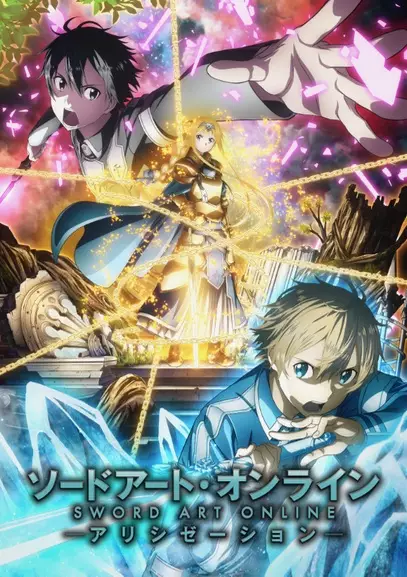
Sword Art Online: Alicization
ソードアート・オンライン アリシゼーション
Studio: A-1 Pictures
Synopsis
The Soul Translator is a state-of-the-art full-dive interface which interacts with the user's Fluctlight—the technological equivalent of a human soul—and fundamentally differs from the orthodox method of sending signals to the brain. The private institute Rath aims to perfect their creation by enlisting the aid of Sword Art Online survivor Kazuto Kirigaya. He works there as a part-time employee to test the system's capabilities in the Underworld: the fantastical realm generated by the Soul Translator. As per the confidentiality contract, any memories created by the machine in the virtual world are wiped upon returning to the real world. Kazuto can only vaguely recall a single name, Alice, which provokes a sense of unease when mentioned in reality. When Kazuto escorts Asuna Yuuki home one evening, they chance upon a familiar foe. Kazuto is mortally wounded in the ensuing fight and loses consciousness. When he comes to, he discovers that he has made a full-dive into the Underworld with seemingly no way to escape. He sets off on a quest, seeking a way back to the physical world once again. [Written by MAL Rewrite]
Recommendations


Characters & Voice Actors

Eugeo
Main
VA: Shimazaki, Nobunaga

Kirigaya, Kazuto
Main
VA: Matsuoka, Yoshitsugu

Zuberg, Alice
Main
VA: Kayano, Ai

Airy
Supporting
VA: Martin, Corinne

Aki, Natsuki
Supporting
VA: Taylor, Julie Ann

Antinous, Raios
Supporting
VA: Iwase, Shuuhei

Arabel, Ronie
Supporting
VA: Kondou, Reina

Asada, Shino
Supporting
VA: Sawashiro, Miyuki

Ayano, Keiko
Supporting
VA: Hidaka, Rina

Azariya
Supporting
VA: Bienaimé, Nathalie

Azurika
Supporting
VA: Jeru, Gabrielle

Balto, Golgorosso
Supporting
VA: Covarrubias, Víctor
Eugeo
Main
VA: Shimazaki, Nobunaga
Kirigaya, Kazuto
Main
VA: Matsuoka, Yoshitsugu
Zuberg, Alice
Main
VA: Kayano, Ai
Airy
Supporting
VA: Martin, Corinne
Aki, Natsuki
Supporting
VA: Taylor, Julie Ann
Antinous, Raios
Supporting
VA: Iwase, Shuuhei
Arabel, Ronie
Supporting
VA: Kondou, Reina
Asada, Shino
Supporting
VA: Sawashiro, Miyuki
Ayano, Keiko
Supporting
VA: Hidaka, Rina
Azariya
Supporting
VA: Bienaimé, Nathalie
Azurika
Supporting
VA: Jeru, Gabrielle
Balto, Golgorosso
Supporting
VA: Covarrubias, Víctor
Related Anime
Summary
Reviews
I tried to like this. I really, really did. I was even sticking out for it upon its announcement because for all of the problems earlier iterations of SAO had, there was always a sense that, if the finer details were checked over and looked at in complete retrospect of what came before, it could be deservedly fun, inspiring or genuinely meaningful. A series deserving of the immeasurable hype phenomenon it generated. Escapism, blurring between actions of reality and fiction was always a thematic that separated the series from the many isekais this decade that followed in its footsteps, and something that held my interestin how it would be handled, but aside from arguably the Mother’s Rosario arc, this wasn’t given enough space in the narrative between all the superfluous anime tropes that seem to be there to draw the most general audience possible. Look no further than the original Aincrad arc, praised most by anime-only fans for its concepts, but forcibly rushed to completion when its author chose to submit a word limited contest draft as the first novel, compared to refining the fully story he wanted to make. Sword Art Online’s biggest problem is itself. Its writer, Reki Kawahara, keeps getting in his own way, and when he doesn’t, the anime eschews his vision. What he wants to get across is almost always clear, and there are effortful attempts to act on those ideas, but with the anime’s focus on moving the plot forward rather than making details feel elaborately set, it ends up bringing down the entire experience to make watching the series weekly for the most part, feel like a slog of boring exposition attempting to cover up poor pacing of external events. If something from earlier is justified, it can feel annoyingly retroactive. Kirito himself is less a factor than in previous arcs, he is still partially to blame in the indistinct coverage of how this season adds to the themes of the franchise. General spoilers for the season below: The main premise of this arc is that Kirito, while on a date with his girlfriend Asuna, is caught off guard and stabbed to near death by one of the three Death Guns from the previous season. While in a coma, he ends up in the digital world of Rath, a system used for a military experimentation project where he must do..............................nothing in particular at no real urgency. There is a plot, and there is a goal, but for once they feel entirely separate from the tension. But I’ll get to that later. SAO, being as popular as it is, has mostly being met with snark and derision from people calling it the “worst ever” or otherwise exaggerating the flaws of it, so I think it’s fair to start off with the positives of this season, because contrary to what haters will tell you, they do exist. 1. Production value and music. These have been consistent strengths of the SAO series throughout the years and generally, they still hold up here. The character models take on the new polished style from the Ordinal Scale Movie, and while not having as much animation (I’ll get to that), the look is maintained very well across all 24 episodes of the show. If you compare to the original two seasons, there is a definite improvement, and while the architecture present isn’t particularly unique or standout, it is well presented. Likewise, Yuki Kajura’s music, while not her best soundtrack, still does what it can to set the mood for the quieter scenes and the action scenes, with a great new remix of Swordland to go along with it. Special mention to some of the opening moments of Episode 2, and the fight in Episode 16. Of the music outside of the show, the first OP and the second ED are the best ones and do have a good amount of catchiness and energy to them. 2. Alice Schuberg, the arc’s new female lead. While it takes 16 episodes in to actually really explore her as a character, and she looks a lot like Saber from the Fate series, the time we do have from then on with her sets her as probably the most consistent female lead in SAO so far. As of yet, she’s hasn’t been subjected to an endless supply of ass shots, her growth hasn’t been stunted by time skips, nor is her growth entirely for Kirito’s sake. Her arc of rejecting the corrupt system she’s been brainwashed under, wanting to reconnect with her old life and opening up on her feelings is adequately handled and leads to some of the stronger character moments this season. She also has one of the coolest weapons in terms of both design and animation; a space bending sword acting as moving protection with golden butterflies as weapons. It’s been put to effective use in the fights so far and has potential to be used further as the story moves along. 3. Measuring Kirito’s power. Compared to say, the Phantom Bullet arc, some of the worst aspects of his character are toned down. He doesn’t start the series overpowered from the get-go, has actual struggles in several fights and even takes a few Ls in a couple of them. It gives a couple of the fights in the season more tension than previous ones. The existence of Eugeo also helps for his sake since the show is better able to balance the battles between the two of them rather than giving Kirito the entire spotlight. It doesn’t mean there isn’t still an annoying amount of contrived solutions to conflicts, but that’s more on the writing than him specifically. 4. Actually building the villain. The arc’s villain, a Knight Templar dictator calling herself Quinella, has an established backstory and a defined reason for ruling the way she does. We know why she is the villain, we see the clear consequences of her actions on the world and she isn’t as laughable to be taken seriously compared to say, Sugou from ALFheim. She’s a product of an as of now unknown evil seed, but nonetheless she’s established properly. However, showing her attractive naked body on screen doesn’t work at all to be alienating for a series that in the past used naked bodies during bath scenes as fanservice. There are some fun intensity moments with her in the climax, even if the battle is a mere two minutes long. Unfortunately, that’s the positives out of the way. Now for everything else that really breaks this arc and saddens me given the inherent potential of a SAO story. The biggest problem that persists throughout the entire show is the immeasurable focus on exposition over every other element. Characters will abandon the idea of development, fighting, talking, world building, or anything else for the opportunity to talk in technical terms about topics that, while somewhat relevant, are not as important as what else could be focused on. Eugeo, the new male lead, has got family issues? No, that's not important. We need to talk about the villain’s plan and “Fluctlights” (the series’ pretentious name for digital souls in an indistinct coverage of AI vs humans) again. Knowing how that works is way more important that a main character's backstory. The exposition often brings the narrative to a screeching halt, especially in scenes where the heroes stop fighting the villain and exposition for a few minutes while the villain just stands around waiting for them. Exposition is something inherent in building a setting and establishing the plot. I understand the use for it. There are several shows that have still been entertaining despite or because of their exposition. But SAO Alicization’s exposition is not only incredibly frequent but boring and lacking in character. It’s frequent enough to where Episode 1 spends 10 minutes just expositioning off vague terms about the setting, while half of Episode 12 and nearly all of Episode 13 are nothing but this flat delivery of the plot. Other episodes tend to tag nearly every fight with exposition that’s 8 times longer than the fight itself. While the old director was no exemplar by any means, he at least knew how to make fights seem varied and exciting visually with a lot of movement. Here, Yuki Kajiura puts in the effort, but this new director who directed some of the worst LN adaptations in recent memory like Mahouka and The Asterisk War, just cannot pull it off. So, when the OP makes you think you’ll be getting this epic fight, it’s usually just maybe two attacks apiece preceded and followed by 5-10 minutes of exposition. The framing device of the season also presents several issues this time around. The idea that Kirito’s exploration in this new world is happening while his real-world body is comatose could generate tension, but this alongside Kirito’s connection to the real world is poorly substantiated. In learning about this framing device, we, as the audience, know it is just a waiting game for Kirito to heal up and be back to normal. Until the very last episode, his actions in Rath have absolutely no consequences in the real world. None of that “die in the game die in real life” stuff here. He gets really hurt from time to time but we have no idea how his real body is taking it. There’s a two-year timeskip at one point, but unlike in Season 1 where it really was two years, we have no idea how much the time exchange is between the system and the real world which I think hurts the connection to the story. This framing device also separates Kirito from his past connections in this story. I don’t mind the reduced role of his entourage for the moment (even if Asuna, who SHOULD be important, has nothing to do right now), but he barely brings them up over what’s been at least two years. There was one moment Kirito thought of his real-world connections, but that was for a poorly animated fight that ended in a draw and had absolutely no effect going forward. Kirito cries more over the fact that flowers he planted were destroyed (that were contrivedly brought back anyways) than even the chance that he might NEVER see Asuna again being stuck for so long. I want to care, but the show refuses to let me with a framing device that undermines the events and severs past connections. Other old habits die hard, whether because of Kawhara’s own writing or the adaptation. Not only do we get another ridiculous rapey scene, but there’s a two-year timeskip rather than say, actually seeing Kirito and Eugeo train up to be better swordsman. They set off for the Capital and the next we see them, BOOM, two years pass, and they’ve already had a lot of training done. They could’ve at least done an FMA03 type thing by building character relationships prior to a timeskip but nope, nearly all relationships at the sword academy are shown after and as of now, doesn’t matter to anything since we know so little about them. If this was better in the light novel, good for Kawahara, but perhaps it should’ve been a cause for concern seeing how much got cut for the anime onlys. In this adaptation, the only purpose of the sword academy stuff, aside from telling us Kirito and Eugeo became better swordsmen offscreen, was to build two bullies as irredeemable rapey monsters, and paint two cute girls as victims of this. We don’t know much about them either, aside from one of them having a romance arc with Eugeo that goes absolutely nowhere. There’s also a lot of contrivances to make progress, like with Kirito seeing the “ghost” of Alice in Episode 4 lead him the right way, how Cardinal is introduced into the story specifically to ex Machina Kirito and Eugeo out of a scene, and how Kirito uses a completely unknown attack to one shot a late-game villain that returns him to his Black Swordsman coat for a bit. This attack is never referred to by name and never mentioned again. And it’s not like this progress has done well for the characters, as Alice aside, they range from passable to horribly flat. Kirito isn’t as overpowered as before, but aside from problems the framing device puts on him, he still has annoying moments, like one case where he retroactively Sherlocked his way to avoid being poisoned, or where he used a device he only had two of on a character he barely knew, rather than to potentially stop the villain and save Alice. The show puts him in the right for this by the way, and there’s not much of an arc for him this season either. Cardinal is actually pretty decent, even if the show’s use of her as an ex Machina isn’t for the best. The sword academy characters are barely developed at all, and among the antagonists, only Bercouli and Deusolbert are passable; the rest are just obnoxious. Fanatio’s only character trait is being ashamed of being a woman, which falls deaf when both the main villain and Alice, whom she knows personally, are also women, as well as there being no indication of gender division in the world. And Chudelkin’s only purpose is to ruin the tone and make rapey faces whenever possible until kill stealing at the end. Which leads us to the biggest wasted potential so far, Eugeo. There was a lot of potential for his character at the start. Being a guy partner to help balance Kirito out of the spotlight, there was a lot Kawahara could do with what he distinctly did not know about Kirito, his personal relationships with him and Alice as kids, his fighting ability, the idea that he has more innate fighting potential than Kirito, his unawareness of being an AI program and his romantic relationship to Tiese. Unfortunately, not one of these elements get to shine in this adaptation to let us in on his blank sheet personality. Perhaps improved in the light novel, but the anime should have better stood on its own. Him having more innate potential than Kirito is completely ignored later on, his sword training is told not shown, and anything the show tries to pull regarding his relationships with Kirito/Alice as kids, his family, or Tiese fall completely deaf because they received little to no focus. He didn’t even TALK to Alice in the present day, once. The show would rather go into long tirades of exposition than show a main character’s backstory! Near everything about him was entirely cut short by the show despite having more than enough time to act on all of it. They try their best to make up for it at the end, but it’s a bit too little too late. It’s hard to say whether I’m more annoyed or disappointed with how Alicization has been executed so far. Sure, some of the problems in the world, characters and framing device can be fixed going forward, but first impressions are everything and this series did not make a good one. The focus on constant exposition over all else, the disconnected framing device, and lackluster character writing drag it down more than needed, but it could’ve been avoided if Kawahara just knew what to focus on or the anime didn’t skim over the better parts, since his ideas are abundantly clear. The SAO franchise can theoretically explore a lot, but it almost deliberately gets written into corners. That’s something I’ve always given SAO over the many works that have almost no effort at all to act on their ideas, and though there’s that chance for the future with new elements coming in to make the second half an improved experience, this season’s quality suggests it won’t be without a wide range of caveats.
In a world where popular light novels gets anime, manga, games, and hell, even live action movies, there’s one title I’m sure no anime fan can ignore. Sword Art Online. Becoming ever more popular and entering a mainstream line of anime adaptations, the franchise has also no doubt sparked decent deal of controversy. But hey, controversy sometimes makes cash right? It’s not rocket science to realize SAO would eventually get a continuation. It was just a matter of when and after 5 years since the second season, the time is now. Sword Art Online Alicization covers the light novels with an extended amount of material,much more than the previous season. It’s so much that in fact, a full 2-cour season of 24 episodes isn’t enough. Luckily, it has been confirmed the series would run more than that and given an additional season for its adaptation. However, the big question people should ask themselves if this is another SAO show to jump into or a cash grab at making more money. Starting with the prologue, we get a double length episode to give a general background of the new season. Make no mistake though as Alicization is not going to spoonfeed viewers with recapping. The show assumes you are familiar with the first two shows so anyone hoping to watch this needs to have completed the first two seasons. Light novel adaptations tends to suffer a lot from adaptation standards but thankfully, Alicization manages to deliver a faithful start with its character cast and storytelling. Besides Kirito, we are introduced to Eugeo, a new character who serves as his partner and best friend in this arc. Similar to Kirito, he has a kind heart although lacks experience in the beginning compared to him. He also appears somewhat cowardly in the beginning as he is unable to prevent certain events from happening, in particular for failing to help his childhood friend Alice. It’s not until he meets Kirito that he develops a resolve and finds the courage to become a stronger person. That is to say, Alicization features a lot of character bonding especially in the first half of the show. Eugeo begins to grow out of his shell after training and becoming strong enough to fight as a warrior. It really shouldn’t take long to realize that he has great potential, perhaps even someday of surpassing Kirito himself. As for Kirito, his personality remain largely the same in this season. That is, he is a selfless person who isn’t afraid to help others in need. Kirito and Eugeo develops great respect for each other and the latter even finds his resolve. The two sometimes almost feel like brothers. Outside of the duo, you may have noticed another prominent character being featured in the trailers or key visuals. Alice would be her name and she is Eugeo’s childhood friend. The show makes it clear that she is an important character from her introduction to later on in the story. Alicization also devotes time to developing her character after meeting Kirito. Despite having a rocky start, she develops respect and a growing trust for him. Now, people may have a curiousity if Alice become another ‘harem girl’ similar to some of the previous seasons. SAO is not a harem although it gives off a stench at times. Thankfully, there’s no need to worry. The closest that Alice seems to be with Kirito is when they are at the tower during one of the episodes and nothing more comes out of it. On the other hand, Kirito’s friends from the real world are still concerned about his well-being. In particular, Asuna searches for him through unorthodox methods while discovering some revelations about the technology in the real world. Remember, the world of SAO contains complex technology that defies the law of nature. I’m not even referring the VR system or robotics but rather the capability of influencing people’s lives. This extends to the virtual world where the Administrator managed to use system commands to reverse her own age. Sounds unbelievable, right? As with previous seasons, Alicization can’t be complete without antagonists and conflicts. One of the major antagonist in the new season is the Administrator, Quinella and her Integrity Knights. She’s an important character as not only is she a threat to the main protagonists but also a catalyst for some of the key events in this season. This includes character manipulation that extends to our new characters such as Eugeo and Alice. I’m not going to lie though, one of the events in this show is rather disturbing to watch considering the way she manipulates others. (I’m looking at you, Eugeo) On even more disturbing matters, we even have characters that commits unforgiveable sins that pushes Eugeo to the edge. It’s the type of event that brings controversy out of its fullest. I’m not going to spoil it but when you get to that particular episode, you’ll feel disgusted too. It’s so disturbing that it even changes Eugeo’s views on the laws of their world and causes him to rebel. Quinella herself also demonstrates a God-like complex with her own dark motives. If I said it once, I’ve said it a hundred times. She is detestable. I doubt anyone with a sane mind would find her character likable. I can’t be the only one to notice that the animation quality improved more than the previous seasons, right? The Ufotable-like animation is used in parallel with the Sword Art Online movie, Ordinal Scale. Not only did the animation style improve, it also managed to craft an imaginative virtual world to it its fullest. The character designs are also featured in great details compared to previous seasons. In particular, Alice is important to note for her chivalrous look and golden armor. Character expressions are meaningful with an emphasis put on human emotions. Eugeo is a prominent example especially as his personality shifts from a weak survivor to a noble swordsman. While I’m not impressed by how antagonist are portrayed this season, they were able to deliver their dialogues straight with a degree of villainous expressions. Quinella is the biggest culprit with her manipulative personality. Her malevolence simply cannot be overlooked. The SAO franchise is one of the longer light novel running adaptations that continues to build more into its universe. Truthfully and despite some of the controversy from the past seasons, this one managed to finally jump out of its rabbit hole and deliver what I wanted to see. With another season on the way, I cross my fingers that it will ride on this momentum.