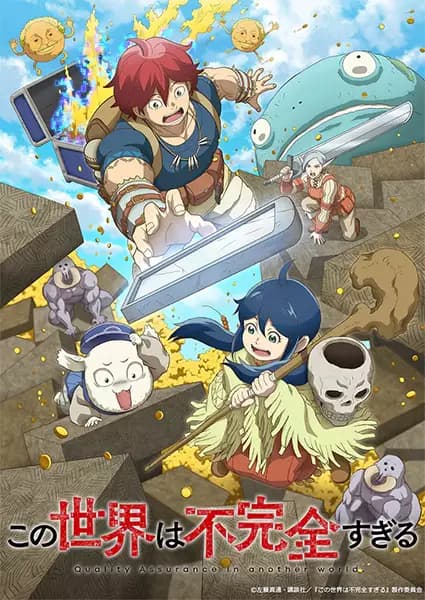
Quality Assurance in Another World
この世界は不完全すぎる
Studio: Studio Palette, 100studio
Synopsis
Nikola is just a village girl working at the inn...until the day dragons invade, and she meets Haga, a scholar of everything around him. He's a part of an elite society called "Seeker," created to address a series of maladies plaguing their usually peaceful world. But both Nikola and Haga have secrets they hide...ones that will change each other's very existence... (Source: Kodansha USA)
Recommendations


Characters & Voice Actors

Akira
Main
VA: Takahashi, Rie

Amano
Main
VA: Kawashima, Reiji

Haga
Main
VA: Ishikawa, Kaito

Nikola
Main
VA: Yano, Hinaki

Akane
Supporting
VA: Arai, Satomi

Alba
Supporting
VA: Matsuoka, Yoshitsugu

Duca
Supporting
VA: Miyuki, Sanae

Elder
Supporting
VA: Naka, Hiroshi

Godel
Supporting
VA: Kobayashi, Yuu

Guard Captain
Supporting
VA: Tone, Kentarou

Head Guard
Supporting
VA: Zylberberg, Jérémy

Imai
Supporting
VA: Ura, Kazuki
Akira
Main
VA: Takahashi, Rie
Amano
Main
VA: Kawashima, Reiji
Haga
Main
VA: Ishikawa, Kaito
Nikola
Main
VA: Yano, Hinaki
Akane
Supporting
VA: Arai, Satomi
Alba
Supporting
VA: Matsuoka, Yoshitsugu
Duca
Supporting
VA: Miyuki, Sanae
Elder
Supporting
VA: Naka, Hiroshi
Godel
Supporting
VA: Kobayashi, Yuu
Guard Captain
Supporting
VA: Tone, Kentarou
Head Guard
Supporting
VA: Zylberberg, Jérémy
Imai
Supporting
VA: Ura, Kazuki
Related Anime
Adaptation
Reviews
I simply can't recommend this anime because it has no end and no development of its main plot at all! In the first episode, it's explained that the debuggers are trapped inside the game. By the last episode, they are still trapped and they haven't stumbled upon ANY information about this problem. The whole anime is about the MC meeting other debuggers, and their interactions are all messed up because it seems that every human being trapped inside the game has a wicked personality. They just brushed aside the fact that they are trapped and the plot turns into "let's hunt other debuggers and destroy their debuggerstone so they stop messing up with the game". The only good point about this anime is how they explore the game mechanics and bugs in order to win their battles against the evil debuggers. BUT often times we feel disappointed because the bugs can be very broken, and when we are in the middle of a great fight and the MC uses some dumb bug to end the fight, it's simply anti-climatic. We are left thinking "what, just like that? that was it?". When (and IF) this anime has a second season, I will make sure to watch and delete/update this review. But for now, I really can't recommend an anime that has only a start, but no middle (no real development) and no end (literally, it doesn't end, last episode feels like we are barely into the first half of the anime).
Quality Assurance in Another World - Just Isekai and fantasy things, but gone technological to deter bugs, lags and such before its eventual release to the masses. What could possibly go wrong? In the world of video games, computer programs, and the like, I think that the underrated group of unsung heroes who have to always be commended for, are the software engineers. They ensure all the programs we use in our daily lives are free of problems, and that's no easy task given the insanity and complexity of the IT industry to thwart even the smallest of errors that will break the functionality of thefeatures we use on the internet, for better or for worse. And from the mind of someone who prefers supporting roles more than main ones, bringing about the fascination of seeing NPCs move on their own will to want to depict inconspicuous people doing stuff that's meant for players, this is mangaka Masamichi Sato's way of depicting it in Kono Sekai wa Fukanzen Sugiru a.k.a Quality Assurance in Another World, a Sword Art Online derivative that shows a different code of arms than what you might expect. Ask anyone on the IT side of relevant industries, especially who specializes in software engineering and mainly debugging in general, that it’s a never-ending tedious task to identify areas where bugs and glitches happen in real time enough to be alert 24/7 to issue constant reports and update developers on the never-ending growth of tasks to fix and repair so that the public won’t notice them, nor be affected by the annoying things that affect how the program should operate. This is more so the case for video games, be it console games, or in this case, using VR (virtual reality) to deliver neurotic games. And in this show, the series’ titular MC Makoto Haga is at the helm of doing his job as a debugger for a VRMMO game that is still in quality assurance development mode, until a moment arises that one tries to log out of the game, but they could not do so (a la SAO style) until all the game’s bugs are reported to ensure a safe exit. Down but not out, Haga gets to work with his debugger stone, a tablet that all character debuggers acquire to send their reports to the developers to get the many, countless issues fixed as soon as possible. The one anomaly, together with Haga, is a young girl named Nikola. Her living in a rural village just outside the borders of the Bayle Kingdom as a designated village girl NPC, she only does the simplest of chores that she’s programmed to do, until a weird-looking dragon comes to thwart the village, rendering Haga’s help as part of the enigmatic investigative squad, the King’s Seekers, to save her out of trouble. But being an NPC, Nikola is only programmed to live and die under the events of the game’s quests itself, so when she lives, breathes, and dies under her village’s event, somehow by hook or by crook, she lived to see the future thereafter of the decimation of her small village by the giant butt-crack-faced dragons, thanks to Haga who put in the effort to save her, even if he knew that she was programmed to invoke death. Forming an unlikely duo after Nikola survived her programmed onslaught, both she and Haga venture onto the game’s vast playing areas, going wherever it takes them: reporting bugs, finding fellow in-game debuggers from other companies, as well as the other elements that make fantasy the genre it is. As an unusual piece of literature, there’s some originality to be had here in QA Isekai Land. To pen a story about Isekai debuggers, I have to say that Masamichi Sato is a pioneer in this regard, having an Isekai fantasy be centred not so much on the tried-and-true trope of heroes vs. villains (though the show has elements of this for conflicts between fellow debuggers), but of actual professional work that goes into his one-of-a-kind series that hasn’t been explored much in AniManga. Sure, there’s actual video game-inspired series like Shangri-La Frontier that focuses on games that teach about the knows and the don’ts of video game design and balance, but none so much like what this show is doing, focusing on the backend instead with game development. When you add the context of the mangaka’s first serialized work being a short 4-volume series of 2016-2017’s Iron Buddy, which depicts a robot engineer working on his own robot, that even once had a collab with Astro Boy, Masamichi Sato certainly had a hand on being obsessed about the weird, but innovative stuff that no one ever takes a chance with to create something so original, that its Achilles’ Heel is how far this story could go in the long run. And this story…it’s the weakest aspect of the anime, if I’m being blunt and low-key honest. Sure, Haga’s serious commitment to debugging the game that he’s stuck in at least does feel fresh when in comparison to the character archetypes found in the anime, much less Nikola’s occasional “awakening” moments to deal with evildoers who see the in-game world as a place to do whatever the hell they want to. And what is the tactic, you might say? Nikola’s not just a regular village girl NPC, she’s one of the game’s neurotical consciousness, or the term commonly known as AI, whereby she’s known as Tesla (all you science geeks will know this famed inventor-cum-engineer Nikola Tesla), who is like the in-game mods to micromanage all players and NPCs to decide if they commit evil that’s calls for a ban. As Nikola, she can’t really do much, but as Tesla, the neurotical consciousness only feeds on the players’ debugging stones, which act as their lifeline in the game, and only does so when it detects players acting outside of the game’s justice parameters enough to kill them off in-game, banished to the depths of an endless black hole of blank code. The story can work around both Haga and Nikola alone, but with the focus on other players too (the more prominent ones in the anime being one gang of debugger murderers, as well as a furry debugger and an elf debugger), it just keeps dragging on and on to the point of staleness. The pacing is rather wonky, as well as its tone needing a lot of work with Masamichi Sato writing the series like a novel that despite its simplicity, is overtly too complex for its own good. The characters may be unique (heck, even Nikola as Tesla sure brings out some chuckles), but a little goes a long way, and this cast is definitely on the weird side. Moreover, everything else in the anime is just on the thread of being serviceable at best. Studio Palette already had an ousting of Kimi to Boku no Saigo no Senjou, Aruiwa Sekai ga Hajimaru Seisen a.k.a Our Last Crusade or the Rise of a New World’s sequel in the same Summer 2024 season, delaying the entire sequel up to a point because of production issues, when Silver Link was clearly still working on their current juggernaut that is the ongoing Yozakura-san Chi no Daisakusen a.k.a Mission: Yozakura Family, that the once primary studio had to discreetly wash their hands off the project to hand it over to the rather small studio for production assistance. And with this show being a collab with studio-cum-producer 100studio, it looks nice and alright with a game-like minimalistic art style with not much going for it. Trust me, Studio Palette is still not in the position to run a production house just yet, and giving the small studio 2 shows to work with simultaneously is an utter disaster, as is proven. The OST is just there, but forgettable at best. Not once did I ever get or feel anything, much less its accompanying OP and ED songs from Liyuu and NACHERRY that were both mediocre to decent. Sure, as a marketing niche, Kono Sekai wa Fukanzen Sugiru a.k.a Quality Assurance in Another World will speak a lot to the IT engineering Otakus within our midst, and even those who play video games for long to like this show, albeit on a biased level. But regardless of its target audience, this anime is quite the mixed bag for me: it’s enjoyable, but it’s also a slog to sit through at the same time. Ultimately (and ironically enough), as much debugging as the show is worth analyzing from a professional level, regular anime watchers just don’t see it like that, and only come for the entertainment, which, don’t get me wrong, there’s definitely some entertainment to be had, but your mileage will vary.